Best Concrete Adhesive Types for Structural and Cosmetic Fixes
Match the right concrete adhesive to your project. Compare epoxy, polyurethane, and acrylic bonding agents for structural and cosmetic masonry repairs.
The Chemistry of Bonding: Why One Adhesive Doesn't Fit All
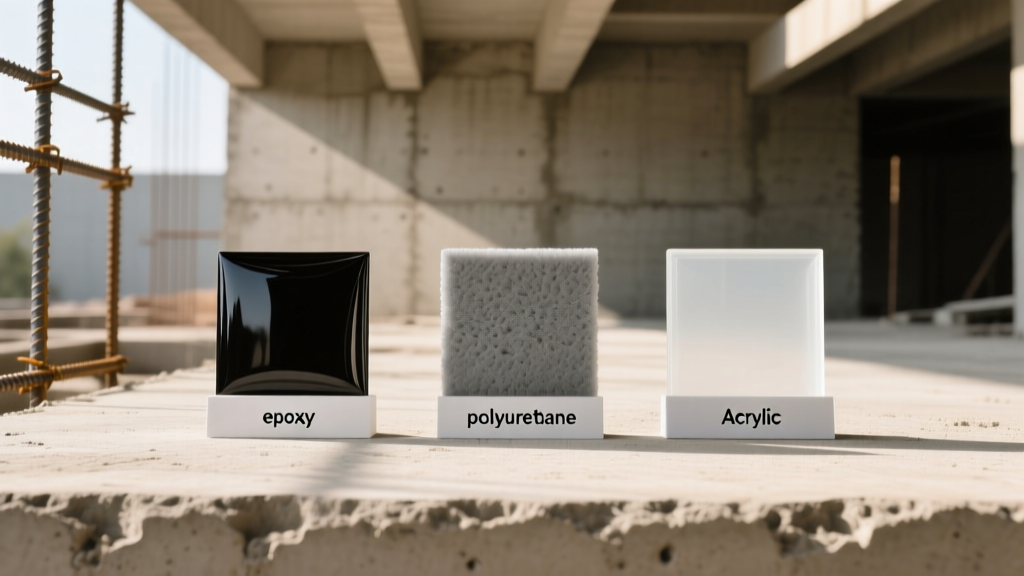
Selecting the correct concrete adhesive requires matching the chemical properties of the bonding agent to the mechanical and environmental demands of the repair. A product that excels at sealing a weeping basement crack will fail catastrophically if used to bond a structural overhead beam. The construction industry categorizes masonry bonding agents into three primary chemical families: epoxies, polyurethanes, and acrylic/SBR emulsions. Each interacts with the alkaline, porous surface of cured cement differently, dictating its tensile strength, moisture tolerance, and long-term durability.
Scenario Matching Matrix: Epoxy vs. Polyurethane vs. Acrylic
Use the following decision matrix to identify the correct chemical family for your specific application before selecting a brand or product line.
| Adhesive Family | Primary Scenario | Tensile Strength | Moisture Tolerance | Est. Cost (per Gallon) |
|---|---|---|---|---|
| 100% Solids Epoxy | Structural bonding, overhead patches, dowel bar retrofitting | 5,000 - 8,000 psi | Low (requires dry substrate unless hydro-tolerant) | $60 - $110 |
| Polyurethane | Active crack injection, water sealing, expansion joints | 300 - 1,500 psi | High (requires moisture to cure) | $90 - $150 |
| Acrylic / SBR Latex | Thin overlayments, feather-edge patches, stucco bonding | 200 - 600 psi | Medium (water-based, breathable) | $20 - $45 |
Deep Dive: Structural Load-Bearing Repairs (Epoxy)
When a repair must restore the original structural integrity of a concrete element—such as bonding a new corbel to an existing column or securing dowel bars in pavement—100% solids epoxy is the mandatory choice. According to guidelines published by the International Concrete Repair Institute (ICRI), structural epoxies must exhibit a tensile strength exceeding the tensile strength of the concrete substrate itself, ensuring that if the assembly fails, it fails within the concrete, not at the bond line.
Product Spotlight: High-Modulus vs. Flexible Epoxies
Not all structural epoxies are identical. For rigid structural transfers, use a high-modulus epoxy like Sikadur-32 Hi-Mod. This product cures to a rigid state capable of transferring heavy compressive and shear loads. However, if the concrete element is subject to thermal expansion, vibration, or dynamic loading (such as a bridge deck or industrial factory floor), a flexible, elastomeric epoxy like Sikadur-31 CF is required. Flexible epoxies sacrifice some compressive strength to absorb kinetic energy without shattering the bond line.
Deep Dive: Crack Injection and Water Sealing (Polyurethane)
Polyurethane adhesives and injection resins are the industry standard for managing water ingress and accommodating structural movement. Unlike epoxy, which forms a rigid weld, polyurethane remains elastomeric. The Portland Cement Association notes that active cracks—those that continue to open and close with seasonal temperature shifts—must be sealed with flexible materials to prevent the repair from tearing out.
Hydrophobic vs. Hydrophilic Injection Resins
- Hydrophobic Resins (e.g., Sika Injection-201 CE): These repel water and do not shrink or swell after curing. They are ideal for permanently sealing dry or slightly damp cracks where dimensional stability is critical.
- Hydrophilic Resins (e.g., Sika Injection-306): These react with water to expand into a dense, closed-cell foam. They are specifically designed for stopping active, high-pressure water leaks in below-grade foundations and tunnels. The expansion forces the resin into microscopic capillaries that hydrophobic resins cannot penetrate.
Deep Dive: Thin Bonding and Overlayments (Acrylic & SBR)
When applying a thin layer of new concrete or mortar over an existing slab (such as a feather-edge patch or a stamped concrete overlay), structural epoxies are overkill and too viscous. Liquid bonding agents are required to prevent the thin overlay from curling and delaminating due to rapid moisture loss into the old slab.
Never use a PVA (Polyvinyl Acetate) bonding agent for exterior applications. PVA re-emulsifies when exposed to water, meaning a freeze-thaw cycle will destroy the bond. For exterior or wet-area overlayments, you must use an SBR (Styrene Butadiene Rubber) or pure Acrylic emulsion, which remain water-resistant after curing. Products like Quikrete Concrete Bonding Adhesive (No. 9902) are acrylic-based and suitable for exterior use, provided they are applied correctly.
Application Method: Wet-on-Wet vs. Tacky
Read the manufacturer's technical data sheet carefully. Some SBR latex agents must be applied 'wet-on-wet' (mixed directly into the scratch coat or brushed on while the new mortar is placed immediately over the wet liquid). Others, like Quikrete 9902, must be painted on and allowed to dry for 1 to 2 hours until it forms a clear, tacky film before the new concrete is placed. Applying new concrete over a fully dried, non-tacky film will result in immediate delamination.
Critical Failure Modes and How to Avoid Them
Even the most expensive concrete repair adhesives will fail if subjected to the following common application errors:
- Amine Blush on Epoxy: When high-modulus epoxies cure in high humidity and low temperatures, a waxy, oily film called 'amine blush' rises to the surface. If a second coat or a topcoat is applied over this blush, it will peel. Fix: Wash the cured epoxy with warm water and a Scotch-Brite pad, then dry completely before proceeding.
- Starved Joints: Applying an adhesive layer that is too thin fails to fill the microscopic voids in the concrete profile, resulting in a bond line with less than 20% actual contact area. Fix: Maintain the manufacturer's specified mil thickness, usually between 15 and 30 mils for structural epoxies.
- Acid Etching Residue: Muriatic acid etching leaves behind chloride salts in the concrete pores. These salts absorb atmospheric moisture, creating a microscopic layer of water that prevents epoxy adhesion. Fix: Never use acid etching for structural adhesive prep; use mechanical profiling instead.
Step-by-Step Surface Preparation Protocol
The ICRI specifies a Concrete Surface Profile (CSP) ranging from 1 to 10. Structural epoxies typically require a CSP 3 to 5 (rough, grit-blasted profile). Follow this protocol to achieve it:
- Mechanical Abrasion: Use a walk-behind shot blaster or a handheld angle grinder equipped with a 30-grit or 40-grit diamond cup wheel. This removes laitance, curing compounds, and exposes clean aggregate.
- Dust Extraction: Vacuum the surface using a HEPA-filtered shop vac. Do not use compressed air, as it merely blows dust deeper into the pores and may introduce oil from the compressor tank.
- Solvent Wipe: Wipe the surface with a clean, lint-free rag dampened with Methyl Ethyl Ketone (MEK) or acetone. This removes microscopic oils and form-release agents.
- Moisture Testing: Tape a 2x2 foot square of clear 4-mil polyethylene sheeting to the concrete. Wait 24 hours. If condensation forms under the plastic, the slab is emitting too much moisture vapor for standard epoxy; switch to a moisture-mitigating primer or a hydro-tolerant adhesive.
By matching the chemical adhesive family to the specific mechanical and environmental scenario, and by adhering to strict surface preparation protocols, contractors and DIYers can ensure permanent, code-compliant concrete repairs that outlast the original substrate.