Concrete vs Asphalt Lifespan in Hot Climates: Application Showcase
Compare the lifespan of concrete vs asphalt in hot climates with real-world application data, maintenance costs, and thermal performance insights.

Key Lifespan Metrics at a Glance
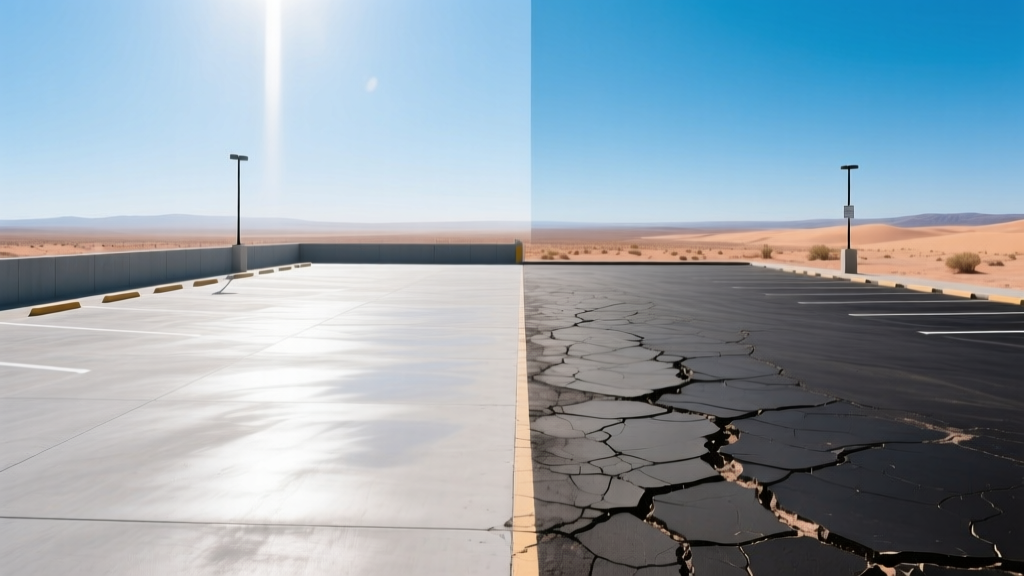
In environments where summer air temperatures routinely exceed 100°F (38°C), surface temperatures can surpass 150°F (65°C). Under these extreme thermal loads, Jointed Plain Concrete Pavement (JPCP) consistently delivers a 30- to 40-year structural lifespan, while even polymer-modified Hot Mix Asphalt (HMA) typically requires major structural rehabilitation between years 15 and 20.
The Thermal Battleground: Why Heat Changes the Paving Equation
When specifying paving materials for hot-climate applications—such as the American Southwest, the Middle East, or Northern Australia—engineers must account for severe thermal gradients. The fundamental difference in how Portland Cement Concrete (PCC) and asphalt concrete react to extreme heat dictates their long-term viability. Asphalt is a viscoelastic material; as temperatures rise, its binder softens, drastically reducing its stiffness and load-bearing capacity. Concrete, conversely, is a rigid, elastic material whose structural modulus remains virtually unaffected by high ambient temperatures.
However, heat introduces unique failure modes for both materials. For asphalt, the primary enemy is plastic deformation (rutting) under heavy static and dynamic loads. For concrete, the challenge lies in thermal curling and expansion stresses that can compromise joint integrity and cause mid-panel cracking if the mix design and slab geometry are not optimized for high-heat curing and daily temperature swings.
Application Showcase 1: High-Stress Municipal Intersections
Intersections represent the most punishing environment for any pavement. Vehicles decelerating, idling, and accelerating apply immense horizontal shear forces combined with heavy vertical axle loads. In hot climates, this combination rapidly exposes the limitations of traditional paving materials.
Asphalt Performance and Failure Modes
In a high-heat intersection, standard asphalt binders (e.g., PG 64-22) will soften to the point of failure. To mitigate this, municipalities must specify highly modified binders, such as PG 76-22 or Stone Matrix Asphalt (SMA) reinforced with cellulose fibers. Even with these upgrades, the lifespan of asphalt in hot-climate intersections is severely truncated. The constant stopping and starting of heavy transit vehicles pushes the softened asphalt laterally, creating deep corrugations and shear rutting at stop lines. Typically, intersection asphalt requires aggressive milling and resurfacing every 7 to 10 years, disrupting traffic and inflating lifecycle costs.
Concrete Performance and Failure Modes
Concrete's rigid structure makes it entirely immune to shear rutting, regardless of surface temperature. A properly designed 8-inch to 10-inch thick JPCP slab with 4,500 psi compressive strength will maintain its geometric profile at stoplights for decades. The primary thermal vulnerability in concrete intersections is joint spalling. High daytime temperatures cause the concrete to expand, closing the joints. If the joints are filled with incompressible debris or the sealant fails, the expansion forces can crush the concrete edges. Specifying wider joint widths (e.g., 3/8-inch) and utilizing high-quality, hot-pour silicone sealants (ASTM D5893) effectively neutralizes this risk, preserving a 35+ year lifespan.
Application Showcase 2: Heavy-Duty Logistics and Distribution Yards
Distribution centers in hot climates feature heavily loaded trucks parked in staging areas for extended periods. This application highlights the critical difference between static and dynamic load resistance under thermal stress.
| Performance Metric | Concrete (JPCP, 8-inch) | Asphalt (HMA, Polymer-Modified) |
|---|---|---|
| Design Life Expectancy | 30 - 40 years | 15 - 20 years |
| Surface Temp (at 105°F Air) | 115°F - 125°F | 145°F - 160°F |
| Albedo (Solar Reflectivity) | 0.30 - 0.40 | 0.05 - 0.10 |
| Static Load Rutting (120°F+) | Zero deflection | High susceptibility (depression) |
| Maintenance Cycle Trigger | Joint sealant degradation | Binder oxidation and rutting |
When a fully loaded 80,000-pound tractor-trailer parks on hot asphalt for 48 hours, the concentrated static load from the landing gear and drive axles will slowly press into the softened pavement, creating permanent depressions. Over a 15-year period, these depressions collect water, leading to localized pooling and accelerated pavement deterioration. Concrete pavements distribute these static loads across a wider area via slab action and remain dimensionally stable, making them the undisputed choice for logistics yards in regions like Phoenix, Las Vegas, or Riyadh.
The Hidden Economics: Maintenance Cycles in 100°F+ Environments
The initial capital cost of asphalt is generally 20% to 30% lower than concrete, but this advantage evaporates in hot climates due to accelerated maintenance schedules. Understanding the exact maintenance interventions required is crucial for accurate lifecycle cost analysis.
Asphalt Maintenance Realities
- Sealcoating: Required every 3 to 5 years to protect the binder from intense UV oxidation. Cost: $0.15 to $0.25 per square foot.
- Mill and Overlay: Necessary every 10 to 15 years to correct rutting and thermal cracking. Cost: $4.50 to $6.00 per square foot.
- Crack Sealing: Annual requirement due to severe thermal contraction during cool desert nights. Cost: $0.75 to $1.25 per linear foot.
Concrete Maintenance Realities
- Joint Resealing: Required every 7 to 10 years to prevent water infiltration and incompressible material intrusion. Cost: $1.50 to $2.50 per linear foot.
- Diamond Grinding: May be required at the 20-year mark to restore surface smoothness and correct minor faulting at joints. Cost: $2.50 to $3.50 per square foot.
- Slab Stabilization: Occasional void filling under slabs if base erosion occurs. Cost: $150 to $250 per slab.
According to data synthesized by the American Concrete Pavement Association (ACPA), the net present value of concrete pavement over a 40-year lifecycle in high-temperature zones is frequently 15% to 25% lower than asphalt when all rehabilitation, traffic delay costs, and user costs are factored into the equation.
Decision Matrix: Specifying the Right Material
Selecting between concrete and asphalt in hot climates requires a nuanced evaluation of the specific application's operational demands. Use the following framework to guide material specification:
Specify Concrete When:
- The application involves heavy static loads (e.g., truck staging areas, port terminals, aircraft aprons).
- The project is located in an urban heat island where high albedo (reflectivity) is required to lower ambient temperatures, aligning with EPA Cool Pavements guidelines.
- The pavement will experience high shear forces at low speeds (e.g., busy intersections, toll plazas, bus rapid transit lanes).
- Long-term lifecycle cost and minimal traffic disruption during maintenance are the primary project drivers.
Specify Asphalt When:
- The project requires immediate opening to heavy traffic (asphalt cures and cools to bearing strength within hours, whereas concrete requires 7 to 14 days of curing and strength gain).
- The budget is strictly constrained by initial capital expenditure rather than long-term operational expenditure.
- The application involves low-speed, low-volume access roads where minor rutting can be easily and cheaply milled and filled.
- Underground utility access is frequent, as asphalt is significantly easier to trench, patch, and compact.
Advanced Mitigation: Hot-Climate Mix Designs and Technologies
When the decision is made, optimizing the material for extreme heat is non-negotiable. For concrete, hot-weather paving requires strict temperature control. The initial mixing temperature should be kept below 90°F. This is achieved by using chilled mixing water, flaked ice, or liquid nitrogen dosing. Furthermore, substituting 20% to 30% of the Portland cement with Class F fly ash or ground granulated blast-furnace slag (GGBFS) reduces the heat of hydration, minimizing the risk of early-age thermal cracking.
For asphalt, relying on standard penetration-grade binders is a recipe for premature failure. Engineers must specify Performance Grade (PG) binders tailored to the specific 7-day maximum pavement temperature of the site. In extreme hot climates, this often means utilizing a PG 82-22 or incorporating styrene-butadiene-styrene (SBS) polymers to increase the high-temperature stiffness of the binder. The Asphalt Institute strongly recommends evaluating hot-climate asphalt mixes using the AASHTO T324 Hamburg Wheel Tracking test to ensure the mix design can resist rutting under sustained high temperatures and moisture exposure.
Ultimately, while asphalt offers short-term financial flexibility, concrete provides unmatched structural permanence in hot climates. By understanding the distinct thermal failure modes and specifying rigorous, climate-adapted mix designs, engineers can deliver pavements that withstand the relentless heat while optimizing long-term taxpayer and owner investments.
Written by
Priya KapoorPriya Kapoor is a real estate market analyst and construction economics researcher with expertise in housing affordability, development feasibility, and infrastructure investment. She holds a Master of Regional Planning from Cornell University and previously worked as a senior analyst at CBRE's Investment Properties group, where she modeled returns for $4B in mixed-use development pipelines. Priya now runs an independent research practice advising developers, municipalities, and REITs on construction cost forecasting and market timing. She publishes the quarterly "BuildMat Market Pulse" report tracking material price indices across 12 commodity categories. Based in Austin, TX, Priya serves on the board of Habitat for Humanity Austin and is a marathon runner.
More from Priya Kapoor
View all
Construction Cost
Cost to Build a 1600 Sq Ft Home in 2026: Full Breakdown
Accurate 2026 cost to build a 1600 sq ft home—material, labor, and regional pricing breakdowns included. Plan your budget with real-time estimates.
Aug 11, 2026

Wood & Lumber
Name the Types of Wood for Pressure Treatment and Preservation
Learn how to name the types of wood best suited for pressure treatment. Compare species treatability, chemical retention levels, and 2026 preservation costs.
Aug 4, 2026

Stone & Masonry
Stone Veneer Suppliers Lindenhurst: 2026 Cost Analysis
Analyze 2026 stone veneer costs in Lindenhurst, NY. Compare local supplier pricing, delivery fees, and Suffolk County installation labor rates.
Aug 4, 2026