Concrete vs Asphalt Pavement: Real-World Applications
Compare rigid concrete and flexible asphalt pavement for driveways and commercial lots. Explore costs, lifespans, and real-world application showcases.

The Core Debate: Rigid vs. Flexible Pavement Systems
When property owners and engineers evaluate 'concrete vs pavement' options, they are typically navigating the fundamental divide between rigid pavement (poured Portland cement concrete) and flexible pavement (hot mix asphalt). While both serve the primary function of distributing vehicular loads to the underlying subgrade, their structural behaviors, material compositions, and lifecycle economics are vastly different. According to the Federal Highway Administration, the choice between these two systems should never be based solely on initial installation costs; it requires a comprehensive analysis of traffic volume, environmental stressors, and long-term maintenance capabilities.
In North American construction, concrete acts as a rigid beam that bridges over minor subgrade imperfections, relying on its high flexural strength. Asphalt, conversely, is a viscoelastic material that flexes under load, meaning it requires a much thicker, highly compacted aggregate base to prevent structural fatigue. Understanding these mechanical differences is the first step in selecting the right material for your specific application.
Quick Decision Matrix
- Choose Rigid Concrete if: You are paving commercial loading docks, RV pads, or areas subjected to heavy static point loads and chemical spills. Budget allows for higher upfront capital expenditure ($9–$14 per sq. ft.) in exchange for a 30- to 40-year lifespan.
- Choose Flexible Asphalt if: You are paving long residential driveways, sprawling suburban parking lots, or regions with extreme freeze-thaw cycles where ground heaving is prevalent. Upfront budget is constrained ($5–$8 per sq. ft.), and you can commit to a 3- to 5-year sealcoating maintenance cycle.
Application Showcase 1: The Heavy-Duty Commercial Loading Dock
For commercial logistics hubs, fire stations, and waste management facilities, rigid concrete is the undisputed standard. Flexible asphalt simply cannot withstand the sheer static point loads generated by the landing gear of fully loaded semi-trailers or the outriggers of fire trucks.
Engineering the Concrete Pad
A successful commercial concrete pavement application requires meticulous mix design and subgrade preparation. For a standard loading dock, engineers typically specify a 6-inch thick slab utilizing a 4,500 PSI compressive strength mix. To ensure durability against deicing salts and freeze-thaw damage, the mix must include 5% to 8% air entrainment and maintain a strict water-to-cement (w/c) ratio of 0.45 or lower, adhering to Portland Cement Association guidelines for severe exposure.
Joint detailing is where most commercial concrete pavements fail. To prevent faulting at the joints under heavy truck traffic, smooth steel dowel bars (typically 1.5 inches in diameter and 18 inches long) must be placed at mid-depth across all transverse contraction joints. These joints should be spaced in a grid no larger than 15 feet by 15 feet to control thermal cracking. The subgrade must be uniformly compacted to a minimum 95% Proctor density, often stabilized with a 4-inch layer of cement-treated base (CTB) to prevent erosion pumping—a failure mode where water and fine soil are ejected through the joints under heavy wheel loads.
Application Showcase 2: The Suburban Residential Driveway
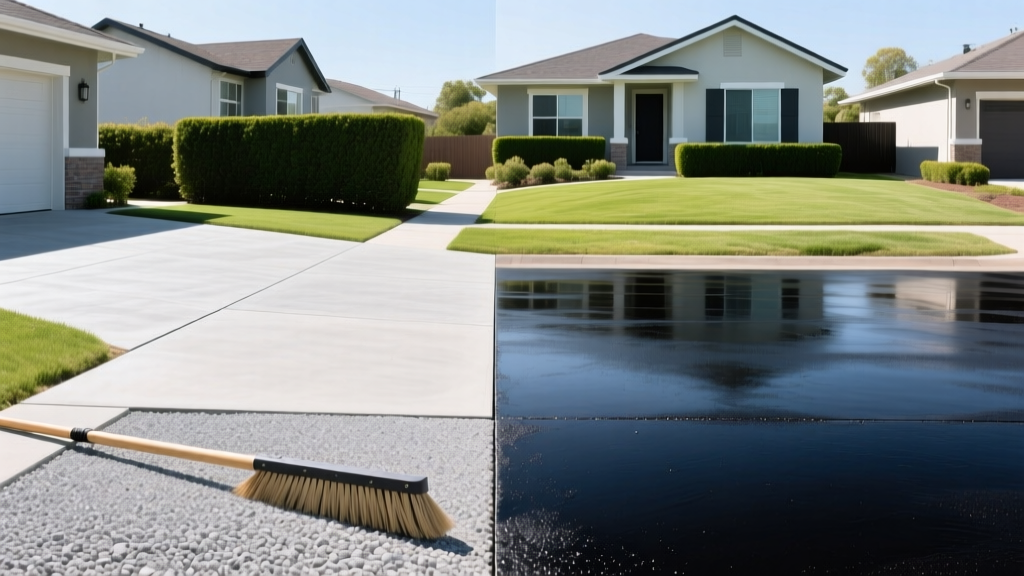
While concrete is popular for residential driveways, asphalt pavement remains the dominant choice in northern climates due to its superior flexibility and lower initial cost. A properly installed asphalt driveway can easily last 20 to 25 years with proactive maintenance.
Executing the Asphalt Installation
The secret to a long-lasting asphalt driveway lies entirely in the base preparation. A standard residential application requires the removal of topsoil and the installation of a 6- to 8-inch compacted crushed aggregate base (often crushed limestone or recycled concrete). Before the asphalt is laid, a tack coat (an emulsified asphalt binder) must be sprayed onto the base to ensure a chemical and mechanical bond.
The surface course should consist of a Superpave Hot Mix Asphalt (HMA) designed with a PG 64-22 performance-graded binder and a 9.5mm nominal maximum aggregate size (NMAS). This specific mix provides a smooth, quiet ride while maintaining enough stone-on-stone contact to resist rutting. The asphalt must be laid in a single 2- to 2.5-inch lift and compacted with a vibratory roller while the mat temperature is above 185°F. According to the National Asphalt Pavement Association, allowing the driveway to cure for a minimum of 90 days before applying a coal tar or asphalt-based sealcoat is critical to prevent trapping volatile oils that cause premature softening and tracking.
Lifecycle Cost & Maintenance Matrix
When comparing concrete vs pavement alternatives, evaluating the 30-year lifecycle cost provides a much clearer financial picture than looking at the initial bid price alone. The following matrix outlines the expected financial commitments for a standard 10,000 square foot parking area.
| Cost Factor | Rigid Concrete (6-inch) | Flexible Asphalt (3-inch surface) |
|---|---|---|
| Initial Installation (per sq. ft.) | $9.00 – $14.00 | $5.00 – $8.00 |
| Year 1-10 Maintenance | $0.15 (Joint sealing) | $1.20 (Sealcoating & crack fill) |
| Year 11-20 Maintenance | $0.25 (Slab mudjacking) | $3.50 (Mill & 1.5" overlay) |
| Expected Lifespan | 30 – 40+ Years | 15 – 20 Years (before full rebuild) |
| 30-Year Total Cost (per sq. ft.) | $10.50 – $15.00 | $11.00 – $14.50 |
Expert Insight: While the 30-year costs often converge, asphalt requires active, scheduled maintenance. If a property management company is known for deferring maintenance, concrete is the safer financial choice, as neglected asphalt will suffer catastrophic base failure requiring a full-depth reconstruction.
Edge Cases & Failure Modes to Watch
Both materials have specific vulnerabilities that must be addressed during the design phase to prevent premature failure.
Concrete Vulnerabilities
- Alkali-Silica Reaction (ASR): Often called 'concrete cancer,' this occurs when reactive silica in the aggregate reacts with the alkaline pore solution in the cement, causing expansive gel formation and map cracking. Mitigation requires specifying low-alkali cement (ASTM C150 Type II) or incorporating 20% to 30% fly ash or slag cement into the mix design.
- D-Cracking: A freeze-thaw failure that occurs near joints when porous coarse aggregates (like certain limestones or cherts) absorb water and fracture internally. Always specify durable, low-absorption aggregates verified by local DOT testing.
Asphalt Vulnerabilities
- Alligator (Fatigue) Cracking: Interconnected cracks resembling reptile skin. This is never a surface issue; it indicates that the underlying aggregate base or subgrade has failed due to moisture infiltration or insufficient thickness. Patching the surface is useless; the area must be saw-cut, excavated, and rebuilt.
- Thermal Cracking: Long, transverse cracks that form when asphalt becomes brittle in extreme cold and shrinks. Using a polymer-modified binder (such as PG 58-28) increases the low-temperature flexibility of the asphalt, significantly reducing thermal cracking in northern climates.
Environmental & Permeability Considerations
Modern site design increasingly demands stormwater management, which impacts the concrete vs pavement decision. Traditional concrete and asphalt are both impervious. However, permeable concrete pavement systems—utilizing a no-fines mix design with 15% to 25% void space—allow water to pass directly through the slab into an underlying crushed stone reservoir. This is highly effective for meeting municipal impervious surface limits in residential and light commercial parking lots.
Permeable asphalt exists but is generally less durable and more prone to clogging from sediment and deicing sand than its concrete counterpart. If stormwater infiltration is a primary site requirement, permeable concrete or a permeable interlocking concrete paver (PICP) system offers superior structural longevity and easier vacuum-sweeping maintenance compared to porous asphalt.
Written by
Priya KapoorPriya Kapoor is a real estate market analyst and construction economics researcher with expertise in housing affordability, development feasibility, and infrastructure investment. She holds a Master of Regional Planning from Cornell University and previously worked as a senior analyst at CBRE's Investment Properties group, where she modeled returns for $4B in mixed-use development pipelines. Priya now runs an independent research practice advising developers, municipalities, and REITs on construction cost forecasting and market timing. She publishes the quarterly "BuildMat Market Pulse" report tracking material price indices across 12 commodity categories. Based in Austin, TX, Priya serves on the board of Habitat for Humanity Austin and is a marathon runner.
More from Priya Kapoor
View all
Construction Cost
Cost to Build a 1600 Sq Ft Home in 2026: Full Breakdown
Accurate 2026 cost to build a 1600 sq ft home—material, labor, and regional pricing breakdowns included. Plan your budget with real-time estimates.
Aug 11, 2026

Wood & Lumber
Name the Types of Wood for Pressure Treatment and Preservation
Learn how to name the types of wood best suited for pressure treatment. Compare species treatability, chemical retention levels, and 2026 preservation costs.
Aug 4, 2026

Stone & Masonry
Stone Veneer Suppliers Lindenhurst: 2026 Cost Analysis
Analyze 2026 stone veneer costs in Lindenhurst, NY. Compare local supplier pricing, delivery fees, and Suffolk County installation labor rates.
Aug 4, 2026