How Concrete Block Dimensions Impact Structural Lifespan
Analyze how concrete block dimensions dictate structural lifespan. Compare 8-inch, 12-inch, and 16-inch CMU durability, load limits, and failure modes.
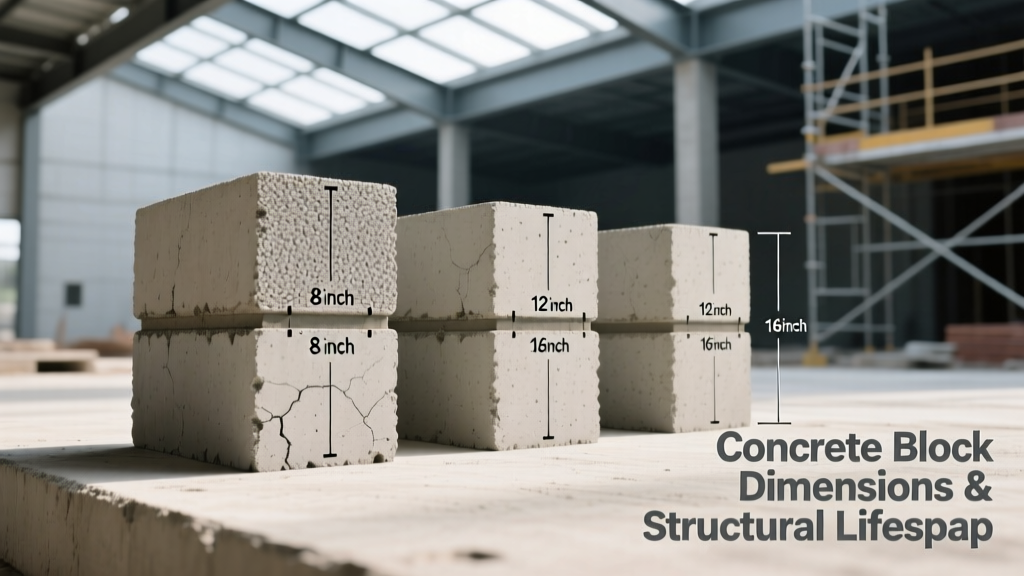
The Physics of Nominal vs. Actual CMU Dimensions
When specifying concrete masonry units (CMUs) for load-bearing walls, architects and engineers rely on nominal dimensions—such as 8x8x16 inches. However, the structural lifespan of the masonry assembly is dictated by the actual physical measurements and the resulting internal geometry. A standard nominal 8-inch block actually measures 7.625 inches by 7.625 inches by 15.625 inches. This precise 3/8-inch reduction is engineered to accommodate standard mortar joints, but it fundamentally alters the load-bearing cross-section and the protective cover over internal steel reinforcement.
According to Portland Cement Association guidelines, the durability of a CMU wall is directly proportional to the thickness of the face shells and the webs. For a standard 8-inch block, ASTM C90 mandates a minimum face shell thickness of 1.25 inches. This 1.25-inch barrier is the sole defense against moisture ingress, carbonation, and physical abrasion. When designers opt for wider blocks—such as 10-inch or 12-inch nominal dimensions—the face shell thickness typically remains similar, but the core volume expands dramatically, altering the thermal dynamics and the structural lifespan of the wall assembly.
Dimensional Tolerances and the Carbonation Front
The most critical, yet frequently overlooked, factor in CMU lifespan is dimensional tolerance. ASTM C140 permits a dimensional variation of ±1/8 inch in length, width, and height. While this seems negligible, it has profound implications for mortar joint integrity and long-term durability.
When blocks are at the extreme ends of the ±1/8 inch tolerance, the resulting mortar joints vary from 1/4 inch to 1/2 inch. Thicker mortar joints cure with higher shrinkage rates, creating micro-fissures. These fissures accelerate the penetration of the carbonation front—the chemical process where atmospheric CO2 lowers the pH of the concrete, eventually depassivating the steel rebar and initiating corrosion.
Once the carbonation front reaches the rebar, the steel expands up to seven times its original volume as it rusts. In a standard 8-inch block with a 1.25-inch face shell, this expansion causes spalling (surface breaking) in as little as 25 to 30 years in coastal or high-humidity environments. Upgrading to a 12-inch block does not necessarily thicken the exterior face shell, but it allows for the rebar to be placed deeper within the grouted core, increasing the distance the carbonation front must travel and effectively doubling the time to first corrosion.
Comparative Lifespan Matrix: CMU Dimensions in Harsh Environments
The following matrix illustrates how varying concrete block dimensions perform under aggressive environmental conditions, specifically focusing on coastal salt spray and severe freeze-thaw cycles. Data is synthesized from National Concrete Masonry Association (NCMA) technical evaluations and long-term masonry degradation studies.
| Nominal Dimension | Actual Width | Core Volume | Typical Rebar Cover | Expected Lifespan (Coastal) | Primary Failure Mode |
|---|---|---|---|---|---|
| 4-inch | 3.625" | Minimal | 0.75" | 20-30 Years | Rapid rebar corrosion, face shell delamination |
| 8-inch | 7.625" | Standard | 1.25" (Face) | 40-60 Years | Spalling at mortar joints, web cracking |
| 10-inch | 9.625" | Large | 2.0" (Grout offset) | 75-90 Years | Mortar joint erosion, thermal bridging |
| 12-inch | 11.625" | Extra Large | 3.5" (Centered core) | 100+ Years | Foundation settlement, extreme seismic shear |
Thermal Mass, Block Width, and Freeze-Thaw Durability
In northern climates, the width of the concrete block dictates the wall's thermal mass and its resistance to freeze-thaw spalling. The National Institute of Standards and Technology (NIST) highlights that moisture trapped within the concrete matrix expands upon freezing, generating internal tensile stresses that exceed the concrete's tensile strength.
The Dew Point Shift
In a standard 8-inch CMU wall with interior rigid insulation, the dew point often falls within the outer wythe of the concrete block during winter months. This means internal condensation forms directly inside the block cores. When temperatures drop below freezing, this water turns to ice, causing micro-cracking that compounds annually. By specifying 12-inch concrete block dimensions and placing the insulation within the deeper cores (or on the exterior), the dew point is shifted away from the structural masonry. The increased thermal mass of the 12-inch block buffers temperature fluctuations, keeping the interior masonry above freezing and effectively eliminating freeze-thaw degradation.
Actionable Framework: Selecting Dimensions for 100-Year Lifespans
To engineer a masonry structure for maximum longevity, follow this dimension-selection framework based on environmental exposure and structural demands:
- Coastal and High-Salinity Zones: Mandate 10-inch or 12-inch nominal dimensions. The larger core allows for the placement of vertical rebar in the absolute center of the grout cell, maximizing the concrete cover on all sides. Specify epoxy-coated or stainless-steel rebar to eliminate the corrosion vector entirely.
- Severe Freeze-Thaw Regions (USDA Zones 4 and below): Utilize 12-inch blocks with exterior continuous insulation (ci). Never rely on 8-inch blocks with interior furring, as this traps moisture inside the CMU cores. Ensure the specified blocks meet ASTM C90 requirements for a maximum absorption rate of 10 lbs/ft³ to limit internal water retention.
- High-Seismic Zones: While 8-inch blocks are common, 10-inch dimensions provide a wider grout cell that accommodates heavy horizontal joint reinforcement and larger vertical rebar without congestion. Proper rebar placement ensures the grout fully encapsulates the steel, preventing voids that lead to localized structural failure during a seismic event.
- Standard Commercial Interiors: 8-inch blocks are sufficient for non-load-bearing or lightly loaded interior partition walls where moisture and thermal cycling are controlled by the building's HVAC system. Focus on strict adherence to ASTM C140 dimensional tolerances to ensure uniform mortar joints.
FAQ: Concrete Block Dimensions and Durability
Does a heavier concrete block dimension guarantee a longer lifespan?
Not inherently. Weight indicates density, which correlates to compressive strength, but lifespan is governed by moisture management and rebar protection. A lightweight 12-inch block with a deep, well-grouted core will outlast a high-density 8-inch block in a freeze-thaw environment because the wider dimension allows for better insulation integration and deeper rebar cover.
How do dimensional variations affect the structural load capacity over time?
Blocks that exceed the ±1/8 inch ASTM tolerance create uneven bearing surfaces. Under heavy vertical loads, these uneven surfaces create point-loading stresses that exceed the localized compressive strength of the masonry. Over decades, this leads to vertical micro-cracking through the webs of the block, compromising the wall's ability to resist lateral wind and seismic loads.
Can I use 6-inch concrete blocks for exterior load-bearing walls to save costs?
While 6-inch blocks meet minimum code requirements for some low-rise residential structures, they are highly discouraged for long-term durability. The narrow core restricts the size of the vertical rebar and limits grout flow, often resulting in honeycombing (voids in the grout). These voids become direct pathways for moisture, drastically reducing the wall's lifespan and thermal performance compared to standard 8-inch dimensions.