Paver vs Concrete Driveway: Cost, Durability, and ROI Compared
Compare paver vs concrete driveway options for 2026. Analyze installation costs, lifespan, maintenance, and resale value to choose the best surface.

The Structural Divide: Rigid vs. Flexible Pavements
When evaluating a paver vs concrete driveway, the fundamental difference lies in structural mechanics. Poured concrete is a rigid pavement system. It relies on the tensile strength of the slab and the underlying base to distribute vehicular loads across a wide area. Because it acts as a single monolithic unit, any failure in the subgrade or thermal expansion will manifest as surface cracking.
Concrete pavers, conversely, form a flexible pavement system. Individual units interlock over a bed of sand and a compacted aggregate base. Load distribution occurs through particle-to-particle contact and the interlocking friction of the joints. This flexibility allows the surface to absorb minor subgrade shifts and freeze-thaw cycles without fracturing the individual units.
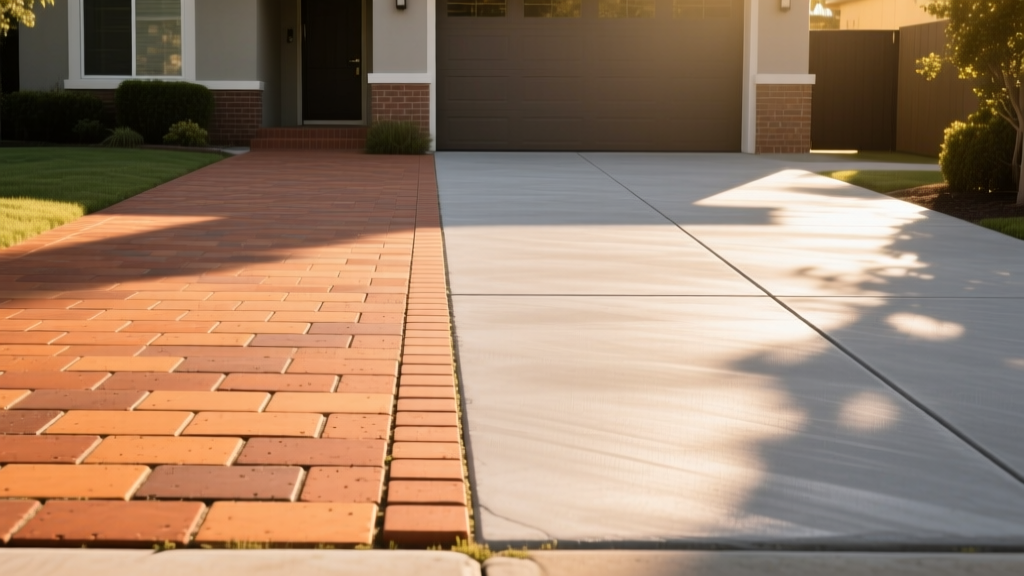
2026 Cost Breakdown: Paver vs Concrete Driveway
Material and labor costs have shifted entering 2026, driven by cement production adjustments and specialized masonry labor rates. Below is a comparative cost matrix for a standard 600-square-foot residential driveway.
| Material Type | Material Cost (per sq. ft.) | Labor & Equipment (per sq. ft.) | Total Installed Cost (per sq. ft.) |
|---|---|---|---|
| Standard Broom-Finish Concrete | $3.50 - $5.00 | $5.50 - $9.00 | $9.00 - $14.00 |
| Stamped/Colored Concrete | $5.00 - $8.00 | $9.00 - $14.00 | $14.00 - $22.00 |
| Standard Concrete Pavers | $4.00 - $8.00 | $12.00 - $16.00 | $16.00 - $24.00 |
| Permeable/Premium Pavers | $7.00 - $12.00 | $15.00 - $23.00 | $22.00 - $35.00 |
Many concrete contractors quote a low price by assuming an existing stable subgrade. If your soil requires excavation and the installation of 4 to 6 inches of compacted Class II road base, expect to add $2.00 to $4.50 per square foot. Paver quotes almost always include base preparation, as a paver system will catastrophically fail without it, whereas a concrete slab might temporarily bridge a poor base.
Durability and Real-World Failure Modes
Understanding how each material fails is critical for long-term satisfaction. Both systems have specific vulnerabilities based on installation quality and environmental stressors.
Poured Concrete: Spalling and Thermal Cracking
The most common failure in concrete driveways is not structural collapse, but surface spalling and scaling. This occurs when water penetrates the concrete pores, freezes, and expands. To prevent this in northern climates, the National Ready Mixed Concrete Association (NRMCA) mandates an air-entrained mix design. Air entrainment introduces microscopic bubbles (typically 5% to 8% air content) that give expanding ice room to expand without blowing off the surface layer.
Additionally, concrete requires precise control joints. A standard rule of thumb is placing joints at intervals 2 to 3 times the slab thickness in feet (e.g., an 8-inch thick slab needs joints every 16 to 24 feet). Without these engineered weak points, the concrete will crack randomly as it cures and shrinks.
Pavers: Edge Restraint Failure and Joint Washout
Pavers themselves are incredibly durable; units manufactured to ASTM C936 standards boast a minimum compressive strength of 8,000 PSI—double that of standard poured concrete. The failure point in a paver driveway is almost always the perimeter.
Without a rigid edge restraint (such as a Snap-edge or ProFlex plastic restraint secured with 10-inch galvanized spikes every 12 inches), the outward lateral pressure from vehicles turning will cause the pavers to spread. Once spreading begins, the jointing sand washes away, the interlock is lost, and the driveway unravels. Furthermore, using standard masonry sand instead of modern polymeric sand in the joints invites weed growth and ant infestations, which undermine the bedding layer.
Maintenance Matrix and Long-Term Upkeep
Maintenance requirements diverge significantly after year three. Here is what homeowners must budget for over a 20-year lifecycle:
- Concrete Sealing: Requires a penetrating silane/siloxane sealer every 3 to 5 years to block chloride ion penetration from deicing salts. Cost: $0.15 - $0.25 per sq. ft.
- Concrete Crack Repair: Routing and sealing cracks with polyurethane caulk is necessary to prevent water from eroding the subgrade. Cost: $5 - $10 per linear foot.
- Paver Joint Maintenance: Polymeric sand degrades over time. Expect to power wash and re-sand joints every 7 to 10 years. Cost: $1.50 - $2.50 per sq. ft.
- Paver Re-leveling: If tree roots or utility repairs heave the surface, pavers can be unzipped, the base repaired, and the exact same pavers reinstalled. Concrete requires full-depth saw-cutting and patching, which leaves permanent aesthetic scars.
Climate and Soil Decision Framework
Do not choose your driveway material based solely on aesthetics. Use this decision framework based on your property's geotechnical and climatic profile:
- Expansive Clay Soils (Texas, Colorado, Southeast): Choose Pavers. Clay soils swell when wet and shrink when dry. A rigid concrete slab will inevitably crack under this differential movement. A flexible paver system will undulate slightly but remain structurally intact and easily releveled.
- Heavy Freeze-Thaw with High Salt Usage (Midwest, Northeast): Choose Pavers or Stamped Concrete with extreme caution. Deicing salts (calcium chloride) accelerate surface scaling on stamped concrete because the stamping process can trap excess water and weaken the top paste. Standard broom-finished concrete with proper air-entrainment or pavers are superior here.
- Stable Bedrock / Sandy Soils (Florida, Coastal regions): Choose Concrete. With minimal subgrade shifting, a rigid concrete slab will easily last 30+ years with minimal maintenance, offering the highest ROI for stable terrains.
- Municipal Stormwater Runoff Restrictions: Choose Permeable Pavers. Many municipalities in 2026 are enforcing strict impervious surface limits. Permeable paver systems allow water to infiltrate the subgrade, often qualifying homeowners for stormwater utility rebates.
Resale Value and ROI Analysis
According to real estate appraisal data and Angi's driveway cost guides, upgrading from a degraded gravel or asphalt driveway to poured concrete typically yields a 60% to 75% return on investment at resale. It signals to buyers that the property has solid, low-maintenance infrastructure.
However, a professionally installed, high-end paver driveway can yield an 80% to 100% ROI, particularly in luxury housing markets. Pavers elevate the curb appeal and are perceived as a premium, custom architectural feature rather than a utilitarian surface. The caveat is that the paver design must complement the home's architecture; mismatched or overly complex paver patterns can actually deter buyers who fear high maintenance.
Final Verdict: Aligning Material with Project Goals
The choice between a paver vs concrete driveway ultimately hinges on your budget, soil conditions, and tolerance for maintenance. If your priority is the lowest initial cost, minimal annual upkeep, and you have stable soil, a 4,000 PSI air-entrained poured concrete slab with a broom finish is the undisputed champion of utility.
If your property suffers from expansive soils, you require complex utility access beneath the driveway, or you are targeting a high-end aesthetic that can be repaired invisibly decades down the line, the premium paid for an ASTM C936-compliant paver system with rigid edge restraints and polymeric sand is a justifiable, long-term investment.
Written by
Elena RodriguezElena Rodriguez is a civil engineer and technical writer specializing in concrete technology, masonry systems, and ASTM/ACI compliance. She earned her B.S. in Civil Engineering from Texas A&M University and spent a decade at a materials testing laboratory, performing over 2,000 concrete compressive strength tests and masonry prism evaluations. Elena is an ACI-certified Field Testing Technician (Grade I) and a member of ASTM Committee C12 on Natural Building Stone. She currently consults on forensic engineering cases involving concrete failures and moisture intrusion. Based in San Antonio, TX, Elena is a proud member of the Society of Women Engineers (SWE) and coaches her daughter's FIRST Robotics team.
More from Elena Rodriguez
View all
Walls & Panels
Cost Analysis: Light Gauge Steel Framing Advantages and Disadvantages
Evaluate light gauge steel framing advantages and disadvantages through a strict cost analysis lens, comparing material, labor, and lifecycle expenses.
Aug 4, 2026

Walls & Panels
Gypsum Board Types: Exact Specifications, Thickness & Dimensions
Compare standard, Type X, and moisture-resistant gypsum board types. Get exact specifications, thicknesses, dimensions, and ASTM standards for your project.
Aug 4, 2026

Fire Resistance
Best Fire-Resistant Outdoor Decking Materials: 2026 Buyer Guide
Discover the best fire-resistant outdoor decking materials for 2026. Compare Class A PVC, aluminum, and hardwood options for WUI compliance and safety.
Aug 4, 2026