Types of Concrete Work: Matching Mix Designs to Structural Needs
Discover the main types of concrete work and how to match specific mix designs, slump ratings, and PSI strengths to your structural or decorative project.

The Mix Design Matrix: Matching Parameters to Application
Specifying the correct concrete mix is the single most critical decision in any construction project. The phrase 'types of concrete work' encompasses everything from residential flatwork to heavily reinforced structural columns, and each application demands a distinct chemical and physical profile. A mix optimized for a broom-finished driveway will fail catastrophically if pumped into a densely rebar-congested shear wall.
According to the Portland Cement Association, modern ready-mix concrete is engineered at the batch plant to meet precise performance criteria, balancing workability, durability, and strength. In 2026, regional ready-mix pricing averages $135 to $165 per cubic yard, with specialized admixtures adding $15 to $30 per yard. Understanding these variables prevents costly over-engineering and dangerous under-specification.
| Type of Work | Target PSI (28-Day) | Slump / Flow | Max Aggregate Size | Key Admixtures / SCMs |
|---|---|---|---|---|
| Residential Flatwork (Driveways/Patios) | 3,500 - 4,000 | 4 to 5 inches | 3/4 inch | Air-entraining, Water-reducers |
| Commercial Warehouse Slabs | 4,000 - 5,000 | 4.5 to 5.5 inches | 1 inch | Macro-synthetic fibers, Slag (Type IS) |
| Vertical Walls & Columns | 4,000 - 6,000 | 6 to 8 inches (or SCC) | 1/2 to 3/4 inch | Superplasticizers, VMA (for SCC) |
| Mass Concrete (Dams/Large Piers) | 3,000 - 4,500 | 4 to 6 inches | 1.5 to 2 inches | High-volume Fly Ash (Type IP), Retarders |
| Decorative / Stamped | 3,500 - 4,000 | 4 to 5 inches | 3/8 to 1/2 inch | Integral color, White cement base |
Flatwork and Horizontal Slabs: Durability and Finishability
Horizontal placements—such as driveways, sidewalks, and industrial floors—require a delicate balance between surface finishability and long-term durability. The primary enemy of flatwork is an excess of water at the job site. Adding water to increase slump weakens the surface paste, leading to scaling, craze cracking, and reduced freeze-thaw resistance.
Never authorize the addition of water to the truck drum on-site if it pushes the W/C ratio above 0.45 for exterior flatwork. Instead, specify a mid-range water-reducing admixture (MWR) at the batch plant. This maintains a low W/C ratio while achieving the 5-inch slump required for screeding and floating.
Air Entrainment for Freeze-Thaw Cycles
For any exterior slab exposed to freezing temperatures and deicing chemicals, air-entraining admixtures are non-negotiable. These chemicals create microscopic, disconnected air bubbles (typically 4% to 7% by volume) that provide expansion chambers for freezing water. Without this, the internal hydraulic pressure will spall and delaminate the surface within two to three winter cycles.
Reinforcement Strategies
- Welded Wire Mesh (WWM): Effective for temperature and shrinkage cracking in light-duty residential slabs. Must be pulled to the top third of the slab during the pour to be structurally effective.
- Macro-Synthetic Fibers: Increasingly preferred in 2026 for commercial flatwork. Dosed at 3 to 5 lbs per cubic yard, these fibers provide multi-dimensional crack control and can eliminate the need for WWM, reducing labor costs and eliminating the risk of mesh being stepped to the bottom of the slab.
- Rebar (Doweled): Required for structural slabs, heavy vehicle traffic, and at all control joints to maintain vertical load transfer.
Vertical and Structural Elements: Flow and Early Strength
When transitioning to vertical types of concrete work—such as foundation walls, elevator cores, and retaining walls—the mix design must prioritize flowability and formwork pressure management. Congested rebar makes standard vibration difficult, leading to honeycombing and structural voids.
Self-Consolidating Concrete (SCC)
SCC has revolutionized vertical placements. Unlike traditional mixes that require mechanical vibration, SCC flows under its own weight, filling complex formwork and encapsulating dense rebar networks. According to the National Ready Mixed Concrete Association, SCC is measured by 'slump flow' rather than standard slump, typically targeting a spread of 22 to 28 inches. To prevent the aggregate from segregating from the paste at this high fluidity, SCC requires a Visco-Modifying Admixture (VMA). While SCC adds roughly $20 to $25 per cubic yard, the elimination of vibration labor and the reduction in surface blemishes often yield a net positive ROI on large commercial projects.
High-Early Strength Mixes
For projects requiring rapid form removal or post-tensioning, specify a high-early strength mix. This is achieved not just by increasing cement content, but by utilizing Type III (high-early) cement, lowering the W/C ratio to 0.38, and incorporating non-chloride accelerating admixtures. These mixes can achieve 3,000 PSI in 24 to 48 hours, compared to the 7 to 14 days required for standard Type I/II mixes.
Architectural and Decorative Concrete: Aesthetics and Consistency
Decorative concrete work demands absolute batch-to-batch consistency. Variations in water content, cement color, or aggregate gradation will result in visible mottling and color banding across a stamped patio or polished interior floor.
For vibrant integral colors (especially reds, yellows, and bright blues), specify a mix based on White Portland Cement rather than standard gray. Gray cement muddies integral pigments, requiring up to 30% more pigment loading to achieve the same visual saturation, which can inadvertently alter the mix's structural chemistry and set time.
Exposed Aggregate Retarders
For exposed aggregate finishes, a surface retarder is sprayed onto the freshly struck-off concrete. This delays the hydration of the top 1/4 inch of cement paste, allowing it to be washed away the next morning to reveal the underlying aggregate. The mix must feature a uniform, single-sized aggregate (e.g., exactly 3/8-inch pea gravel) rather than a graded blend, ensuring an even, aesthetically pleasing exposure depth.
Mass Concrete and Extreme Placements: Thermal Management
Mass concrete—defined by the American Concrete Institute as any volume large enough that thermal cracking is a primary concern—requires a fundamentally different approach. The heat of hydration generated by cement can cause the core temperature of a thick pier or mat foundation to exceed 158°F (70°C). When the temperature differential between the hot core and the cooler surface exceeds 35°F (19°C), thermal cracking occurs, compromising structural integrity and inviting moisture ingress.
'The primary strategy for mass concrete thermal control is the substitution of Portland cement with Supplementary Cementitious Materials (SCMs) like fly ash or slag cement, which significantly lower the peak heat generation while maintaining long-term design strength.'
— American Concrete Institute (ACI) Guidelines on Mass Concrete
To mitigate thermal cracking in mass elements, specify a Type IP (Portland-Pozzolan) or Type IS (Portland Slag) cement with a 50% to 70% SCM replacement rate. Additionally, incorporate extended-set retarders and utilize chilled batch water or liquid nitrogen at the plant to ensure the concrete is placed at a temperature below 65°F.
How to Specify Your Mix to the Batch Plant
Ordering concrete requires precise communication. Do not simply call and ask for 'a truck of 4,000 PSI concrete.' Provide the batch plant dispatcher with a written specification sheet that includes the following parameters:
- Design Compressive Strength (f'c): e.g., 4,000 PSI at 28 days.
- Maximum Aggregate Size: Dictated by the spacing of your rebar and the depth of your forms (typically 1/3 the slab depth or 3/4 the clear spacing between rebars).
- Target Slump and Tolerance: e.g., 4 inches +/- 1 inch. (Never specify a high slump without specifying a water-reducer).
- Air Content: Specify 6% +/- 1.5% for exterior freeze-thaw exposure; 2% to 3% for interior structural elements.
- Specific Admixtures: Explicitly list required mid-range water reducers, accelerators, or fibers.
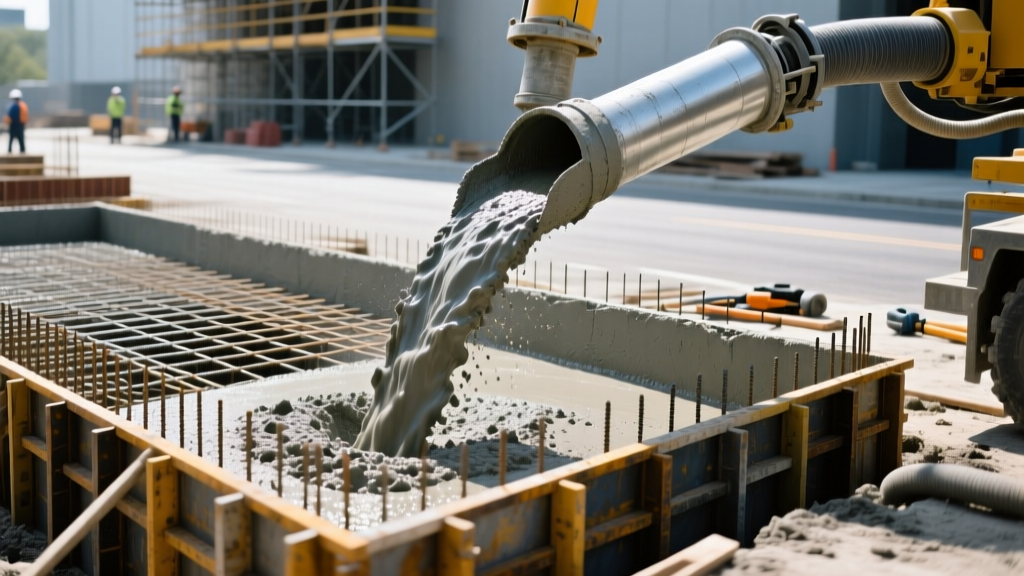
- Placement Method: Inform the plant if the mix will be pumped. Pumped mixes require a slightly higher sand content (fine aggregate) to lubricate the pump line and prevent blockages.
By aligning your mix design parameters with the specific physical and environmental demands of your project, you eliminate the root causes of premature concrete failure, ensuring a structure that performs flawlessly for decades.
Written by
Elena RodriguezElena Rodriguez is a civil engineer and technical writer specializing in concrete technology, masonry systems, and ASTM/ACI compliance. She earned her B.S. in Civil Engineering from Texas A&M University and spent a decade at a materials testing laboratory, performing over 2,000 concrete compressive strength tests and masonry prism evaluations. Elena is an ACI-certified Field Testing Technician (Grade I) and a member of ASTM Committee C12 on Natural Building Stone. She currently consults on forensic engineering cases involving concrete failures and moisture intrusion. Based in San Antonio, TX, Elena is a proud member of the Society of Women Engineers (SWE) and coaches her daughter's FIRST Robotics team.
More from Elena Rodriguez
View all
Walls & Panels
Cost Analysis: Light Gauge Steel Framing Advantages and Disadvantages
Evaluate light gauge steel framing advantages and disadvantages through a strict cost analysis lens, comparing material, labor, and lifecycle expenses.
Aug 4, 2026

Walls & Panels
Gypsum Board Types: Exact Specifications, Thickness & Dimensions
Compare standard, Type X, and moisture-resistant gypsum board types. Get exact specifications, thicknesses, dimensions, and ASTM standards for your project.
Aug 4, 2026

Fire Resistance
Best Fire-Resistant Outdoor Decking Materials: 2026 Buyer Guide
Discover the best fire-resistant outdoor decking materials for 2026. Compare Class A PVC, aluminum, and hardwood options for WUI compliance and safety.
Aug 4, 2026