Driveway Concrete vs Asphalt: Technical Specs & Load Ratings
Compare driveway concrete vs asphalt through technical specifications, load capacities, mix designs, and subgrade requirements for 2026 builds.

Material Composition and Mix Designs
Specifying pavement for residential and light-commercial driveways requires strict adherence to material mix designs. The structural integrity of both concrete and asphalt relies on precise chemical and physical ratios tailored to local environmental stressors.
Concrete Mix Specifications
For standard vehicular loads, a 4,000 PSI compressive strength at 28 days (tested per ASTM C39) is the baseline. The mix must maintain a water-cementitious ratio (w/cm) of 0.45 to balance workability with long-term impermeability. In climates experiencing freeze-thaw cycles, air-entraining admixtures are mandatory. Per ASTM C260, the concrete must achieve a microscopic air content of 5% to 8%, creating a network of bubbles that relieve internal hydraulic pressure during ice expansion. The target slump for driveway placements is 4 to 5 inches; exceeding this compromises surface hardness and increases the risk of plastic shrinkage cracking.
Hot Mix Asphalt (HMA) Specifications
Asphalt driveways utilize Hot Mix Asphalt engineered via the Superpave mix design method. The binder grade is selected based on regional temperature extremes; PG 64-22 (Performance Grade) is standard for most of the United States, meaning the binder resists rutting at 64°C and thermal cracking at -22°C. The aggregate blend typically features a Nominal Maximum Aggregate Size (NMAS) of 3/8 inch or 1/2 inch for the surface course to ensure a smooth finish, while the underlying binder course may use a 3/4 inch NMAS for structural stability. A tack coat of asphalt emulsion (typically SS-1h or CSS-1h) applied at 0.15 to 0.25 gallons per square yard is required between the base and surface courses to prevent delamination.
Structural Load Capacity and Subgrade Engineering
The pavement surface is only as stable as the earth beneath it. Both materials demand rigorous subgrade preparation, but their load-distribution mechanics differ fundamentally. Concrete acts as a rigid slab that bridges minor subgrade imperfections, while asphalt is a flexible pavement that transfers loads directly downward, making it highly susceptible to subgrade deflection.
| Specification | Portland Cement Concrete | Hot Mix Asphalt (HMA) |
|---|---|---|
| Pavement Type | Rigid (Load bridging) | Flexible (Load transfer) |
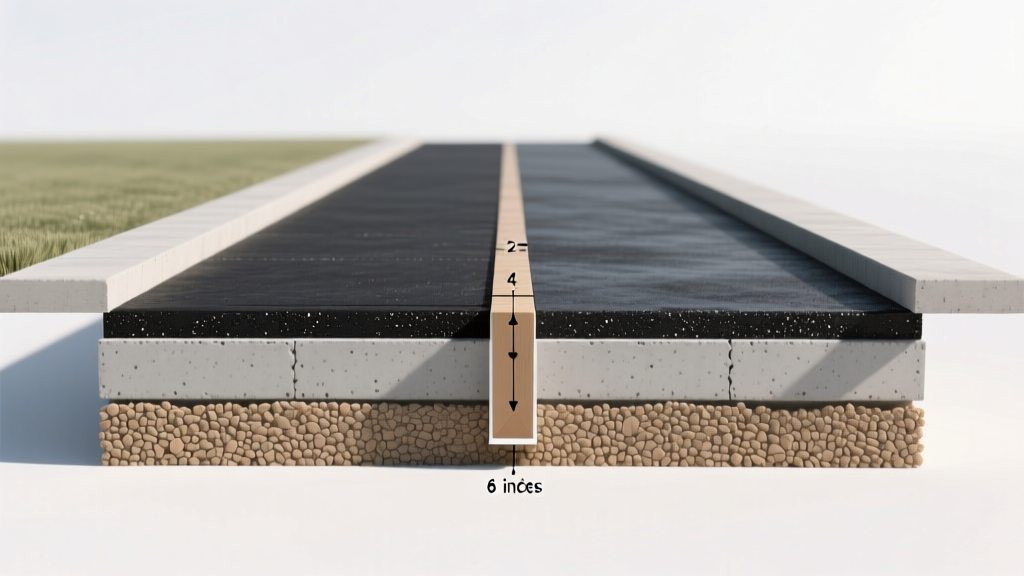
| Standard Thickness | 4 inches (5-6" for RVs/Trucks) | 2" binder + 1.5" surface course |
| Base Course Requirement | 4" Class II Road Base (Optional on stable soils) | 4" to 8" Class II Road Base (Mandatory) |
| Subgrade CBR Minimum | CBR > 5 | CBR > 8 |
| Compaction Standard | 90% Standard Proctor | 95% Modified Proctor (ASTM D1557) |
| Flexural Strength (MR) | 500 - 600 PSI | N/A (Measured in Structural Number) |
If soil testing reveals highly expansive clays (Plasticity Index > 25), asphalt will inevitably suffer from severe alligator cracking and rutting due to vertical subgrade movement. In these scenarios, engineers must specify a rigid concrete slab reinforced with #4 rebar at 18-inch centers, or utilize a lime-stabilized subgrade before laying asphalt.
Thermal Dynamics and Joint Engineering
Temperature fluctuations dictate the long-term failure modes of driveway materials. Concrete and asphalt react inversely to thermal stress, requiring entirely different jointing and edge-restraint strategies.
Concrete: Contraction and Isolation Joints
Concrete shrinks as it cures and expands during high heat. To control where the slab cracks, saw-cut contraction joints must be introduced within 12 hours of placement. These joints should be spaced at 10-foot intervals and cut to a depth of exactly one-quarter the slab thickness (1 inch for a 4-inch slab). Furthermore, isolation joints utilizing 1/2-inch asphalt-impregnated fiberboard (ASTM D1751) must be installed wherever the concrete abuts rigid structures like garage floors, foundations, or light poles to prevent crushing spalls during thermal expansion.
Asphalt: Viscoelastic Flow and Edge Restraint
Asphalt is viscoelastic; it becomes brittle in freezing temperatures and softens in extreme heat. Rather than saw-cut joints, asphalt relies on continuous flexibility. However, this flexibility causes lateral spreading under heavy loads. To prevent edge raveling and structural collapse, asphalt driveways require rigid edge restraints, such as concrete curbing or heavily compacted shoulder backfill. Without lateral confinement, the outer 12 inches of an asphalt driveway will prematurely fail under the weight of turning vehicle tires.
Curing Timelines and Traffic Readiness
Project scheduling relies heavily on the curing and set times of the chosen material. Misjudging these timelines leads to permanent surface deformation.
- Concrete Curing Profile: Concrete reaches approximately 70% of its design strength at 7 days and 99% at 28 days. Light passenger vehicles can safely drive on the slab after 7 days, but heavy loads (RVs, concrete trucks, dumpsters) must be restricted for a full 28 days. Wet curing or the application of a ASTM C309 compliant curing compound is required for the first 7 days to prevent plastic shrinkage.
- Asphalt Cooling Profile: Asphalt does not "cure" chemically; it cools and hardens. While it can support foot traffic once it cools below 150°F (usually 4-6 hours), vehicular traffic should be delayed for 48 to 72 hours. In ambient temperatures exceeding 90°F, the asphalt binder remains susceptible to power-steering scuffing and tire rutting for up to a week. Full oxidative curing of the binder takes 6 to 12 months before sealcoating can be applied.
Lifecycle Cost Analysis and Maintenance Intervals
Initial installation costs heavily favor asphalt, but 30-year lifecycle calculations often shift the advantage to concrete, depending on maintenance adherence. Based on 2026 material and labor indices, poured concrete driveways average $9.00 to $14.00 per square foot installed, while asphalt ranges from $5.00 to $8.00 per square foot.
30-Year Maintenance Framework
Asphalt Maintenance: Requires crack sealing annually and coal-tar or asphalt-based sealcoating every 3 to 5 years. Failure to sealcoat allows UV oxidation, which strips the binder from the surface aggregate, leading to raveling. Expect a full mill-and-overlay rehabilitation at year 20.
Concrete Maintenance: Requires joint resealing with polyurethane caulking every 5 to 7 years to prevent incompressible debris (rocks, dirt) from entering the joints, which causes spalling during expansion. In northern climates, avoid magnesium chloride deicers, which chemically attack the calcium hydroxide in the cement paste, causing severe surface scaling.
Decision Matrix: Specifying the Right Pavement
Use the following technical framework to determine the optimal material based on site-specific variables:
- Specify Concrete When: The site features expansive clay soils, the driveway has a steep gradient exceeding 12% (where asphalt rutting and softening are high risks), the owner plans to park heavy RVs or dual-tire trucks, or the design requires integral color or stamped architectural finishes.
- Specify Asphalt When: The project operates on a strict initial capital budget, the site is located in a deep-freeze climate where concrete deicer-scaling is a primary concern, the driveway features complex curved geometries that make forming and saw-cutting concrete cost-prohibitive, or the subgrade consists of highly stable, well-draining granular soils.
For comprehensive pavement design guidelines and regional climate adjustments, engineers and contractors should consult the structural design manuals provided by the Asphalt Institute and the Federal Highway Administration pavement preservation resources.
Written by
Priya KapoorPriya Kapoor is a real estate market analyst and construction economics researcher with expertise in housing affordability, development feasibility, and infrastructure investment. She holds a Master of Regional Planning from Cornell University and previously worked as a senior analyst at CBRE's Investment Properties group, where she modeled returns for $4B in mixed-use development pipelines. Priya now runs an independent research practice advising developers, municipalities, and REITs on construction cost forecasting and market timing. She publishes the quarterly "BuildMat Market Pulse" report tracking material price indices across 12 commodity categories. Based in Austin, TX, Priya serves on the board of Habitat for Humanity Austin and is a marathon runner.
More from Priya Kapoor
View all
Construction Cost
Cost to Build a 1600 Sq Ft Home in 2026: Full Breakdown
Accurate 2026 cost to build a 1600 sq ft home—material, labor, and regional pricing breakdowns included. Plan your budget with real-time estimates.
Aug 11, 2026

Wood & Lumber
Name the Types of Wood for Pressure Treatment and Preservation
Learn how to name the types of wood best suited for pressure treatment. Compare species treatability, chemical retention levels, and 2026 preservation costs.
Aug 4, 2026

Stone & Masonry
Stone Veneer Suppliers Lindenhurst: 2026 Cost Analysis
Analyze 2026 stone veneer costs in Lindenhurst, NY. Compare local supplier pricing, delivery fees, and Suffolk County installation labor rates.
Aug 4, 2026