Block Foundation vs Concrete: 2026 Cost Breakdown
Compare block foundation vs concrete poured walls. Explore 2026 material costs, labor rates, structural benefits, and regional pricing factors.

The Core Dilemma: Masonry Craft vs. Monolithic Pours
When evaluating the structural base of a residential or light-commercial build, the debate of block foundation vs concrete poured walls remains one of the most critical decisions for general contractors and owner-builders. While both systems utilize cementitious materials and steel reinforcement, their cost architectures, labor requirements, and structural behaviors diverge significantly. In 2026, supply chain stabilizations have normalized material costs, but acute regional shortages in skilled masonry labor continue to skew the financial calculus between Concrete Masonry Unit (CMU) block and monolithic poured concrete.
According to structural guidelines published by the Portland Cement Association (PCA), poured concrete foundations offer superior lateral load resistance due to their continuous monolithic nature. Conversely, the National Concrete Masonry Association (NCMA) highlights CMU block foundations for their adaptability in complex architectural footprints and crawl space configurations where forming monolithic pours is cost-prohibitive.
2026 Cost Breakdown Matrix: CMU Block vs. Poured Concrete
The following matrix breaks down the average installed costs per square foot of vertical foundation wall (based on a standard 8-foot basement wall depth). Note that excavation and continuous spread footings are excluded, as they remain identical across both methods.
| Cost Component | CMU Block Foundation (8x8x16) | Poured Concrete (3000-4000 PSI) |
|---|---|---|
| Raw Materials (Blocks/Concrete, Rebar, Mortar/Forms) | $3.50 - $5.50 / sq ft | $6.00 - $9.50 / sq ft |
| Labor (Masonry vs. Form-Setting/Finishing) | $8.00 - $15.00 / sq ft | $5.00 - $9.00 / sq ft |
| Equipment (Scaffolding vs. Cranes/Pump Trucks) | $0.75 - $1.50 / sq ft | $1.50 - $3.00 / sq ft |
| Waterproofing & Parge Coat Prep | $4.00 - $6.50 / sq ft | $2.50 - $4.50 / sq ft |
| Total Installed Cost (Per Sq Ft of Wall) | $16.25 - $28.50 | $15.00 - $26.00 |
The Labor vs. Material Seesaw
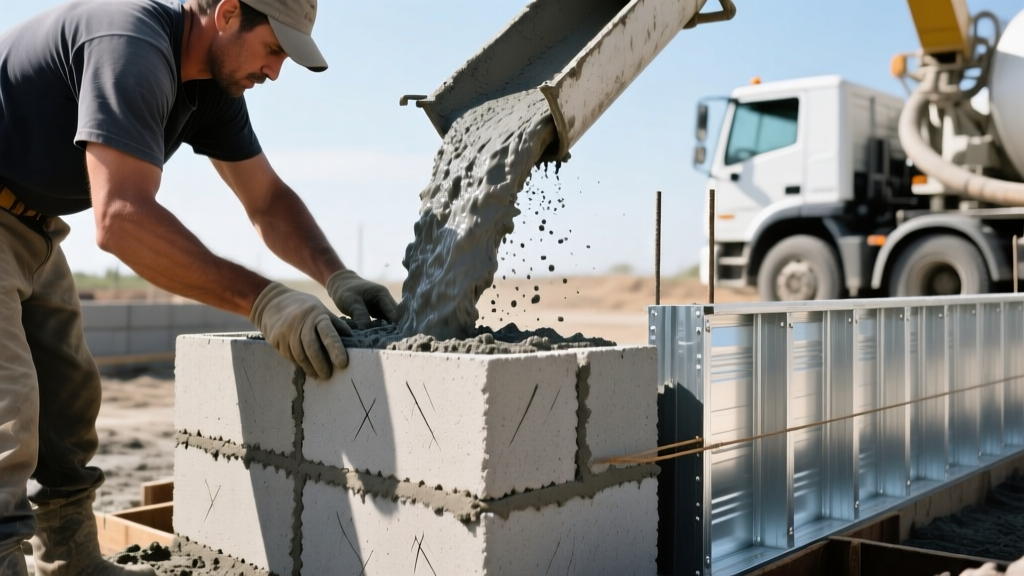
Notice the inverse relationship in the matrix above. Poured concrete requires significantly more upfront capital for materials, formwork rental, and heavy equipment (pump trucks, cranes). However, CMU block demands vastly more manual labor. In highly unionized regions or areas with a dearth of certified masons, block labor rates can exceed $75/hour, pushing the total CMU cost well above poured concrete. In rural markets with abundant masonry trades, block remains the budget-friendly option.
Hidden Variables That Skew the Budget
Surface-level per-square-foot estimates often fail to capture the logistical realities of the job site. When running your block foundation vs concrete comparison, factor in these secondary cost drivers:
- The Parge Coat Penalty (CMU Only): Because CMU walls feature mortar joints and porous block faces, applying a direct-to-surface elastomeric waterproofing membrane (like Tremco Paraseal or Henry Blueskin) is ill-advised. Block walls require a cementitious parge coat (a 3/8-inch skim coat of surface-bonding cement) to create a smooth, continuous substrate. This adds $1.50 to $2.50 per square foot and an extra day of labor before waterproofing can begin.
- Formwork Transport and Stripping (Poured Only): Engineered aluminum or steel forms (e.g., Symons systems) must be trucked to the site, set with a crane, and stripped after curing. For remote sites, form transport and crane mobilization can add a flat $2,500 to $4,500 to the project, heavily penalizing smaller footprint homes.
- Core Grouting and Rebar Placement: A structural CMU wall is not just hollow blocks. To match the shear strength of a poured wall in expansive soils, vertical #4 or #5 Grade 60 rebar must be placed in the cells, followed by high-slump grout pumping. Fully grouting an 8-inch block wall increases material costs by roughly $2.00 per square foot.
- Backfill Timing: Poured concrete walls typically reach 75% of their compressive strength within 3 to 5 days, allowing for rapid backfilling. CMU block walls require careful curing of mortar joints and often need temporary lateral bracing before heavy soil backfill is pushed against them, potentially delaying site grading by a week.
Structural Lifespan and Maintenance Costs
The American Concrete Institute (ACI) sets rigorous standards for foundation durability, particularly regarding freeze-thaw cycles and hydrostatic pressure. Both systems can easily exceed a 100-year structural lifespan if engineered correctly, but their failure modes differ.
Poured Concrete: The Monolithic Advantage
Poured walls excel in high-water-table environments and seismic zones. Because there are no mortar joints, the wall acts as a single, continuous beam when reinforced with a horizontal and vertical rebar grid. The primary maintenance cost risk is shrinkage cracking. As a 3000 PSI or 4000 PSI mix cures, it inevitably develops vertical micro-cracks. While structurally benign if properly reinforced, these cracks become direct conduits for water infiltration if the exterior membrane is punctured during backfill.
CMU Block: The Mortar Joint Vulnerability
Block foundations are highly resistant to shrinkage cracking due to the modular nature of the units. However, the 3/8-inch mortar joints represent a continuous weak point. In regions with heavy clay soils that exert immense lateral hydrostatic pressure, ungrouted or poorly reinforced block walls are prone to step-cracking along the mortar lines and inward bowing. Repairing a bowed block wall often requires interior steel I-beam bracing or carbon-fiber strap installations, costing $500 to $800 per linear foot of damaged wall.
Decision Framework: Choose CMU Block If...
- Your build is in a rural region with abundant, affordable masonry labor.
- The foundation features complex, tight-radius curves or numerous small jogs that would make custom formwork prohibitively expensive.
- You are building a crawlspace or a walk-out basement with staggered elevation drops.
- Site access prevents the entry of ready-mix concrete trucks or pump trucks.
Decision Framework: Choose Poured Concrete If...
- You are building in a seismic zone or an area with highly expansive, lateral-load-heavy clay soils.
- The local labor market is dominated by concrete contractors, making masonry bids artificially inflated.
- Speed of construction is paramount; a poured wall can be formed, poured, and stripped in 48 to 72 hours.
- The site has a high water table requiring maximum resistance to hydrostatic seepage through joints.
Regional Labor Market Impact on Pricing
The geographical location of your 2026 build will likely dictate the winner of the block foundation vs concrete cost war more than material prices. In the Midwest and rural South, where masonry is a traditional, multi-generational trade, CMU block remains highly competitive, often undercutting poured concrete by 10% to 15% on standard rectangular footprints.
Conversely, in the Pacific Northwest, the Northeast, and dense suburban corridors, the masonry workforce has aged out without sufficient apprenticeship replacement. In these markets, general contractors frequently report that CMU bids are 20% to 30% higher than poured concrete bids, simply due to the premium charged by the few remaining masonry firms. If you are building in a high-cost labor market, poured concrete is almost universally the more economical and schedule-friendly choice for standard basement foundations.
Expert Verdict and Final ROI Considerations
There is no universal 'cheaper' option in the block foundation vs concrete debate; there is only the option that aligns with your specific site logistics, soil engineering requirements, and local trade availability. If your geotechnical report indicates stable, well-draining soils and your site plan features complex architectural offsets, CMU block offers unmatched flexibility and potential cost savings in the right labor market. However, for standard rectangular basements in expansive soils or regions facing masonry labor shortages, monolithic poured concrete delivers superior structural continuity, faster dry-in times, and a more predictable, tightly controlled budget.
Written by
David NakamuraDavid Nakamura is a licensed architect (AIA) and construction technology writer focused on sustainable building methods, mass timber engineering, and high-performance building envelopes. He holds a Master of Architecture from the University of Washington and is a certified Passive House Consultant (CPHC). David spent eight years at the Seattle firm Mithun, where he led the design of three LEED Platinum projects, before founding his own practice specializing in net-zero residential design. He serves on the editorial advisory board of GreenBuilder Magazine and has authored peer-reviewed papers on cross-laminated timber (CLT) connections for the Journal of Structural Engineering. In his spare time, David teaches woodworking at Pratt Fine Arts Center and kayaks the Puget Sound.
More from David Nakamura
View all
Construction Cost
Labor Cost to Build a Deck Per Sq Ft: 2026 Installation Guide
Discover the exact labor cost to build a deck per sq ft in 2026. This installation guide breaks down contractor rates, complexity factors, and hidden fees.
Aug 4, 2026

Construction Cost
How Much Does It Cost to Build a 3 Bedroom House? Financing Guide
Learn exactly how much it costs to build a 3 bedroom house and explore 2026 financing options, construction loan types, and budget frameworks for your build.
Aug 4, 2026

Construction Cost
Cost to Build a Tennis Court: 2026 Guide
How much does it cost to build a tennis court in 2026? Breakdowns for asphalt, concrete, and synthetic surfaces plus fencing and lighting.
Jul 30, 2026