Concrete Countertop PSI, Shrinkage & Performance Specs Guide
Explore exact PSI ratings, shrinkage limits, and curing specifications for concrete countertops to prevent cracking and ensure long-term durability.
Core Material Specifications: Mix Designs & Compressive Strength
Standard structural concrete is fundamentally unsuited for countertop fabrication. Its high water-cement (w/c) ratio and large aggregate size lead to excessive shrinkage, surface pitting, and structural warping when cast in thin slabs. A high-performance concrete countertop requires specialized rheology, low w/c ratios (typically 0.30 to 0.45), and advanced admixtures to achieve the necessary compressive strength and dimensional stability.
According to guidelines established by the American Concrete Institute (ACI), decorative and architectural precast elements demand strict tolerance controls. For countertops, the target compressive strength must exceed standard residential flatwork (2,500 to 3,000 PSI) to withstand the cantilever stresses of overhangs and the point-loads of heavy appliances.
Mix Design Comparison Matrix
| Mix Category | Target PSI (28-Day) | w/c Ratio | Max Aggregate Size | Standard Thickness |
|---|---|---|---|---|
| Wet-Cast Precast (e.g., Quikrete Countertop Mix) | 6,000 - 7,500 PSI | 0.40 - 0.45 | 3/8 inch | 1.5 inches |
| GFRC (Glass Fiber Reinforced Concrete) | 8,000 - 10,000+ PSI | 0.30 - 0.35 | 1/16 inch (Sand only) | 3/4 to 1 inch |
| UHPC (Ultra-High Performance) | 18,000 - 22,000 PSI | 0.20 - 0.25 | 1/32 inch (Micro-sand) | 1/2 to 3/4 inch |
Dimensional Stability: Shrinkage Limits & Reinforcement
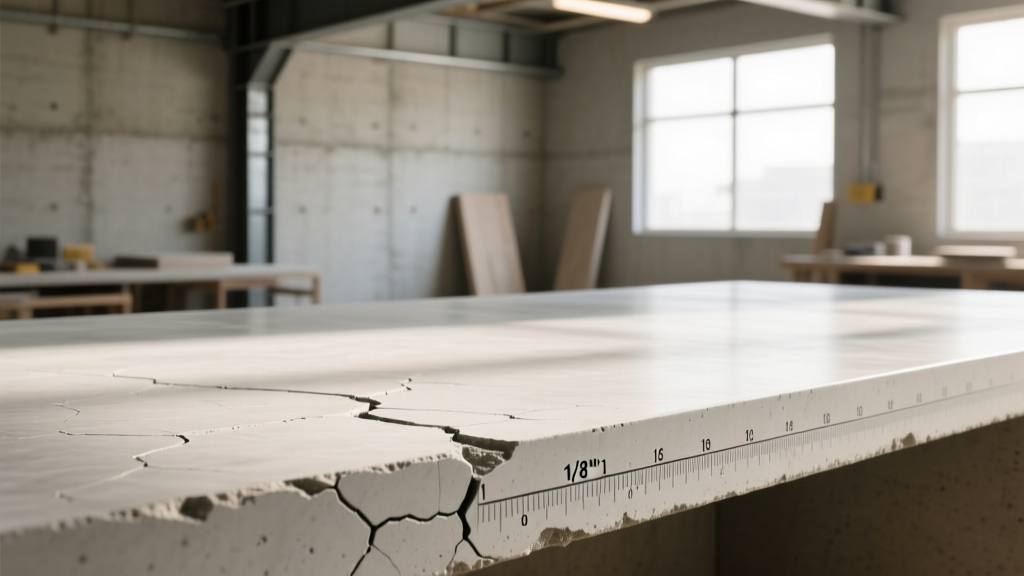
The primary cause of failure in concrete countertops is not compressive overload, but tensile stress induced by drying shrinkage. The Portland Cement Association (PCA) notes that standard concrete undergoes drying shrinkage of 0.05% to 0.10%. In a 10-foot countertop slab, 0.10% shrinkage translates to nearly 1/8 inch of dimensional reduction—more than enough to cause catastrophic mid-span cracking or delamination from cabinetry.
For architectural countertops, the mix design must incorporate Shrinkage-Reducing Admixtures (SRAs) and internal curing agents (such as pre-wetted lightweight fine aggregates) to cap drying shrinkage at less than 0.04%.
Reinforcement Specifications
Passive reinforcement is mandatory to bridge micro-cracks and distribute tensile loads. The choice of reinforcement depends entirely on the casting method:
- Welded Wire Mesh (WWM): Used in wet-cast precast slabs. Must be 10-gauge or 13-gauge, placed exactly in the bottom third of the slab (the tension zone) for standard cantilever overhangs. Never let WWM touch the formwork; maintain a minimum 1/4-inch concrete cover to prevent rust bleed-through.
- AR (Alkali-Resistant) Glass Fibers: Mandatory for GFRC. Fibers must contain a minimum of 16% Zirconia to resist the highly alkaline environment of Portland cement (pH > 12.5). Dosage rate is strictly 2% to 3% by weight of the cementitious material. Standard fiberglass will dissolve and fail within 5 years.
- Carbon Fiber Grid: Used in UHPC and thin-profile wet-cast mixes. Provides high tensile strength without the corrosion risk of steel or the thickness requirements of WWM.
Sealer Performance Ratings: Chemical & Abrasion Resistance
Concrete is inherently porous, with a capillary network that readily absorbs oils, acids, and water. The performance of a concrete countertop in a kitchen environment is dictated not by the concrete itself, but by the chemical specification of the sealer. The National Ready Mixed Concrete Association (NRMCA) emphasizes that surface treatments must be matched to the specific exposure conditions of the substrate.
| Sealer Chemistry | Pencil Hardness (ASTM D3363) | Stain Resistance (Acid/Oil) | Thermal Limit | Best Application |
|---|---|---|---|---|
| Penetrating Silane/Siloxane (e.g., Cheng Sealer) | N/A (Sub-surface) | Low (Requires topical wax) | > 500°F | Vanities, low-use bars, matte finishes |
| Hybrid Polyurethane/Acrylic (e.g., Omega 9) | 2H - 4H | High (Resists wine, lemon) | ~ 250°F | Residential kitchens, integral pigments |
| Water-Based Epoxy (e.g., SureCrete XS-327) | 4H - 6H | Exceptional (Commercial grade) | ~ 300°F | Commercial restaurants, heavy abuse |
Fabrication Tolerances & Curing Timelines
Premature drying is the enemy of compressive strength and surface density. A concrete countertop must follow a strict moisture-management protocol during the first 72 hours of hydration. Wet-curing (using saturated burlap and plastic sheeting) or the application of a high-solids acrylic curing compound is non-negotiable.
- T+0 to 24 Hours (Initial Set): Maintain ambient temperature between 65°F and 75°F. Do not demold. The concrete is undergoing peak exothermic heat generation.
- T+24 to 48 Hours (Demolding & Initial Grind): Strip forms. Begin wet-polishing with 50-grit to 200-grit resin pads. Keep the surface continuously flooded to prevent slurry from drying into the pores.
- T+48 to 72 Hours (Densification): Apply a lithium or sodium silicate densifier. This reacts with free calcium hydroxide to form additional calcium silicate hydrate (C-S-H) gel, hardening the surface and reducing porosity before sealing.
- T+7 Days (Minimum Cure for Sealing): Most high-performance topical sealers require the slab to reach a moisture vapor emission rate (MVER) of less than 3 lbs per 1,000 sq ft per 24 hours. Sealing too early traps moisture, leading to osmotic blistering of the polyurethane film.
Expert Troubleshooting: Micro-Crazing & Edge Spalling
Even with perfect mix designs, fabrication errors can introduce localized failures. Use this diagnostic framework to address common specification breaches:
Symptom: Map-Crazing (Fine, shallow surface cracks)
- Root Cause: Rapid surface evaporation during the first 4 hours of placement, causing plastic shrinkage. Often occurs when shop humidity drops below 40% or ambient temperature exceeds 80°F.
- Specification Fix: Introduce an evaporation retardant (e.g., Confilm) immediately after screeding. Increase the dosage of synthetic micro-fibers in the face coat to 1.5 lbs per cubic yard.
Symptom: Edge Spalling During Demolding
- Root Cause: Low early-age flexural strength combined with mechanical shock from form removal. Often caused by an excessively high w/c ratio or insufficient vibration at the form edges.
- Specification Fix: Utilize a form-release agent specifically designed for architectural precast (not standard petroleum oil). Vibrate edges with a high-frequency pencil vibrator (10,000+ RPM) for exactly 3 to 5 seconds per linear foot to consolidate the paste without segregating the aggregate.
Fabricator's Pre-Flight Specification Checklist
- [ ] Verify AR Glass Fiber Zirconia content (>16%) for GFRC mixes.
- [ ] Confirm w/c ratio is below 0.45 using a calibrated slump cone or flow table.
- [ ] Ensure WWM reinforcement is elevated 1/4-inch from the bottom form.
- [ ] Check shop ambient humidity (>50%) and temperature (65-75°F) prior to casting.
- [ ] Validate MVER moisture levels before applying topical polyurethane sealers.