Types of Concrete Floor Finishes: A Comprehensive Guide
Explore the top types of concrete floor finishes, from polished and epoxy to stamped and stained. Compare costs, durability, and applications.

The Mechanics of Concrete Surface Profiling
Selecting from the various types of concrete floor finishes begins with understanding the Concrete Surface Profile (CSP). The International Concrete Repair Institute (ICRI) categorizes CSP on a scale from 1 to 10, dictating the physical roughness of the slab. Mechanical finishes like polishing require a dense, hard-troweled surface (CSP 1-2), while high-build coatings like 100% solids epoxy demand aggressive shot-blasting or scarification (CSP 3-5) to achieve mechanical interlock. Applying the wrong finish to an improperly profiled slab is the leading cause of delamination and coating failure in commercial construction.
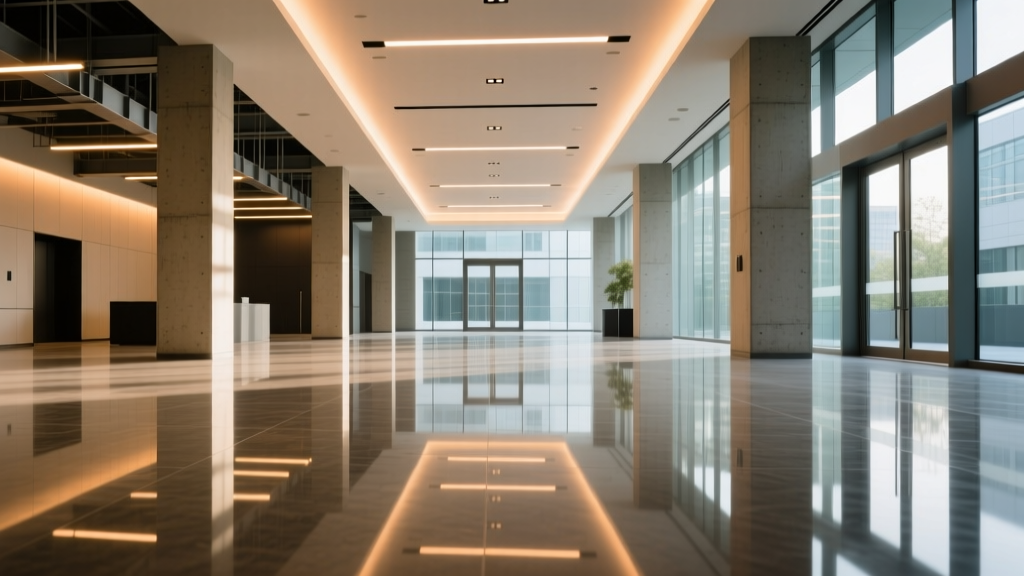
Mechanical and Abrasive Finishes
Mechanical finishes alter the physical surface of the concrete through grinding, honing, and burnishing, exposing the aggregate and cement paste without adding topical films.
Polished Concrete
Polished concrete is achieved through a multi-step diamond abrasive sequence, typically progressing from 40-grit metal bonds up to 3000-grit resin pads. The critical differentiator between true polished concrete and simply 'ground' concrete is the application of a chemical densifier. Lithium silicate densifiers (such as Prosoco Consolideck LS) penetrate the capillary network of the cement paste, reacting with free calcium hydroxide to form calcium silicate hydrate (C-S-H) gel. This permanently hardens the surface, preventing dusting and allowing the resin diamonds to refine the scratch pattern into a high-gloss, light-reflective finish.
Burnished and Ground Finishes
Burnished concrete utilizes high-speed planetary machines (1,500+ RPM) with specialized impregnated pads to create a low-sheen, industrial finish. Unlike polishing, burnishing relies on friction heat to melt topical guard products into the pores. Ground finishes stop at lower grit levels (typically 100 to 400 grit), providing a matte, industrial aesthetic with excellent slip resistance, often specified for warehouse aisles where high-gloss glare is a safety hazard.
Chemical and Reactive Finishes
Chemical finishes penetrate the concrete matrix to alter its color and surface tension without building a measurable film thickness on top of the slab.
Acid Staining vs. Water-Based Stains
Acid stains utilize a solution of water, hydrochloric acid, and acid-soluble metallic salts (iron, copper, chromium). The acid etches the surface, allowing the metallic ions to react with the hydrated lime in the concrete, creating permanent, variegated, marble-like earth tones. Because the reaction depends on the local concentration of calcium hydroxide, acid stains are inherently unpredictable and mottled.
Conversely, water-based stains utilize acrylic polymers and inorganic pigments that penetrate the pores and bind mechanically. They offer a vastly broader color palette, including vibrant blues and reds, and provide highly uniform, repeatable coloration. For architectural consistency across large commercial pours, water-based reactive stains are the superior specification.
Protective Coatings and Overlays
Topical coatings provide a sacrificial wear layer that protects the concrete substrate from chemical attack, UV degradation, and heavy impact.
100% Solids Epoxy and Polyaspartic Systems
100% solids bisphenol-A or bisphenol-F epoxies remain the gold standard for heavy industrial environments, food processing plants, and automotive bays. They provide exceptional compressive strength (often exceeding 10,000 psi) and chemical resistance. However, epoxies are moisture-sensitive during cure and possess a high modulus of elasticity, making them prone to brittle cracking if the substrate moves.
Polyaspartic and polyurea coatings are aliphatic polymers that cure in 2 to 4 hours, allowing same-day return-to-service. They are UV-stable (unlike aromatic epoxies which amber over time) and remain flexible across a wider temperature range, making them ideal for exterior applications or unheated warehouses.
Textured and Formed Finishes
Textured finishes are applied while the concrete is in its plastic state, altering the macro-texture for slip resistance or aesthetic mimicry.
- Broom Finish: The most economical exterior finish. Dragging a coarse-bristled broom across the screeded surface creates linear striations. Per the Portland Cement Association, timing is critical: brooming too early causes the ridges to slump, while brooming too late tears the surface paste, exposing aggregate and creating a weak wear layer.
- Exposed Aggregate: Achieved by applying a surface retarder (typically a sugar-based or phosphonate chemical) immediately after placement. The retarder delays the hydration of the top 1/4 inch of cement paste, which is then washed away with a pressure washer 12 to 24 hours later, revealing the underlying stone matrix.
- Stamped Concrete: Utilizes polyurethane stamping mats pressed into the plastic concrete after broadcasting a colored release agent. The release agent prevents the mats from sticking and adds a secondary antiquing color. It must be sealed with a high-solids acrylic or polyurethane sealer to lock in the color and provide UV protection.
Decision Matrix: Matching Finish to Environment
Specifying the correct finish requires balancing initial capital expenditure, lifecycle maintenance, and environmental stressors. The matrix below outlines optimal applications based on performance criteria.
| Finish Type | Best Environment | Slip Resistance (DCOF) | Chemical Resistance | Maintenance Level |
|---|---|---|---|---|
| Polished Concrete | Retail, Lobbies, Showrooms | High (>0.42 ANSI A326.3) | Low (Stains if unsealed) | Very Low (Dry mopping) |
| 100% Solids Epoxy | Manufacturing, Food & Bev | Medium (Requires grit add) | Very High | Low (Auto-scrubber) |
| Polyaspartic/Polyurea | Exterior Walkways, Garages | High (Broadcast quartz) | High | Low |
| Acid Stain + Sealer | Restaurants, Boutiques | Medium | Medium (Depends on sealer) | Medium (Re-waxing) |
| Exposed Aggregate | Pool Decks, Patios, Ramps | Very High | Low | Medium (Power washing) |
Lifecycle Cost Analysis and ROI
When evaluating types of concrete floor finishes, facility managers must look beyond the initial installation cost. Polished concrete commands a higher upfront cost ($4 to $14 per square foot in 2026) compared to a basic sealed slab ($2 to $4 per square foot). However, polished concrete eliminates the need for periodic stripping and waxing required by VCT or epoxy systems. Over a 20-year lifecycle, the maintenance savings of polished concrete typically yield a 40% to 60% lower total cost of ownership compared to topical coatings that require re-application every 5 to 7 years.
Troubleshooting Common Finish Failures
Even with premium materials, improper execution leads to catastrophic finish failures. Recognizing these edge cases is vital for quality assurance:
- Osmotic Blistering in Epoxies: Occurs when water vapor from the slab pushes through the coating, creating localized bubbles. Fix: Diamond grind the blisters, apply a moisture-mitigating primer, and patch with a flexible epoxy mortar.
- Amine Blush: A waxy, oily film that forms on the surface of epoxy coatings cured in high humidity and low temperatures. Fix: Wash the surface with warm water and a stiff brush, then lightly scuff-sand before applying the topcoat.
- Ghosting in Polished Concrete: Visible outlines of where the trowel machine overlapped during the initial slab placement, revealed during the 400-grit polishing stage. Fix: Apply a color-matched micro-topping or utilize a heavily pigmented dye to mask the differential density.
Frequently Asked Questions
What is the required slip resistance for commercial concrete floors?
Under OSHA Walking-Working Surfaces standards and ANSI A326.3, hard surface floors in level interior spaces must maintain a Dynamic Coefficient of Friction (DCOF) of at least 0.42 when wet. Polished concrete naturally meets this if maintained properly, while epoxy floors require the broadcast of aluminum oxide or quartz sand to achieve compliance.
Can you polish an existing concrete slab that has glue residue?
Yes, but it requires aggressive preparation. Existing adhesives (like cutback asphalt or mastic) must be removed via shot-blasting or chemical strippers. If the adhesive has deeply penetrated the pores, the polishing process will smear it, resulting in dark, unsightly patches. In these cases, applying a micro-topping overlay before polishing is the most reliable solution.
How does UV exposure affect different concrete finishes?
Aromatic epoxies and standard polyurethane sealers will yellow and chalk when exposed to direct sunlight. For exterior applications or sunrooms, you must specify UV-stable finishes such as polyaspartic coatings, aliphatic polyurethanes, or penetrating silane/siloxane water repellents, which do not form a surface film and are entirely immune to UV degradation.
Written by
Sarah WhitfieldSarah Whitfield is a chartered quantity surveyor (MRICS) and construction cost analyst with 15 years of experience in material pricing, procurement strategy, and project budgeting. She earned her degree in Construction Management from the University of Reading (UK) and has worked on projects ranging from $2M custom homes to $180M mixed-use developments across North America and Europe. Sarah currently leads cost estimating for BuildMat Insight, maintaining a proprietary database of 4,000+ material price points updated quarterly. She is a frequent contributor to RSMeans cost data panels and has presented at the International Cost Engineering Council (ICEC) congress. Based in Denver, CO, Sarah is an avid trail runner and volunteer mentor for Women in Construction.
More from Sarah Whitfield
View all
Wood & Lumber
What Are the Different Types of Wood? A Builder's Guide
Compare structural softwoods, finish hardwoods, and engineered lumber. Analyze Janka ratings, MOE values, and 2026 pricing for construction.
Aug 4, 2026

Walls & Panels
Steel Framing vs Wood Framing: Corrosion and Moisture Defense
Compare steel framing vs wood framing for moisture resistance. Learn about galvanized coatings, condensation risks, and corrosion protection strategies.
Jul 21, 2026

Stone & Masonry
How to Cut Stone Veneer: Wet Saw vs Grinder Comparison
Compare the best tools for cutting stone veneer. We review wet saws, angle grinders, and chop saws to help you achieve clean, chip-free cuts.
Jul 21, 2026