Concrete Countertops Cost vs Granite: Real Kitchen Showcase
Compare concrete countertops cost vs granite with real kitchen application data, pricing breakdowns, sealer specs, and design trade-offs.

The True Cost Breakdown: Concrete vs. Granite
When evaluating concrete countertops cost vs granite, homeowners often assume concrete is the budget-friendly alternative. In reality, architectural concrete is a premium, custom-crafted finish, while granite spans from entry-level prefab slabs to ultra-premium exotic stones. The financial divergence lies in fabrication and labor. Granite is CNC-machined from quarried slabs, whereas concrete requires custom formwork, specialized mix designs like GFRC (Glass Fiber Reinforced Concrete), and meticulous hand-troweling.
| Cost Factor | Cast-in-Place & Precast Concrete | Natural Granite (Levels 1 to 3) |
|---|---|---|
| Raw Material per Sq Ft | $12 - $25 (Mix, pigments, fibers) | $30 - $90 (Slab cost) |
| Fabrication & Formwork | $35 - $60 (Highly labor-intensive) | $10 - $25 (CNC machine cutting) |
| Installation & Rigging | $15 - $30 (Heavy, requires bracing) | $10 - $20 (Standard seaming) |
| Sealing & Finishing | $8 - $15 (Multi-coat polyurethanes) | $2 - $5 (Impregnators) |
| Total Installed Range | $85 - $145 per Sq Ft | $55 - $140 per Sq Ft |
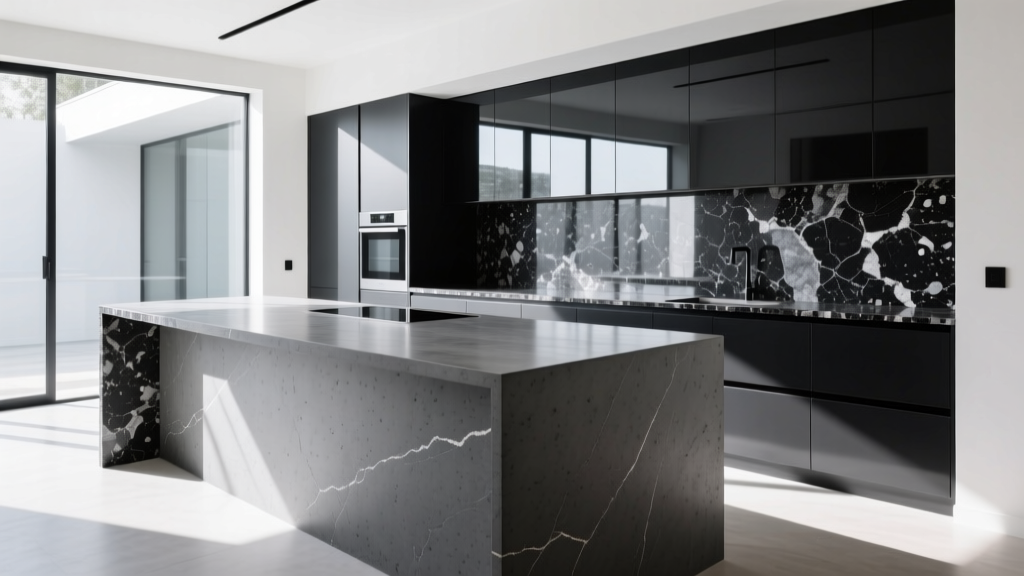
Application Showcase: Three Real-World Kitchen Scenarios
To understand where each material excels, we must move beyond abstract pricing and examine specific architectural applications. The choice between concrete and granite often hinges on the geometry of the space and the functional demands of the cook.
Scenario A: The 40-Square-Foot Galley Kitchen with Standard Layouts
In a straightforward galley kitchen with 90-degree corners and standard 25.5-inch depths, granite holds a distinct cost advantage. Fabricators can utilize remnants or standard 3cm slabs with minimal waste. A basic 'Ubatuba' or 'Absolute Black' granite installation here will cost approximately $2,800 to $3,500 fully installed. Attempting to pour concrete in-place (cast-in-place) for a small galley introduces massive overhead: building melamine forms, managing the mess of wet concrete inside a finished home, and waiting 28 days for a full cure before sealing. For standard geometries, granite is the undisputed winner on both cost and timeline.
Scenario B: The 60-Square-Foot Island with an Integrated Drainboard
This is where the concrete countertops cost vs granite debate shifts dramatically. If the design calls for an integrated concrete sink, a sloped drainboard with custom grooves, and a thickened 3-inch edge profile, granite fabrication costs skyrocket. Cutting and polishing a drainboard into a granite slab requires specialized CNC routing and carries a high risk of fracturing the stone, often adding $1,500 to $2,500 in custom fabrication fees. Conversely, concrete thrives here. Using a GFRC mix, fabricators can cast the sink, drainboard, and countertop as a single, seamless monolithic piece in a warehouse. The mold-making takes time, but the resulting integrated design is impossible to replicate in granite without visible epoxy seams.
Scenario C: The Unconditioned Outdoor Kitchen
Outdoor applications introduce freeze-thaw cycles and UV exposure. Standard interior concrete mixes will spall and crack in freezing temperatures unless specifically engineered. An outdoor concrete countertop requires an air-entrained mix design and a high-performance topical sealer like a polyaspartic or aliphatic polyurethane to prevent UV yellowing. Granite, being a dense igneous rock, is naturally impervious to freeze-thaw damage, provided the substrate is properly sloped for drainage. For outdoor kitchens in northern climates, granite requires less chemical maintenance, though dark granites will absorb significant solar heat, making them uncomfortably hot to touch in direct summer sunlight.
Material Science: Sealers, Scratches, and Heat Tolerance
The longevity of your investment depends entirely on the chemical barrier applied to the surface. According to the Concrete Network guidelines on mix designs and sealing, untreated concrete is highly porous and will stain instantly from acidic foods like lemon juice or red wine.
Concrete Sealer Technology: Modern concrete countertops rely on a dual-sealer system. First, a lithium silicate densifier is applied to chemically harden the surface pores. This is followed by a high-solids, water-based polyurethane (such as OmegaSeal or SureCrete XS-327). This topical layer provides the stain resistance but requires reapplication every 3 to 5 years depending on abrasion.
Granite Sealer Technology: The Natural Stone Institute recommends fluoropolymer-based impregnating sealers for granite. Unlike concrete sealers that sit on top of the surface, granite impregnators penetrate the microscopic fissures and repel water and oil from within. They do not alter the natural matte or polished texture of the stone and typically last 10 to 15 years before reapplication is necessary.
Decision Framework: When to Choose Which
Use this practical matrix to finalize your material selection based on your specific project parameters.
- Choose Precast Concrete If: You require custom integral features (sinks, drainboards, embedded trivets), you want a specific architectural pigment (using Davis Colors or Solomon integral oxides), or you are pursuing an industrial/brutalist aesthetic with exposed aggregate or terrazzo finishes.
- Choose Cast-in-Place Concrete If: The countertop features complex curves that are too large to transport through standard doorways, and you are willing to accept the risk of minor hairline shrinkage cracking inherent to on-site pours.
- Choose Granite If: You need a zero-maintenance surface for heavy daily cooking, you require absolute heat resistance for baking stations, or your layout consists of standard straight runs where prefab slab utilization minimizes waste and cost.
- Choose Granite If: You are flipping a property or working within a strict $60-per-square-foot budget constraint, as Level 1 commercial granites offer the highest ROI for resale value compared to custom concrete.
Sourcing and Fabrication Lead Times
Timeline is a hidden cost in any renovation. Granite fabrication is highly standardized. Once templates are laser-measured, a local fabricator can typically cut, polish, and install granite within 7 to 14 days. Concrete, however, is a slow-craft process. Sourcing a specialized concrete artisan often requires looking beyond local cabinet shops to regional architectural precasters. Expect a 4 to 8 week lead time for concrete. This accounts for template approval, melamine mold construction, the 24-hour casting process, a minimum 7 to 14 day controlled curing period in a humidity-regulated warehouse, and the multi-stage wet-polishing sequence up to 800 or 1500 grit. Factor these lead times into your critical path to avoid delaying cabinet installation and final plumbing hookups.
Written by
Priya KapoorPriya Kapoor is a real estate market analyst and construction economics researcher with expertise in housing affordability, development feasibility, and infrastructure investment. She holds a Master of Regional Planning from Cornell University and previously worked as a senior analyst at CBRE's Investment Properties group, where she modeled returns for $4B in mixed-use development pipelines. Priya now runs an independent research practice advising developers, municipalities, and REITs on construction cost forecasting and market timing. She publishes the quarterly "BuildMat Market Pulse" report tracking material price indices across 12 commodity categories. Based in Austin, TX, Priya serves on the board of Habitat for Humanity Austin and is a marathon runner.
More from Priya Kapoor
View all
Construction Cost
Cost to Build a 1600 Sq Ft Home in 2026: Full Breakdown
Accurate 2026 cost to build a 1600 sq ft home—material, labor, and regional pricing breakdowns included. Plan your budget with real-time estimates.
Aug 11, 2026

Wood & Lumber
Name the Types of Wood for Pressure Treatment and Preservation
Learn how to name the types of wood best suited for pressure treatment. Compare species treatability, chemical retention levels, and 2026 preservation costs.
Aug 4, 2026

Stone & Masonry
Stone Veneer Suppliers Lindenhurst: 2026 Cost Analysis
Analyze 2026 stone veneer costs in Lindenhurst, NY. Compare local supplier pricing, delivery fees, and Suffolk County installation labor rates.
Aug 4, 2026