Concrete vs Blacktop Cost: Technical Specs & Lifecycle
Analyze the true concrete vs blacktop cost through technical specifications, structural load requirements, and 30-year lifecycle pricing data.

The Material Science Driving Initial Costs
Evaluating the concrete vs blacktop cost requires moving beyond superficial per-square-foot estimates to examine the petrochemical and mineralogical components of each paving system. Blacktop, technically known as Hot Mix Asphalt (HMA), relies on a bitumen binder—a viscous petroleum byproduct—mixed with fine and coarse aggregates. The material cost for HMA typically ranges from $100 to $150 per ton. Because bitumen prices are directly tethered to crude oil markets, blacktop material costs exhibit high volatility.
Concrete utilizes Portland cement (Type I/II for standard paving) as its hydraulic binder, combined with water and larger coarse aggregates (typically 3/4-inch crushed stone). According to the Portland Cement Association, a standard 4000 PSI paving mix requires a precise water-cement ratio of 0.45 or lower to ensure durability. Ready-mix concrete costs between $125 and $160 per cubic yard. While the raw material cost per ton of concrete is often higher than HMA, the structural efficiency of a rigid concrete slab often requires less overall material volume to achieve the same load-bearing capacity as a flexible blacktop pavement.
Subgrade Engineering and Base Preparation
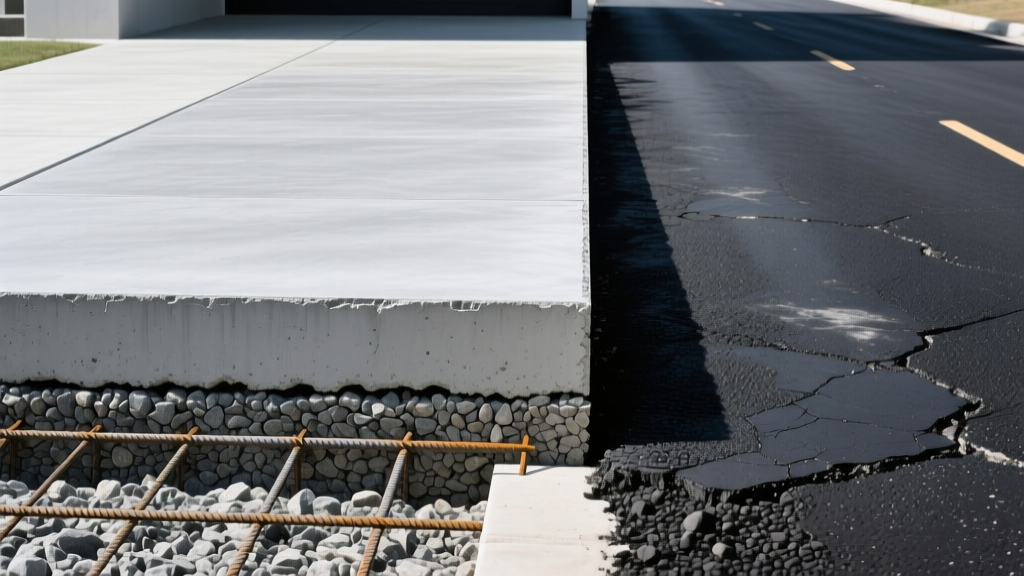
The most frequently miscalculated variable in paving budgets is subgrade preparation. Blacktop is a flexible pavement system; it distributes loads through a grain-to-grain transfer mechanism. If the underlying soil has a low California Bearing Ratio (CBR), the blacktop will conform to the subgrade, leading to rutting and alligator cracking. To mitigate this, blacktop installations require a thick, heavily compacted aggregate base course (ABC)—usually 4 to 8 inches of crushed stone compacted to 95% Proctor density. This base preparation can add $1.50 to $3.00 per square foot to the initial blacktop cost.
Structural Thickness and Load-Bearing Specifications
The required thickness of the paving material dictates the total volume purchased. The Federal Highway Administration outlines distinct structural layer coefficients for rigid versus flexible pavements. Below is a technical comparison of standard specifications for residential and light commercial applications.
| Specification Metric | Portland Cement Concrete | Hot Mix Asphalt (Blacktop) |
|---|---|---|
| Surface Thickness | 4 to 6 inches (monolithic slab) | 2 to 3 inches (compacted HMA) |
| Base Course Requirement | 2 to 4 inches granular base | 4 to 8 inches crushed aggregate |
| Compressive / Tensile Strength | 4,000 PSI minimum (28-day cure) | PG 64-22 Binder (Performance Graded) |
| Jointing / Seaming | Control joints every 10-15 ft (1/4 depth) | Longitudinal and transverse roller seams |
| Average Installed Cost (2026) | $8.00 - $14.00 per sq. ft. | $4.00 - $9.00 per sq. ft. |
Installation Labor and Curing Constraints
Labor dynamics heavily influence the final invoice. Blacktop installation is highly mechanized. A paving train lays the HMA, followed immediately by vibratory steel-wheel rollers and pneumatic-tired rollers to achieve a minimum 92% theoretical maximum specific gravity (Gmm) compaction. Once the mat cools below 140°F (usually within 48 to 72 hours), it can bear vehicular traffic. This rapid turnaround reduces labor hours and site-management overhead.
Concrete installation is intensely labor-dependent and time-sensitive. The process requires building wooden or metal formwork, placing the mix, screeding, bull-floating, and power-troweling. Furthermore, control joints must be saw-cut within 12 to 24 hours to control random shrinkage cracking. The hydration process mandates a 7-day minimum cure time before heavy vehicles can traverse the surface, requiring ongoing site management and potential application of liquid membrane-forming curing compounds.
30-Year Lifecycle Cost Analysis (LCCA)
Initial installation is only the first phase of paving economics. The National Asphalt Pavement Association notes that while blacktop wins on day-one pricing, its flexible nature necessitates continuous preventative maintenance. Concrete requires a higher initial capital expenditure but operates with near-zero structural maintenance for the first two decades.
- Blacktop Maintenance Cycle: Requires sealcoating every 3 to 5 years ($0.15 to $0.25 per sq. ft.) to prevent UV oxidation and water infiltration into the aggregate base. At year 12 to 15, a 1.5-inch structural overlay is typically required ($3.00 to $5.00 per sq. ft.).
- Concrete Maintenance Cycle: Requires joint resealing with polyurethane caulk every 10 to 15 years ($0.50 to $1.00 per linear foot) to prevent incompressible materials from entering joints and causing spalling during freeze-thaw cycles.
LCCA Verdict: Over a 30-year horizon, the net present value (NPV) of a blacktop installation often equals or exceeds that of concrete when factoring in bi-annual sealcoating, crack filling, and a mid-life mill-and-overlay, particularly in regions with high commercial traffic loads.
Climatic Failure Modes and Financial Risk
Environmental stressors dictate the degradation rate of both materials. In northern climates with severe freeze-thaw cycles, concrete must be specified with air-entraining admixtures to create microscopic voids (5-7% total air content). These voids give expanding ice crystals room to form without spalling the surface. If an contractor omits air-entrainment to save $15 per cubic yard, the surface will scale and pop within three winters, leading to catastrophic replacement costs.
Blacktop faces different thermal risks. In high-heat southern climates, standard bitumen binders can soften, leading to rutting under stationary heavy loads (like RVs or delivery trucks). To prevent this, engineers must specify polymer-modified binders (e.g., PG 76-22), which increases the liquid asphalt cost by 15% to 20%. Conversely, extreme UV exposure oxidizes the bitumen, stripping its maltenes and leaving the pavement brittle and gray, accelerating the need for chemical rejuvenators or sealcoats.
Specification Decision Framework
Use the following technical parameters to finalize your material selection:
- Specify Concrete If: The project involves heavy static loads (dumpsters, RV pads, loading docks), the subgrade has a high CBR (>20) minimizing base prep costs, or the design life requirement exceeds 30 years with minimal maintenance intervention.
- Specify Blacktop If: The project covers vast acreage (long rural driveways, large parking lots) where initial capital is constrained, the subgrade is highly expansive clay requiring a flexible pavement to absorb minor shifts, or rapid deployment and immediate traffic access are critical path requirements.
Written by
James ThorntonJames Thornton is a construction industry veteran with 25 years of hands-on experience in wood framing, lumber grading, and residential building codes. He started as a framing carpenter in rural Oregon, earned his ICC Residential Building Inspector certification, and eventually became a senior plan reviewer for the City of Portland Bureau of Development Services. James holds a B.S. in Wood Science & Technology from Oregon State University and is a certified lumber grader through the West Coast Lumber Inspection Bureau (WCLIB). He has inspected over 3,000 residential construction sites and authored the city's internal guide on advanced framing techniques (2x6 at 24" O.C.). James lives in Bend, OR, where he builds custom timber-frame cabins and competes in lumberjack sports.
More from James Thornton
View all
Insulation
Best Home Insulation Materials: Complete 2026 Guide
Compare top home insulation materials for 2026. Find R-values, installed costs per square foot, and best uses for fiberglass, spray foam, and mineral wool.
Aug 4, 2026

Sustainable Building
Certify Your Green Building Material for LEED and WELL
Step-by-step guide to certifying a green building material for LEED v5 and WELL v2. Master EPDs, HPDs, and VOC limits for 2026 project specifications.
Aug 4, 2026

Stone & Masonry
Veneer Stacked Stone Panels: Interior Design & Style Showcase
Discover how veneer stacked stone panels transform interiors. Explore modern design profiles, material pairings, and technical installation specs.
Aug 4, 2026