Concrete Delamination vs Spalling: Causes, Costs, and Repair
Learn the critical differences between concrete delamination vs spalling. Discover causes, repair costs, and step-by-step restoration methods.

The Core Distinction: Subsurface Separation vs. Surface Ejection
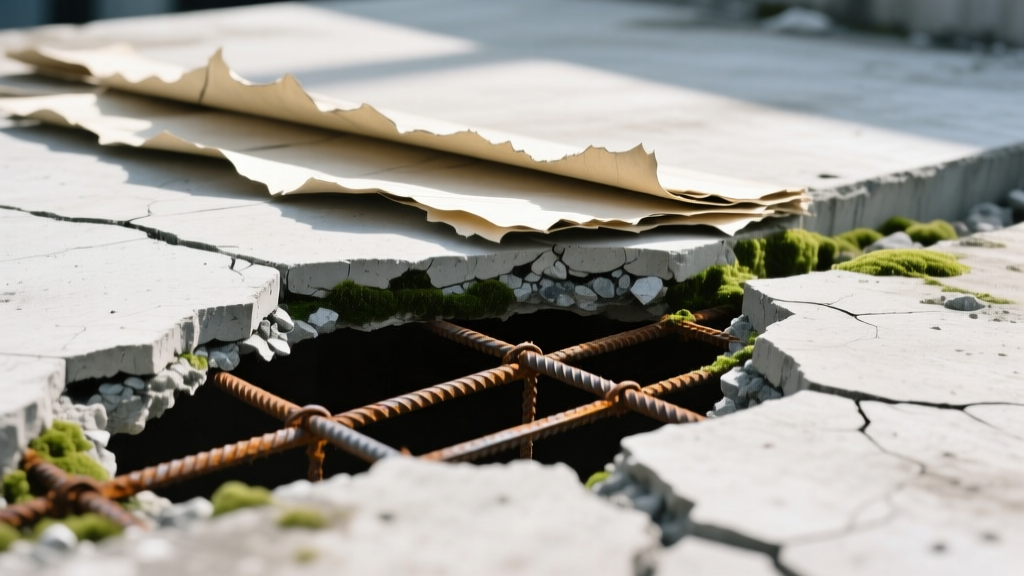
While often used interchangeably by laymen, concrete delamination and spalling represent two fundamentally distinct failure mechanisms with different structural implications, diagnostic methods, and repair protocols. Delamination is the horizontal separation of the concrete surface from the underlying substrate, typically occurring at a depth of 1/8 to 1/2 inch. Spalling is the localized vertical or diagonal breaking, chipping, or flaking of concrete, often extending deep enough to expose the reinforcing steel armature.
• Delamination: Sounds hollow when tapped; surface remains largely intact until traffic breaks it; primarily a finishing or freeze-thaw issue.
• Spalling: Visible craters or missing chunks; exposed rusted rebar; primarily a corrosion-jacking or structural overload issue.
Deep Dive: Concrete Delamination Mechanics
Delamination occurs when a weak horizontal plane forms within the top few inches of a concrete slab. The most common culprit in newly poured slabs is premature finishing. When finishers trowel the surface before bleed water has fully evaporated, they trap water and air voids just beneath the crust. As the concrete cures, this trapped moisture evaporates, leaving a porous, weak subsurface layer that eventually detaches under mechanical stress.
Detection and Mapping Protocols
Visual inspection is insufficient for delamination because the surface often appears perfectly sound until it collapses. Industry standard detection relies on acoustic sounding. According to NRMCA CIP 16 guidelines, the chain drag test (ASTM D4580) involves dragging a heavy metal chain across the slab; a hollow, drum-like acoustic signature indicates subsurface separation. For large-scale infrastructure like bridge decks, automated sounding vehicles equipped with ground-penetrating radar (GPR) and impact-echo sensors are used to map delaminated zones with millimeter precision.
Deep Dive: Concrete Spalling Mechanics
Spalling is generally a more severe structural threat than delamination. The primary driver of spalling in reinforced concrete is corrosion jacking. When the alkaline environment of concrete (pH 12-13) is compromised by carbonation or chloride ion ingress (from deicing salts or seawater), the passive oxide layer on the rebar breaks down. As the steel oxidizes, the resulting iron oxide (rust) occupies 6 to 10 times the volume of the original steel. This immense internal hydraulic pressure exceeds the tensile strength of the concrete cover (typically 300-500 psi), causing the concrete to violently fracture and eject.
Fire-Induced and Chemical Spalling
Spalling also occurs under extreme thermal shock. During a fire, the free moisture inside the concrete pores turns to steam. If the heating rate exceeds the concrete's permeability limits, the trapped steam pressure causes explosive spalling. Additionally, chemical spalling can occur in industrial environments where sulfuric acid or sulfates react with the calcium hydroxide in the cement paste, forming expansive compounds like ettringite that blow the surface apart.
2026 Cost and Repair Matrix: Delamination vs. Spalling
Repair costs vary drastically based on the failure type, depth of damage, and required structural reinstatement. The following matrix reflects current 2026 market rates for commercial and high-end residential restoration.
| Feature | Delamination Repair | Spalling Repair |
|---|---|---|
| Average Cost | $6.00 - $12.00 / sq. ft. | $18.00 - $45.00 / sq. ft. |
| Primary Removal Method | Hydrodemolition or cold planing (milling) | Pneumatic chipping to 1" behind rebar |
| Rebar Intervention | Rarely required | Mandatory cleaning and zinc-rich priming |
| Standard Material | Latex-modified concrete overlay or epoxy injection | Polymer-modified shrinkage-compensated mortar |
| Curing Time to Traffic | 24 - 72 hours | 4 - 24 hours (depending on product) |
Step-by-Step Restoration Protocol
Executing a durable repair requires strict adherence to material preparation and application sequences. Below is the standard operating procedure for addressing severe spalling, which inherently covers delamination repair as a subset.
- Perimeter Saw-Cutting: Use a diamond blade saw to cut a clean, straight boundary around the damaged area. This prevents the chipping tools from feathering the edges, which leads to thin, weak repair margins that will quickly fail.
- Substrate Removal: Chip away the compromised concrete using a lightweight pneumatic hammer. For spalling, you must excavate at least 1 inch behind the exposed reinforcing steel to allow the repair mortar to fully encapsulate the rebar.
- Rebar Preparation: Wire-brush or sandblast the exposed steel to bright metal (SA 2.5 standard). Immediately apply a zinc-rich anti-corrosion primer, such as Sika MonoTop-612, to halt further oxidation.
- Surface Saturation: Soak the exposed concrete substrate with clean water for 2-4 hours prior to patching. The substrate must be Saturated Surface Dry (SSD) — damp, but with no standing puddles — to prevent the dry concrete from sucking the moisture out of the repair mortar.
- Mortar Application: Apply a polymer-modified, shrinkage-compensated repair mortar like MAPEI Planitop XS or Sika MonoTop-615. Trowel firmly to eliminate air pockets. For depths exceeding 2 inches, apply in multiple lifts or use a form-and-pour micro-concrete.
- Curing: Apply a wet burlap cure or a high-quality acrylic curing compound immediately after finishing to prevent plastic shrinkage cracking in the patch.
Preventative Specifications for New Pours
Preventing delamination and spalling is vastly more cost-effective than repair. Specify the following parameters in your structural drawings to ensure long-term durability, particularly in freeze-thaw or marine environments:
- Water-Cementitious Ratio (w/c): Restrict the maximum w/c ratio to 0.45. Lower water content reduces capillary porosity, severely limiting the ingress of chloride ions and moisture.
- Air Entrainment: Specify 5% to 7% entrained air content per ASTM C260. These microscopic air bubbles provide expansion chambers for freezing water, virtually eliminating freeze-thaw delamination.
- Concrete Cover Depth: Maintain a minimum clear cover of 2 inches over rebar for interior slabs, and 3 to 4 inches for exterior structures exposed to deicing salts. This increases the time required for carbonation to reach the steel.
- Finishing Discipline: Strictly prohibit the addition of water to the surface during finishing. Delay final troweling until the bleed water sheen has completely vanished, referencing ASTM C403 for penetration resistance timing.
Applying calcium chloride or sodium chloride deicers within the first 28 days of a concrete pour will almost guarantee surface scaling and spalling. The Portland Cement Association strongly advises using only sand for traction during the first winter season of new concrete exposure.
Expert FAQ: Edge Cases and Troubleshooting
Can delamination be repaired without removing the concrete surface?
Yes, in specific scenarios where the delamination is deep enough (typically >1/2 inch) and the surface is not heavily trafficked. High-modulus, low-viscosity epoxy injection can be used to bond the separated layers back together. Technicians drill small injection ports into the hollow zones, inject the epoxy under low pressure, and grind the ports flush once cured. However, for bridge decks or warehouse floors, milling and overlaying remains the gold standard for structural integrity.
Why is my spalling repair failing and cracking around the edges?
Edge failure in spalling patches is almost always caused by 'feather-edging' — attempting to taper the repair mortar to a thin zero-edge. Polymer-modified mortars lack the tensile strength to hold together at thicknesses less than 1/4 inch. Always saw-cut a minimum 1/2 inch deep perpendicular shoulder around the repair perimeter to ensure the patch material maintains a uniform, structural thickness.
Is carbonation-induced spalling covered by standard warranties?
Rarely. Carbonation is a natural, time-dependent chemical process where atmospheric CO2 reacts with calcium hydroxide to lower the concrete's pH. Unless the contractor deviated from the specified mix design (e.g., using too high a w/c ratio or inadequate cement content) or failed to provide the specified rebar cover depth, carbonation spalling appearing after 15-20 years is classified as normal lifecycle wear and is excluded from standard 1-year or 5-year workmanship warranties.
Written by
James ThorntonJames Thornton is a construction industry veteran with 25 years of hands-on experience in wood framing, lumber grading, and residential building codes. He started as a framing carpenter in rural Oregon, earned his ICC Residential Building Inspector certification, and eventually became a senior plan reviewer for the City of Portland Bureau of Development Services. James holds a B.S. in Wood Science & Technology from Oregon State University and is a certified lumber grader through the West Coast Lumber Inspection Bureau (WCLIB). He has inspected over 3,000 residential construction sites and authored the city's internal guide on advanced framing techniques (2x6 at 24" O.C.). James lives in Bend, OR, where he builds custom timber-frame cabins and competes in lumberjack sports.
More from James Thornton
View all
Insulation
Best Home Insulation Materials: Complete 2026 Guide
Compare top home insulation materials for 2026. Find R-values, installed costs per square foot, and best uses for fiberglass, spray foam, and mineral wool.
Aug 4, 2026

Sustainable Building
Certify Your Green Building Material for LEED and WELL
Step-by-step guide to certifying a green building material for LEED v5 and WELL v2. Master EPDs, HPDs, and VOC limits for 2026 project specifications.
Aug 4, 2026

Stone & Masonry
Veneer Stacked Stone Panels: Interior Design & Style Showcase
Discover how veneer stacked stone panels transform interiors. Explore modern design profiles, material pairings, and technical installation specs.
Aug 4, 2026