Concrete Driveway Resurfacing: 2026 Material Selection Guide
Compare polymer-modified overlays, polyaspartic coatings, and micro-toppings for concrete driveway resurfacing. Get 2026 costs, specs, and frameworks.
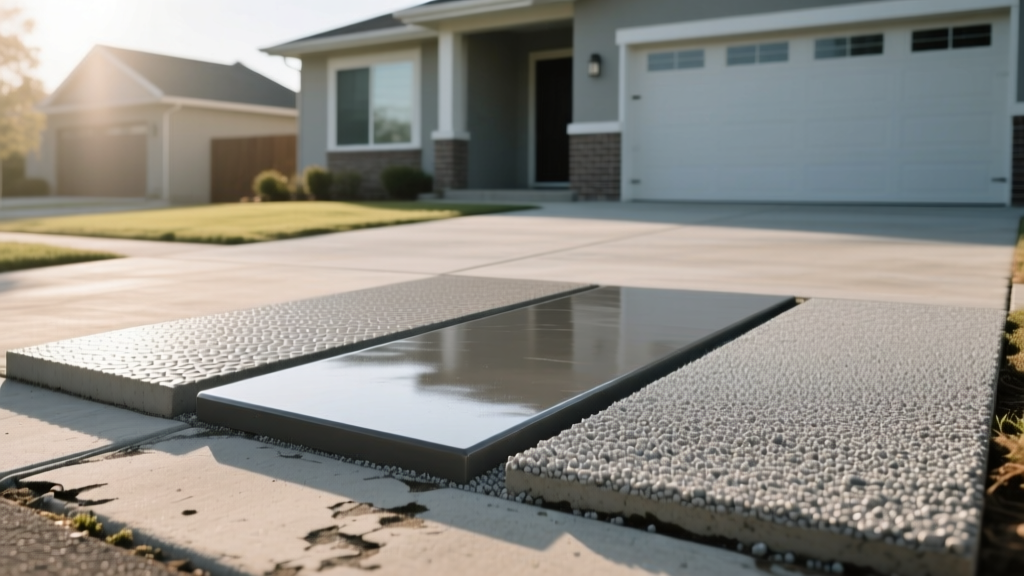
The Taxonomy of Driveway Resurfacing Materials
Selecting the correct material for concrete driveway resurfacing requires matching the overlay chemistry to the substrate condition, environmental exposure, and vehicular load. In 2026, the market has moved beyond basic sand-and-cement patches, offering advanced polymer-modified and aliphatic polyurea systems that drastically extend slab lifespans. Understanding the material taxonomy is the first step in preventing catastrophic delamination.
1. Polymer-Modified Cementitious Overlays
Polymer-modified overlays blend Portland cement, graded silica aggregates, and acrylic or latex co-polymer emulsions. The polymers reduce the water-to-cement ratio required for workability, resulting in higher flexural strength and lower permeability. For standard residential driveways, products like Quikrete Concrete Resurfacer (No. 1101) offer a compressive strength of approximately 4,500 psi at 28 days and are limited to thin applications (maximum 1/2 inch). For heavy vehicular traffic or deeper spall repairs, high-build systems such as MAPEI Mapcrete 2000 or ARDEX CD can be applied up to 2 inches in a single lift, achieving compressive strengths exceeding 6,000 psi. These systems require a minimum application temperature of 50°F and must be kept moist during the initial 48-hour curing phase to prevent plastic shrinkage cracking.
2. Polyaspartic and Polyurea Coatings
While traditional epoxies are prone to UV degradation (yellowing) and hot-tire pickup, aliphatic polyaspartic polyureas have become the premium standard for seamless driveway coatings. Polyaspartics, such as VersaFlex VFI-54, offer 100% UV stability, elongation properties of up to 300% to bridge micro-cracks, and rapid cure times (often walkable in 2 hours). Unlike cementitious overlays, these are purely surface-level membranes (typically 15 to 25 mils thick) and will telegraph any underlying substrate movement. They require an immaculate, dry substrate to prevent osmotic blistering.
3. Stamped and Stenciled Micro-Toppings
Micro-toppings are strictly cosmetic, high-strength cementitious layers applied at thicknesses of 1/16 to 1/8 inch. Products like ARDEX SD-T or Skraffino are designed to accept acid stains, dyes, and stamping mats. Because they lack the aggregate size of traditional overlays, they possess minimal structural bridging capability. They are ideal for sound, uncracked slabs where the goal is purely aesthetic transformation, but they will fail rapidly if applied over active structural cracks.
Material Selection Matrix: Matching Substrate to Overlay
Choosing the wrong material for a specific substrate condition is the primary cause of resurfacing failure. Use the following matrix to align your driveway's current state with the appropriate 2026 material class.
| Material Type | Min. Thickness | Best Substrate Condition | Compressive Strength | 2026 Installed Cost (per sq ft) |
|---|---|---|---|---|
| Standard Polymer Overlay | 1/4 inch | Surface spalling, minor scaling, no active cracks | 4,500 - 5,000 psi | $4.00 - $6.50 |
| High-Build Polymer Overlay | 1/2 - 2 inches | Deep pop-outs, exposed aggregate, minor faulting | 6,000+ psi | $7.00 - $11.00 |
| Polyaspartic Coating | 15 - 25 mils | Sound concrete, high UV exposure, chemical spills | N/A (Tensile: 3,500 psi) | $9.00 - $14.00 |
| Micro-Topping (Decorative) | 1/16 - 1/8 inch | Smooth, uncracked slabs requiring aesthetic upgrade | 5,500 psi | $8.00 - $13.00 |
Critical Preparation Standards: ICRI and ASTM Protocols
The most advanced resurfacing material will delaminate if the Concrete Surface Profile (CSP) is inadequate. According to guidelines published by the International Concrete Repair Institute (ICRI), polymer-modified overlays require a CSP of 3 to 5 to ensure mechanical interlock. This cannot be achieved with simple acid etching or wire brushing.
- Diamond Grinding: Use 30-grit metal-bond diamond segments on a planetary grinder to achieve a CSP 3. This is ideal for removing thin surface sealers and opening the pores of hard-troweled concrete.
- Shot Blasting: For thicker overlays requiring a CSP 4 or 5, shot blasting with S-280 or S-330 steel shot removes laitance and exposes the coarse aggregate matrix, providing maximum bonding surface area.
- Pull-Off Testing: For commercial driveways or heavy-load residential aprons, verify surface prep via ASTM D7234 pull-off adhesion testing. The substrate should yield a minimum pull-off strength of 200 psi before overlay application.
WARNING: Moisture Vapor Transmission (MVT)
Before applying any non-breathable coating (like polyaspartic or epoxy), you must test for MVT using the ASTM F2170 relative humidity (RH) probe method. If the internal RH of the concrete slab exceeds 75%, moisture vapor will become trapped beneath the impermeable membrane, causing hydrostatic pressure buildup and catastrophic osmotic blistering. If RH exceeds 75%, you must either switch to a breathable cementitious overlay or apply a dedicated moisture-mitigating epoxy primer before the topcoat.
The Control Joint Dilemma: Preventing Reflective Cracking
A frequent and costly error in concrete driveway resurfacing is ignoring the existing control joint pattern. Resurfacing does not alter the fundamental thermal expansion and contraction mechanics of the underlying slab. If you pour a continuous overlay over existing saw-cut joints, the slab will naturally crack at those exact weak points, tearing the new overlay apart—a phenomenon known as reflective cracking.
'To prevent reflective cracking, contractors must saw-cut new control joints into the fresh overlay directly over the existing substrate joints. This must be done within 4 to 12 hours of placement, depending on ambient temperature, before the overlay develops sufficient tensile strength to resist the saw blade without raveling.' — American Concrete Institute (ACI) Committee 360 Guidelines
After saw-cutting, the joints must be cleaned with a high-pressure air wand and backfilled with a self-leveling polyurethane joint sealant (such as Sika Sikaflex-1c SL) to prevent water infiltration and freeze-thaw damage beneath the overlay.
Expert Decision Framework: When to Resurface vs. Replace
Resurfacing is a rehabilitation strategy, not a structural fix. Use this framework to determine if your driveway is a candidate for an overlay or if full-depth replacement is required.
Proceed with Resurfacing If:
- Cracks are strictly map-cracking or shrinkage cracks less than 1/8 inch wide.
- Surface spalling or scaling is limited to the top 1/2 inch of the slab.
- The slab is structurally sound with no vertical displacement (faulting) between adjacent panels.
- The underlying base material is stable and properly compacted.
Opt for Full Replacement If:
- Vertical faulting between panels exceeds 1/2 inch, indicating base failure or severe frost heave.
- There are active structural cracks wider than 1/4 inch, particularly those accompanied by differential settlement.
- The slab exhibits 'D-cracking' (a series of fine cracks parallel to the joints and edges), which indicates the internal aggregate is failing due to freeze-thaw cycles. No overlay can stop internal aggregate degradation.
For comprehensive durability standards and long-term performance metrics regarding concrete pavements and driveways, refer to the Portland Cement Association's durability resources. Proper material selection, combined with rigorous substrate preparation, ensures a resurfaced driveway will withstand vehicular loads and environmental stressors for 15 to 20 years.