Best Concrete Epoxy Coatings for Garage Floors: 2026 Brand Guide
Compare top concrete epoxy brands for 2026. Deep dive into ArmorPoxy, Rust-Oleum, and Sherwin-Williams specs, MVT limits, and prep protocols.
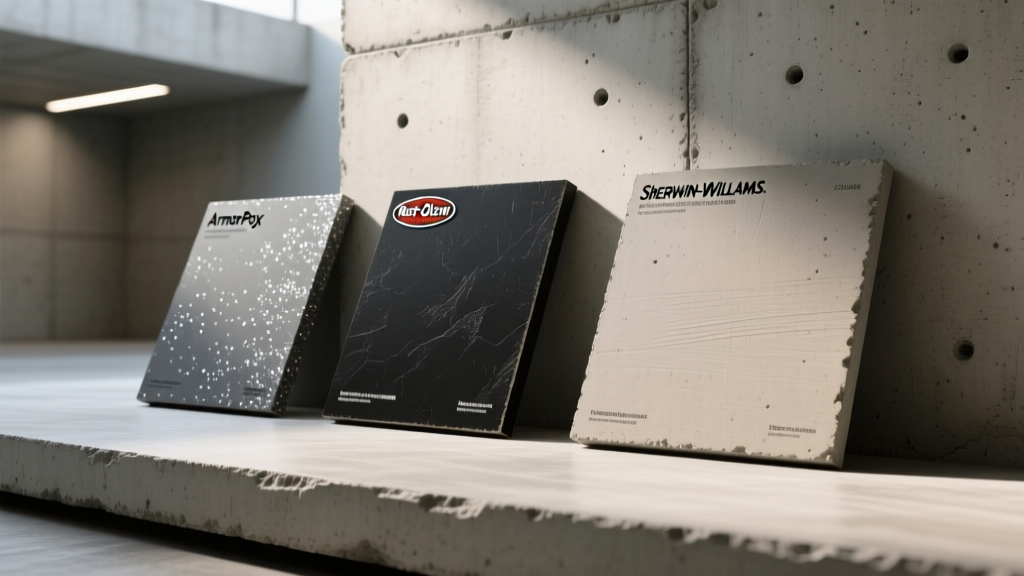
The Chemistry of Concrete Epoxy: 100% Solids vs. Hybrids
When evaluating concrete epoxy systems, the most critical specification is the volume solids content. The term "epoxy" is frequently diluted in the consumer market, leading to catastrophic coating failures in high-traffic environments. True 100% solids epoxy contains no volatile organic compounds (VOCs) or water carriers. When it cures, it retains 100% of its applied wet mil thickness, resulting in a dense, impermeable shield typically measuring 10 to 16 dry mils thick.
In contrast, water-based and solvent-based epoxies contain 40% to 60% solids. As the carrier evaporates, the coating shrinks, leaving a thin film (2 to 3 mils) that is highly susceptible to hot tire pickup and chemical degradation. For any residential garage or commercial workshop, specifying a 100% solids or high-solids cycloaliphatic amine system is non-negotiable for long-term durability.
Brand Deep-Dive: Top Concrete Epoxy Product Lines
The market is segmented between big-box consumer kits, prosumer direct-to-consumer lines, and commercial-grade industrial coatings. Here is a technical breakdown of the leading product lines available in 2026.
Rust-Oleum RockSolid Polycuramine (The Big-Box Standard)
Rust-Oleum markets RockSolid as a "polycuramine" hybrid, blending epoxy, polyurea, and urethane chemistries. While it offers faster cure times (walkable in 8-10 hours) and better UV resistance than standard aliphatic epoxies, it is not a true 100% solids system. It typically yields a dry film thickness (DFT) of 3 to 4 mils. It is an acceptable budget option for light-duty residential garages, but it lacks the impact resistance required for heavy tool drops or steel-wheeled equipment.
- Solids Content: ~90%
- Dry Film Thickness: 3 - 4 mils
- Cost: $2.00 - $2.50 per sq. ft.
ArmorPoxy II 100% Solids (The Prosumer/Contractor Choice)
ArmorPoxy II is a true 100% solids, cycloaliphatic amine-cured epoxy. The cycloaliphatic hardener is critical because it prevents "amine blush" (a waxy surface film caused by humidity during curing) and provides superior UV stability compared to standard polyamide epoxies. Applied at 10 to 12 mils, it delivers exceptional compressive strength (over 10,000 psi) and completely eliminates hot tire pickup. This is the gold standard for high-end residential garages and light commercial showrooms.
- Solids Content: 100%
- Dry Film Thickness: 10 - 12 mils
- Cost: $3.50 - $4.50 per sq. ft.
Sherwin-Williams Macropoxy 646-100 (The Industrial Heavyweight)
For commercial warehouses, automotive shops, and heavy manufacturing, Macropoxy 646-100 is a high-build, 100% solids polyamide epoxy. It is designed to be applied at 16 to 20 mils in a single coat, providing massive impact resistance and chemical protection against harsh solvents, brake fluids, and battery acids. It requires strict environmental controls during application and mechanical surface preparation.
- Solids Content: 100%
- Dry Film Thickness: 16 - 20 mils
- Cost: $5.00 - $7.00+ per sq. ft. (material only)
Head-to-Head Concrete Epoxy Specification Matrix
| Product Line | Chemistry Type | Solids % | DFT (Mils) | Hot Tire Resistance | VOC Level |
|---|---|---|---|---|---|
| Rust-Oleum RockSolid | Polycuramine Hybrid | ~90% | 3 - 4 | Moderate | < 100 g/L |
| ArmorPoxy II | Cycloaliphatic Epoxy | 100% | 10 - 12 | Excellent | 0 g/L |
| SW Macropoxy 646-100 | Polyamide Epoxy | 100% | 16 - 20 | Superior | 0 g/L |
| Generic Big-Box Kit | Water-Based Epoxy | 45 - 50% | 1.5 - 2 | Poor (High Failure Rate) | < 250 g/L |
Critical Failure Modes: Why Concrete Epoxy Peels and Blisters
Even the highest-grade 100% solids concrete epoxy will delaminate if substrate conditions are ignored. The two primary culprits for coating failure are Moisture Vapor Transmission (MVT) and inadequate surface profiling.
Concrete is a porous sponge. If hydrostatic pressure pushes moisture vapor up through the slab, it will become trapped beneath the impermeable epoxy layer, causing osmotic blistering. According to ASTM F1869 standards, the MVT rate must not exceed 3.0 lbs per 1,000 square feet per 24 hours before applying a standard epoxy. If your slab tests higher, you must first apply a moisture-mitigating epoxy primer (such as Vapor Block 24) before the topcoat.
The second major failure mode is hot tire pickup. When vehicle tires heat up during driving and park on a thin, low-solids epoxy, the plasticizers in the tire rubber soften the coating. As the tire cools and contracts, it bonds to the epoxy and literally rips it from the concrete upon departure. Only 100% solids epoxies with a high cross-link density can resist this plasticizer migration.
Surface Preparation: The CSP Standard
Adhesion is entirely dependent on the mechanical interlock between the epoxy and the concrete pores. The International Concrete Repair Institute (ICRI) utilizes the Concrete Surface Profile (CSP) system, ranging from CSP 1 (very smooth) to CSP 9 (very rough). For a 100% solids concrete epoxy, you must achieve a CSP 2 or CSP 3 profile.
Industry Consensus: Acid etching with muriatic acid is no longer considered an acceptable preparation method for high-performance epoxy systems. Acid leaves residual salts (efflorescence) that neutralize the amine hardener, leading to localized curing failures. Mechanical preparation via diamond grinding or shot blasting is mandatory.
Step-by-Step Application Protocol
Follow this precise sequence to ensure optimal cross-linking and adhesion. Always consult the Technical Data Sheet (TDS) for your specific product, as ambient temperature dictates pot life.
- Diamond Grind (Day 1): Use a walk-behind planetary grinder equipped with 30-grit metal-bonded diamonds to open the pores and achieve CSP 2/3. Vacuum all dust with a HEPA-filtered shroud.
- Moisture Testing (Day 1): Perform a calcium chloride test (ASTM F1869) or use an in-situ relative humidity probe (ASTM F2170). Do not proceed if RH exceeds 75%.
- Solvent Wipe (Day 2): Wipe the slab with denatured alcohol or a dedicated concrete degreaser to remove any lingering oils or silicones.
- Primer Coat (Optional but Recommended): Apply a low-viscosity epoxy primer to flood the capillaries. This acts as a bonding bridge for the high-build topcoat.
- Mix and Apply Body Coat (Day 2): Mix Part A and Part B for exactly 3 minutes using a Jiffy mixer at 300 RPM. Pour in ribbons and spread with a 1/8-inch notched squeegee, then back-roll with a 3/8-inch woven epoxy roller. Note: 100% solids epoxies have a strict pot life of 20-30 minutes at 75°F. Do not mix more than you can apply in that window.
- Broadcast Aggregate (Optional): For slip resistance, broadcast aluminum oxide or quartz sand into the wet epoxy at a rate of 1 lb per 100 sq. ft.
- Clear Topcoat (Day 3): After 12-16 hours, scrape off excess aggregate and apply an aliphatic polyurethane or polyaspartic clear topcoat for UV stability and scratch resistance.
Frequently Asked Questions
Can I apply concrete epoxy over existing paint or sealers?
No. Epoxy must bond directly to the bare concrete matrix. Any existing acrylic sealer, latex paint, or curing compound will act as a bond-breaker. You must mechanically scarify the slab down to bare, clean concrete before application.
How do temperature and humidity affect the curing process?
Epoxy curing is an exothermic chemical reaction. At 60°F, the pot life may extend to 45 minutes, but full cure will take 7 days. At 85°F, the pot life drops to 12 minutes, and the coating may flash-cure, leaving roller marks. Furthermore, as noted by the EPA guidelines on indoor air quality, ensuring proper ventilation during application is vital, even with zero-VOC 100% solids systems, to manage ambient fumes and ensure safe working conditions. Never apply epoxy if the slab temperature is within 5°F of the dew point, as microscopic condensation will cause amine blush.