Dry Concrete vs Wet Concrete: Technical Specs and Placement Guide
Compare dry concrete vs wet concrete technical specifications. Explore w/c ratios, slump data, compaction methods, and 28-day strength profiles.

Defining the States: Rheology and Slump Specifications
In structural engineering and materials science, the distinction between dry concrete and wet concrete is not merely about moisture content; it is a fundamental difference in rheology, placement mechanics, and hydration behavior. Wet concrete (plastic or fluid concrete) exhibits high workability, flowing under its own weight to fill formwork. Dry concrete (zero-slump, dry-tamp, or roller-compacted concrete) lacks fluidity, behaving more like a cohesive granular soil that requires immediate mechanical energy to achieve consolidation.
According to Portland Cement Association (PCA) guidelines, wet-cast mixes are designed for slumps ranging from 3 to 8 inches (75 to 200 mm). In contrast, dry concrete registers a 0-inch slump. Because the standard ASTM C143 slump test is useless for zero-slump mixes, engineers must rely on the Vebe consistometer (ASTM C1170) or the Kelly Ball test to measure the workability and compaction energy required for dry mixes.
Water-Cement Ratio and Hydration Mechanics
The water-cement (w/c) ratio dictates the ultimate compressive strength and permeability of the cured matrix. Wet concrete relies on excess water for workability, which subsequently evaporates, leaving capillary pores. Dry concrete operates at the absolute minimum water threshold required for cement hydration, resulting in a denser, less permeable matrix.
| Specification | Wet Concrete (Plastic) | Dry Concrete (Zero-Slump) |
|---|---|---|
| Water-Cement (w/c) Ratio | 0.40 – 0.55 | 0.28 – 0.38 |
| Slump Measurement | 3" – 8" (ASTM C143) | 0" / Vebe Time 10-30s (ASTM C1170) |
| Air Content (Target) | 5.0% – 7.0% (Freeze-Thaw) | 1.5% – 3.0% (Lower due to compaction) |
| Hydration Mechanism | Capillary absorption and fluid diffusion | Surface tension and mechanical forced contact |
Aggregate Grading and Mix Proportioning
The aggregate skeleton in dry concrete vs wet concrete requires different grading curves to optimize particle packing. Wet mixes utilize continuous grading with a higher proportion of fine aggregates (sand) to prevent segregation and bleeding. The fine particles act as ball bearings, allowing the coarse aggregate to suspend in the cement paste.
Dry-Tamp Grading Specifics
Dry concrete mixes, such as those used in concrete masonry units (CMUs) or roller-compacted concrete (RCC), utilize gap-graded or harsh aggregate profiles. The Federal Highway Administration (FHWA) specifies that RCC mixes require a higher percentage of coarse aggregate and a lower fine aggregate ratio to create an interlocking skeleton. This skeleton bears the load of compaction equipment (like vibratory rollers) without rutting or sinking, while the minimal cement paste coats the aggregates just enough to bind them upon vibration.
Admixture Chemistry and Curing Protocols
Chemical admixtures behave differently depending on the moisture state of the mix. In wet concrete, High-Range Water Reducers (HRWR), or superplasticizers (e.g., polycarboxylate ethers), are standard for achieving high flowability without increasing the w/c ratio. In dry concrete, HRWRs are largely ineffective because there is insufficient free water for the polymers to disperse the cement flocculants.
Instead, dry concrete formulations rely on:
- Non-Chloride Accelerators (NCAs): Used heavily in precast dry-cast yards to achieve 4,000+ psi demolding strength within 8 to 12 hours.
- Air-Entraining Agents (AEAs): Difficult to stabilize in zero-slump mixes; requires precise dosing to achieve a 3% air content without making the mix too "fluffy" to compact.
- Hydrophobic Pore-Blocking Agents: Integrated directly into the dry-tamp mix for CMUs to prevent water migration.
Curing protocols also diverge sharply. Wet concrete is typically cured via wet burlap, ponding, or liquid membrane-forming compounds (ASTM C309). Dry concrete, lacking internal bleed water, must be cured using steam curing in enclosed kilns (for precast) or immediate application of high-solids resin-based curing compounds to trap the meager internal moisture.
Compaction and Placement Methodologies
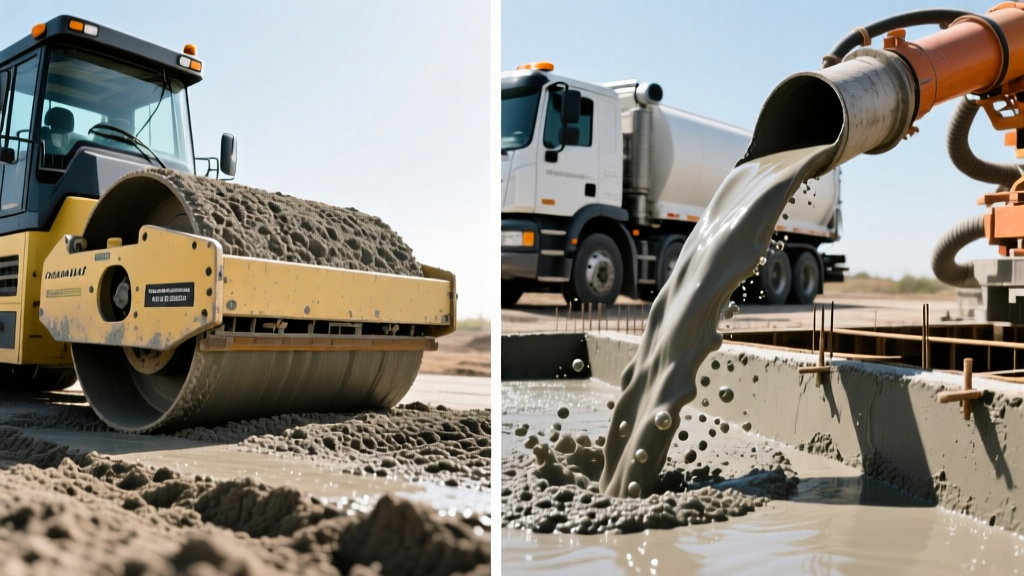
The equipment required for placement highlights the most practical difference between the two states. Wet concrete placement relies on gravity, pumping, and vibration to eliminate voids. Dry concrete placement relies on static weight and high-frequency kinetic energy.
Wet Concrete Equipment
Standard wet placement utilizes boom pumps (e.g., Putzmeister or Schwing) capable of delivering up to 200 cubic yards per hour. Consolidation is achieved using internal pencil vibrators (10,000 to 15,000 RPM) or exterior form vibrators to liquefy the paste momentarily, allowing entrapped air to escape.
Dry Concrete Equipment
Zero-slump concrete cannot be pumped. It is transported via dump trucks, conveyors, or hoppers. In paving applications (RCC), it is spread via asphalt-style pavers and compacted using heavy tandem vibratory rollers (e.g., Caterpillar CB15 or Hamm DV+ series). In precast block manufacturing, dry-tamp concrete is fed into block machines (e.g., Besser or Columbia) where hydraulic tampers and high-frequency pallet vibrators (up to 7,000 RPM) apply immense mechanical force to densify the mix into rigid molds.
Compressive Strength and Durability Profiles
Because dry concrete operates at an ultra-low w/c ratio, its ultimate density and long-term durability often surpass standard wet-cast mixes, provided that 100% compaction is achieved in the field.
| Performance Metric | Standard Wet-Cast (Structural) | Dry-Cast / Roller-Compacted |
|---|---|---|
| 28-Day Compressive Strength | 3,000 – 5,000 psi | 4,500 – 8,000+ psi |
| Early Strength (24-Hour) | 500 – 1,500 psi | 2,500 – 4,500 psi (with steam/accelerators) |
| Water Permeability | Moderate (requires sealers) | Extremely Low (dense matrix) |
| Shrinkage Potential | Moderate to High (drying shrinkage) | Very Low (minimal free water to evaporate) |
Data from the National Precast Concrete Association (NPCA) confirms that dry-cast concrete products exhibit significantly lower drying shrinkage compared to wet-cast equivalents. The lack of excess water means there is less capillary tension pulling the cement matrix together as it dries, resulting in fewer micro-cracks and superior dimensional stability.
Application Decision Matrix
Selecting between dry concrete and wet concrete requires aligning the material's rheological properties with the structural and logistical demands of the project.
- Choose Wet Concrete When: The project involves complex, heavily reinforced formwork (e.g., high-rise columns, suspended slabs, architectural facades). The mix must flow around dense rebar cages and fill intricate geometries without honeycombing. Laser screeds and boom pumps are necessary for rapid, large-scale horizontal placements.
- Choose Dry Concrete When: The application involves mass gravity structures, dam foundations, heavy-duty industrial paving (RCC), or high-volume precast manufacturing (CMUs, retaining wall blocks, pavers). The logistics allow for conveyors or dump trucks, and the site has access to heavy vibratory compaction equipment. The priority is high early strength, low shrinkage, and immediate load-bearing capacity.
Understanding the technical specifications of dry concrete vs wet concrete ensures that engineers and contractors select the correct mix design, testing standard, and placement equipment, ultimately preventing costly field failures and ensuring structural longevity.
Written by
Marcus ChenMarcus Chen is a licensed structural engineer (PE) and building materials analyst with over 12 years of experience across residential, commercial, and industrial construction. He holds a Master of Science in Civil Engineering from UC Berkeley and spent six years at Thornton Tomasetti before transitioning to independent consulting and technical writing. Marcus specializes in material selection for seismic-prone regions, concrete reinforcement strategies, and lifecycle cost analysis. His work has been cited by the American Concrete Institute (ACI) and the Structural Engineers Association of California (SEAOC). When he is not on a job site or at his desk, you will find him hiking the Sierra Nevada or restoring a 1920s craftsman bungalow in Oakland, CA.
More from Marcus Chen
View all
Construction Cost
How Much Did the Eiffel Tower Cost to Build?
How much did the Eiffel Tower cost to build in 1889? We adjust for inflation and compare its budget to modern skyscraper construction.
Aug 4, 2026

Fire Resistance
What Is a Fire Resistant Material? Testing & Certification Guide
Discover what is a fire resistant material through ASTM and UL testing. Learn how fire ratings, certifications, and assemblies work in construction.
Aug 4, 2026

Construction Cost
How Much Did the Burj Khalifa Cost to Build?
How much did the Burj Khalifa cost to build? We break down the $1.5B project and extract 5 money-saving strategies for your next build.
Jul 30, 2026