Water Based Concrete Stain vs Acid: Chemical & Mix Design Guide
Compare water based concrete stain vs acid stain. Learn how cement mix designs, fly ash, and curing affect chemical reactions and color outcomes.

The Chemistry of Concrete Staining: Reactive vs. Non-Reactive
When evaluating water based concrete stain vs acid alternatives, the decision extends far beyond color preference. The fundamental difference lies in the chemical interaction between the stain and the cementitious matrix. Understanding this interaction is critical for contractors and architects, as the concrete's specific mix design will dictate the success, longevity, and visual outcome of the application.
Acid Stains: The Metallic Salt Reaction
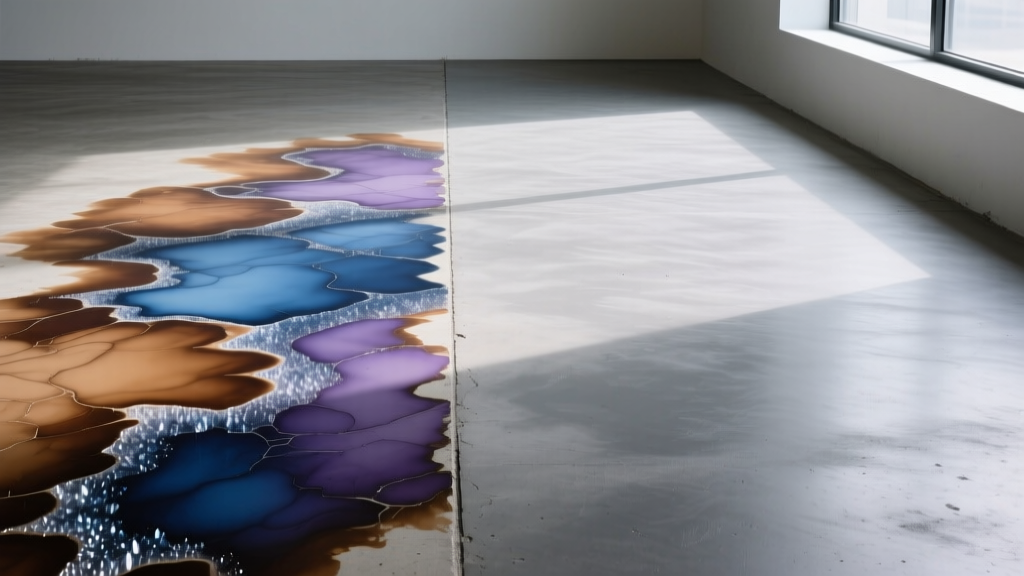
Acid-based stains (often referred to as reactive or chemical stains) do not contain traditional pigments. Instead, they consist of a mild hydrochloric or phosphoric acid solution combined with metallic salts. When applied to concrete, the acid lightly etches the surface, allowing the metallic salts to react with the free lime (calcium hydroxide) present in the hydrated cement paste. This reaction produces permanent, variegated coloration that becomes an integral part of the concrete. Because it relies on a chemical reaction, the final color is inherently unpredictable and highly dependent on the concrete's age, finish, and chemical composition.
Water-Based Stains: Acrylic and Polymer Penetration
Water-based concrete stains are non-reactive. They utilize advanced acrylic, polyurethane, or hybrid polymer resins suspended in a water carrier, combined with organic or inorganic pigments. Rather than reacting chemically with the cement paste, these stains penetrate the concrete's capillary pores and deposit pigment particles as the water evaporates. The polymer binders then lock the pigment into the substrate. Because no chemical reaction is required, water-based stains offer a highly predictable, uniform color palette and are entirely immune to the chemical makeup of the concrete mix.
How Concrete Mix Design Dictates Stain Performance
The most frequent cause of decorative concrete failure is a mismatch between the stain type and the concrete mix design. According to guidelines on proportioning and material selection from the Portland Cement Association, modern structural and flatwork mixes frequently incorporate Supplementary Cementitious Materials (SCMs) to improve durability and reduce carbon footprints. These SCMs drastically alter the stainability of the slab.
If your concrete mix contains high volumes of Class F fly ash (typically >15%) or ground granulated blast-furnace slag (GGBFS), the pozzolanic reaction will consume the free calcium hydroxide (lime) in the paste. Without available lime, acid stains will fail, resulting in pale, washed-out, or entirely non-existent color. Water-based stains, however, will perform perfectly on high-SCM mixes because they rely on physical pore penetration rather than chemical lime reactions.
Likewise, silica fume densifies the concrete matrix and reduces porosity. While this creates a highly durable slab, it severely restricts the penetration depth of both stain types, often requiring mechanical profiling (such as shot blasting or diamond grinding) before application.
Water Based Concrete Stain vs Acid: Technical Comparison Matrix
| Feature | Acid-Based (Reactive) | Water-Based (Non-Reactive) |
|---|---|---|
| Chemical Mechanism | Reacts with calcium hydroxide | Pigment deposition via pore penetration |
| Color Palette | Earth tones (browns, tans, terracottas, muted blues/greens) | Full spectrum (vibrant reds, blues, whites, blacks, metallics) |
| Mix Design Sensitivity | Highly sensitive (fails on high fly ash/slag) | Low sensitivity (works on all standard mixes) |
| Surface Prep & Neutralization | Requires post-application neutralization (baking soda/ammonia) | No neutralization required |
| VOC Content (2026 Standards) | Higher VOCs (acid fumes require ventilation) | Ultra-low VOC (<50 g/L), safe for interior occupied spaces |
| UV Stability | Excellent (inorganic metallic salts do not fade) | Good to Excellent (requires UV-stable acrylic/polyurethane binders) |
Application Variables: Curing, Porosity, and Moisture
Beyond the mix proportions, the curing method and surface moisture content at the time of application are critical variables.
The Impact of Curing Compounds
Membrane-forming curing compounds (compliant with ASTM C309) create a physical barrier on the concrete surface. If a slab is cured using a resin-based membrane, neither acid nor water-based stains will penetrate until the membrane is completely removed via chemical stripping or mechanical abrasion. However, if the slab is wet-cured (using burlap or continuous misting) or cured with dissipating resins (ASTM C309 Type 1-D), water-based stains can often be applied with minimal prep, whereas acid stains may still require light etching to open the pores.
Moisture Tolerance
Water-based stains possess a distinct advantage in damp environments. Because their carrier is water, they can be applied to slightly damp concrete substrates, which actually aids in capillary draw and pigment distribution. Acid stains, conversely, require a completely dry surface; standing water or high internal moisture will dilute the acid concentration, halting the metallic salt reaction and resulting in severe blotching.
Cost and Coverage Realities (2026 Pricing)
When budgeting for decorative flatwork, material costs tell only half the story. Labor and prep time significantly alter the final installed price.
- Material Costs: As of 2026, premium acid stains (e.g., Kemiko Stone Tone) average $35 to $50 per gallon, covering 200–300 sq. ft. High-solids water-based stains (e.g., Direct Colors or Sherwin-Williams H&C) range from $45 to $75 per gallon, covering 250–400 sq. ft.
- Labor & Prep: Acid staining requires a mandatory neutralization and wet-vacuuming step after the chemical reaction, adding 1.5 to 2 hours of labor per 1,000 sq. ft. Water-based stains eliminate this step entirely.
- Total Installed Cost: Acid stain installations typically run $3.50 to $6.50 per square foot. Water-based installations are generally more cost-effective, ranging from $2.50 to $4.50 per square foot, largely due to reduced labor and disposal costs associated with neutralization runoff.
Troubleshooting Common Mix-Design Failures
Even experienced contractors encounter issues when the concrete mix design is unknown. Here is how to diagnose and correct the two most common failures:
Acid Stain Turns Chalky White or Fails to React
Cause: The concrete mix contains excessive fly ash, slag, or was over-troweled, creating a weak layer of laitance that trapped unreacted cement particles while starving the surface of calcium hydroxide. Alternatively, the concrete has heavily carbonated over time, dropping the surface pH below 7.
Fix: Acid staining cannot be forced. You must switch to a water-based penetrating stain or an opaque concrete dye to achieve color.
Water-Based Stain Peels or Flakes
Cause: The concrete was sealed with a silane/siloxane water repellent prior to staining, or the surface was contaminated with form release agents or curing membranes, preventing the acrylic polymers from penetrating the pores.
Fix: Strip the surface using a soy-based or citrus chemical stripper, followed by a 120-grit diamond grind to open the capillary network. Reapply the water-based stain once the surface passes a standard water-drop absorption test.
Decision Framework: Choosing the Right Stain
Use this practical framework to select the appropriate chemistry for your specific project parameters:
- Choose Acid Stain When: You are working with a standard Type I/II Portland cement mix (low SCM content), desire a natural, mottled, variegated 'marble' aesthetic, and the project is an exterior application where maximum UV stability is paramount.
- Choose Water-Based Stain When: The mix design includes >15% fly ash or slag, the project requires vibrant or non-earth-tone colors (e.g., blues, reds, whites), the space is an interior environment with strict VOC limitations, or you need to minimize labor time by eliminating the neutralization phase.
For further technical data on surface preparation and decorative applications, refer to the decorative concrete guidelines published by Concrete Camouflage and the American Concrete Institute's finishing specifications. Matching the stain chemistry to the concrete's physical and chemical reality is the only way to ensure a durable, high-performance decorative finish.
Written by
Sarah WhitfieldSarah Whitfield is a chartered quantity surveyor (MRICS) and construction cost analyst with 15 years of experience in material pricing, procurement strategy, and project budgeting. She earned her degree in Construction Management from the University of Reading (UK) and has worked on projects ranging from $2M custom homes to $180M mixed-use developments across North America and Europe. Sarah currently leads cost estimating for BuildMat Insight, maintaining a proprietary database of 4,000+ material price points updated quarterly. She is a frequent contributor to RSMeans cost data panels and has presented at the International Cost Engineering Council (ICEC) congress. Based in Denver, CO, Sarah is an avid trail runner and volunteer mentor for Women in Construction.
More from Sarah Whitfield
View all
Wood & Lumber
What Are the Different Types of Wood? A Builder's Guide
Compare structural softwoods, finish hardwoods, and engineered lumber. Analyze Janka ratings, MOE values, and 2026 pricing for construction.
Aug 4, 2026

Walls & Panels
Steel Framing vs Wood Framing: Corrosion and Moisture Defense
Compare steel framing vs wood framing for moisture resistance. Learn about galvanized coatings, condensation risks, and corrosion protection strategies.
Jul 21, 2026

Stone & Masonry
How to Cut Stone Veneer: Wet Saw vs Grinder Comparison
Compare the best tools for cutting stone veneer. We review wet saws, angle grinders, and chop saws to help you achieve clean, chip-free cuts.
Jul 21, 2026