Concrete Fast Set Mixes: Quikrete vs. Sakrete vs. Rapid Set Compared
Compare top concrete fast set brands. We analyze Quikrete, Sakrete, and Rapid Set for set times, PSI, chloride content, and best use cases.
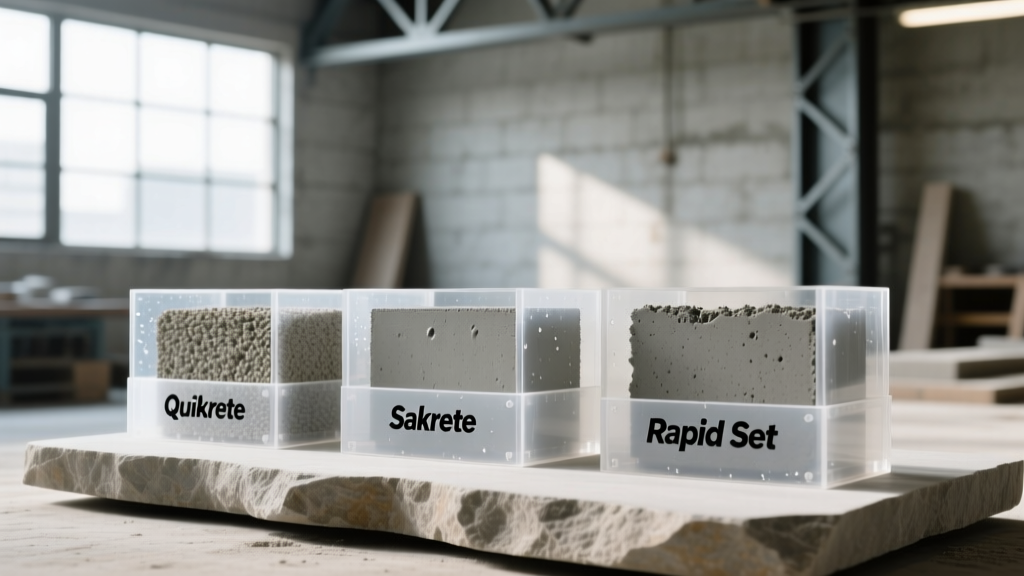
The Chemistry of Speed: How Fast-Setting Concrete Actually Works
When a project demands immediate load-bearing capacity or you are racing against incoming rain, standard Portland cement (which takes 24 to 48 hours to set) is useless. The market for concrete fast set products is dominated by three major players: Quikrete, Sakrete, and CTS Rapid Set. However, not all fast-setting mixes achieve their speed through the same chemical mechanisms. Understanding the difference between chloride-accelerated Portland cement and Calcium Sulfoaluminate (CSA) cement is the single most critical factor in preventing structural failure and rebar corrosion.
Never use chloride-accelerated fast-setting mixes (like standard Quikrete or Sakrete Fast-Setting) in applications containing exposed steel rebar or wire mesh that will be subjected to moisture. The chloride ions break down the passive oxide layer on steel, initiating rapid corrosion. For reinforced structural repairs, you must use a non-chloride CSA-based mix like Rapid Set.
Brand Deep-Dive: Product Line Analysis
1. Quikrete Fast-Setting Concrete Mix
Quikrete’s flagship fast-setting product is a proprietary blend of Portland cement, sand, and coarse aggregate, accelerated primarily with calcium chloride. It is engineered for ease of use in consumer-grade applications like fence post setting and small slab repairs.
- Setting Time: 20 to 40 minutes.
- Compressive Strength: 4,000 PSI at 28 days.
- Water Requirement: Approximately 1.5 quarts per 50 lb bag.
- Best Application: Fence posts, mailbox bases, and non-structural void filling.
- 2026 Average Retail Price: $6.50 - $7.50 per 50 lb bag.
Expert Insight: Quikrete allows for 'dry-pouring' fence posts (pouring the dry mix into the hole and adding water). While this works for lightweight wooden posts, it creates a highly porous matrix. For structural integrity, always pre-mix in a wheelbarrow.
2. Sakrete Fast Setting Concrete Mix
Sakrete’s formulation is chemically very similar to Quikrete, relying on calcium chloride accelerators to speed up the hydration of standard ASTM C150 Portland cement. It is often priced slightly lower and is widely available in big-box hardware stores.
- Setting Time: 30 minutes.
- Compressive Strength: 4,000 PSI at 28 days.
- Water Requirement: 1.25 to 1.5 quarts per 50 lb bag.
- Best Application: Minor driveway patching, step repairs, and post anchoring.
- 2026 Average Retail Price: $5.80 - $6.80 per 50 lb bag.
3. CTS Rapid Set Concrete Mix
Manufactured by CTS Cement, Rapid Set is an entirely different beast. It does not use Portland cement. Instead, it relies on Calcium Sulfoaluminate (CSA) cement, which falls under the ASTM C1600 standard for rapid-hardening hydraulic cement. This chemistry creates ettringite crystals almost instantly upon contact with water.
- Setting Time: 15 minutes.
- Compressive Strength: 7,000 PSI in just 1 hour (exceeds 9,000 PSI at 28 days).
- Water Requirement: 1.15 to 1.5 quarts per 50 lb bag (highly sensitive to over-watering).
- Best Application: Highway repairs, structural slab patching, cold-weather pouring, and reinforced concrete repairs.
- 2026 Average Retail Price: $13.00 - $16.00 per 50 lb bag.
Expert Insight: Because CSA cement does not produce calcium hydroxide (lime) during hydration, it is highly resistant to sulfate attacks and freeze-thaw cycles, making it vastly superior for exterior structural repairs according to the Portland Cement Association (PCA) guidelines on sulfate resistance.
Head-to-Head Performance Matrix
| Feature | Quikrete Fast-Setting | Sakrete Fast Setting | CTS Rapid Set |
|---|---|---|---|
| Base Chemistry | Portland + Chloride | Portland + Chloride | CSA (Non-Chloride) |
| Initial Set Time | 20 - 40 mins | 30 mins | 15 mins |
| 1-Hour PSI | Not Rated | Not Rated | 7,000 PSI |
| 28-Day PSI | 4,000 PSI | 4,000 PSI | 9,000+ PSI |
| Rebar Safe? | No (Corrosion Risk) | No (Corrosion Risk) | Yes |
| Working Time | ~15 mins | ~15 mins | ~5 to 8 mins |
Critical Failure Modes and Application Rules
Fast-setting concrete is notoriously unforgiving. The American Concrete Institute (ACI) frequently highlights accelerated hydration as a primary cause for thermal cracking and flash-setting when handled improperly by non-professionals.
1. The 'Flash Set' Water Trap
The most common mistake with concrete fast set products—particularly Rapid Set—is adding extra water to increase workability. CSA cement requires a precise water-to-cement ratio. If you add an extra half-quart of water to make it 'flow better', you dilute the ettringite crystal matrix. The result is a 'flash set' where the top layer hardens instantly, but the underlying mix turns into a weak, chalky sludge that will never achieve structural strength. Rule: Never exceed the manufacturer's maximum water volume. If it loses workability, discard it; do not re-temper with water.
2. Thermal Cracking from Heat of Hydration
Accelerated mixes generate massive amounts of heat during the curing process. If you pour a fast-setting mix in a thick, unreinforced mass (greater than 12 inches deep in a single lift), the core temperature can exceed 160°F (71°C) while the surface remains cool. This thermal gradient causes severe micro-cracking. Rule: For deep footings, pour in 6-inch lifts, allowing 20 minutes of heat dissipation between layers.
3. Cold Weather Limitations
While fast-setting mixes generate their own heat, they are not immune to freezing. According to the National Ready Mixed Concrete Association (NRMCA), if the ambient temperature drops below 40°F (4°C) and the mix water freezes before the initial set occurs, the expansion of ice will permanently destroy the cement paste. Rule: Use hot water (up to 120°F) to mix fast-setting concrete in cold weather, and insulate the finished surface with curing blankets immediately.
Decision Framework: Which Product Should You Buy?
Selecting the right mix depends entirely on your structural requirements and environmental conditions. Use this framework to make your purchasing decision:
- IF you are setting a wooden fence post or a lightweight mailbox in dry, mild weather, THEN buy Sakrete or Quikrete Fast-Setting. The lower cost is justified, and chloride corrosion is irrelevant since there is no steel.
- IF you are patching a spalled concrete driveway or repairing a structural foundation wall that contains exposed rebar, THEN buy CTS Rapid Set. The non-chloride chemistry protects the steel, and the 7,000 PSI 1-hour strength allows you to drive on the patch the same day.
- IF you are pouring in cold weather (40°F - 50°F) and need the slab to set before the evening temperature drops below freezing, THEN buy CTS Rapid Set. Its rapid heat generation and 15-minute set time will beat the freeze.
- IF you need a long working time to screed a large, smooth surface, THEN avoid all of these. Buy standard concrete mix and add a liquid non-chloride accelerator (like calcium nitrate) to shave a few hours off the set time without sacrificing your 30-minute finishing window.