Burnished vs Polished Concrete Troubleshooting Repair
Master the burnished concrete floor vs polished debate. Learn troubleshooting, repair protocols, and maintenance strategies for commercial floors.

The primary difference between a burnished concrete floor and a polished concrete floor lies in the mechanical process and longevity. Burnishing uses a high-speed machine (1,500 to 3,000 RPM) to melt a chemical guard or wax into the surface for a quick shine, while polishing involves multi-step diamond abrasives and chemical densifiers to mechanically refine the concrete itself. For facility managers, commercial property owners, and concrete contractors dealing with floor degradation, understanding this distinction is critical. Repair protocols for wax-heavy burnished floors differ entirely from the diamond-grinding required for etched polished surfaces.
Key Takeaways
- Process Difference: Burnishing is a surface-level chemical shine; polishing is a deep mechanical refinement.
- Common Burnished Failures: Wax buildup, yellowing, and delamination from improper stripping.
- Common Polished Failures: Acid etching, micro-scratches, and loss of aggregate exposure.
- Repair Strategy: Burnished floors require chemical stripping and re-burnishing; polished floors require mechanical re-honing with resin diamonds.
Core Definitions: Burnished vs. Polished
To troubleshoot effectively, you must first identify the existing floor system. The International Concrete Repair Institute (ICRI) emphasizes that misidentifying the floor type leads to catastrophic repair failures.
What is Burnished Concrete?
Burnished concrete is a trowel-finished concrete slab that has been treated with a chemical hardener and then rubbed with a high-speed burnisher (1,500 to 3,000 RPM) equipped with a soft pad. This process generates friction heat, melting the chemical guard into the pores to create a glossy sheen measuring around 85 gloss units. It is a surface-level treatment that does not mechanically cut the concrete.
What is Polished Concrete?
Polished concrete is a multi-step mechanical process where the concrete surface is ground, honed, and polished using progressively finer diamond abrasives (typically ending at a 400-grit or 800-grit resin). A chemical densifier (usually lithium or sodium silicate) is applied to harden the slab from within. The American Society of Concrete Contractors (ASCC) defines true polished concrete as a mechanically refined surface that relies on the stone aggregate for its aesthetic, rather than topical waxes.
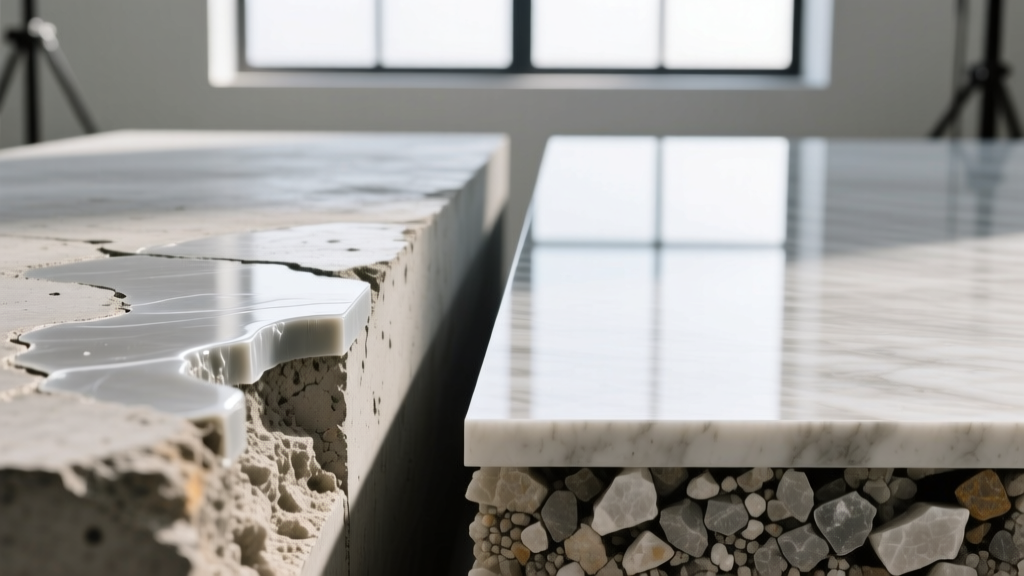
Troubleshooting Common Floor Failures
When a floor loses its luster or begins to degrade, the symptoms will reveal whether you are dealing with a burnished or polished system.
Burnished Concrete Failures
- Wax Buildup and Yellowing: Repeated application of topical guards without proper stripping causes a milky, yellowish haze. This occurs when the chemical layer exceeds 3 to 5 mils in thickness.
- Black Scuff Marks: Because burnished floors rely on a soft topical layer, forklift traffic and rubber-soled shoes easily leave scuffs that embed into the wax.
- Delamination: If the chemical hardener was applied to a slab with high moisture vapor emission rates (MVER), the topical layer will peel or flake under heavy loads.
Polished Concrete Failures
- Acid Etching: Spills from acidic liquids (like battery acid or citrus cleaners) will chemically burn the calcium carbonate in the concrete, leaving dull, rough spots.
- Micro-Scratching: Dragging heavy metal equipment without protective pads will leave visible swirl marks in the mechanically refined surface.
- Dulling from Traffic: High foot traffic in entryways will eventually wear down the top microscopic layer of the polish, reducing light reflectivity.
Repair Protocols: Restoring the Shine
Repairing these floors requires entirely different tooling and chemical approaches.
Fixing Burnished Concrete
- Strip the Surface: Apply an alkaline or solvent-based floor stripper designed for concrete waxes. Agitate with a black scrub pad on an auto-scrubber.
- Neutralize and Rinse: Extract the slurry completely. Any residual stripper will prevent the new guard from bonding.
- Re-apply Guard: Apply a fresh coat of lithium-silicate or acrylic guard.
- Burnish: Run a high-speed propane or electric burnisher at 2,000 RPM to melt the guard into the pores.
Fixing Polished Concrete
- Assess the Damage: Determine the depth of the etch or scratch. Deep scratches require a return to metal-bond diamonds.
- Mechanical Honing: Use a planetary grinder equipped with 100-grit or 200-grit transitional diamonds to remove the damaged layer. According to American Society of Concrete Contractors guidelines, always follow the original grit progression.
- Re-densify: Apply a lithium silicate densifier to the exposed concrete to restore surface hardness.
- Final Polish: Progress through 400-grit and 800-grit resin pads to restore the optical clarity and light reflectivity.
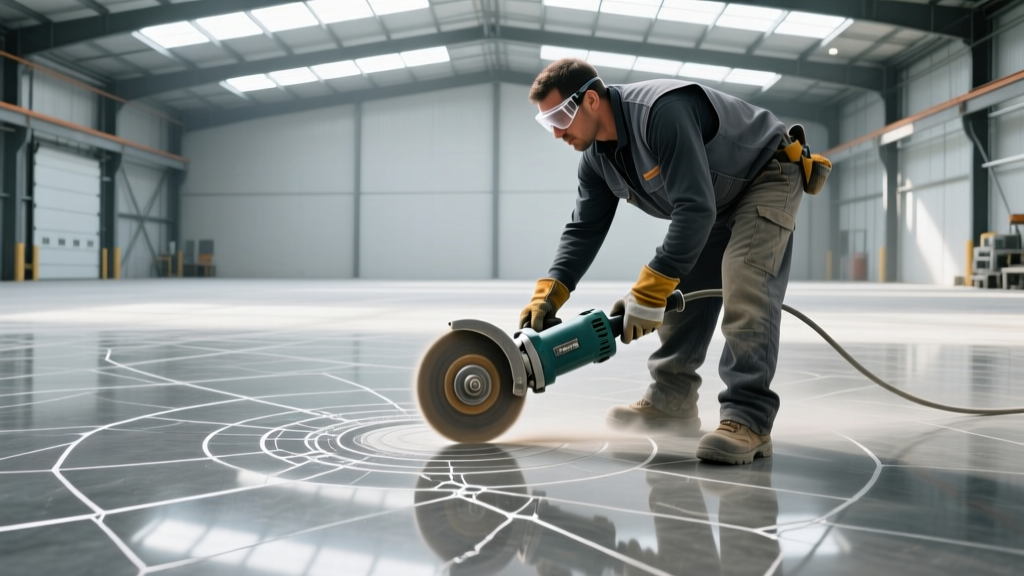
Troubleshooting Decision Matrix
Use this framework to quickly diagnose the floor type and select the correct repair path.
| Diagnostic Test | Burnished Concrete Result | Polished Concrete Result |
|---|---|---|
| Solvent Test (Apply acetone to a rag and rub) | Rag picks up waxy residue; surface becomes dull. | No residue on rag; surface remains unchanged. |
| Scratch Test (Drag a key lightly) | Leaves a visible scratch in the soft topical layer. | No scratch visible on the hardened, densified surface. |
| Repair Cost Estimate | $0.50 to $1.50 per square foot (chemical stripping). | $2.50 to $5.00 per square foot (mechanical grinding). |
Frequently Asked Questions
Can you polish a burnished concrete floor?
Yes, but you must completely strip the topical waxes and chemical guards first. If any burnishing compound remains, it will clog the diamond tooling and cause severe overheating during the mechanical grinding process. Once stripped, the slab can be processed through standard diamond grit progressions.
How do you fix a dull polished concrete floor?
A dull polished floor is usually suffering from surface micro-scratches or chemical etching. The fix requires cleaning the slab with a neutral pH cleaner, followed by a light mechanical pass with a 400-grit or 800-grit resin diamond pad on a high-speed buffer to restore the optical clarity without removing the aggregate exposure.
How long does burnished concrete last compared to polished?
A properly maintained burnished floor lasts 3 to 5 years before requiring a full strip-and-recoat cycle. In contrast, a mechanically polished and densified concrete floor can last 10 to 15 years or more in high-traffic commercial environments before needing a mechanical re-hone.
Conclusion and Next Steps
Choosing the right repair method hinges entirely on accurately identifying whether your slab relies on a topical burnished shine or a mechanically polished surface. Misapplying a wax stripper to a polished floor, or attempting to diamond-grind a wax-heavy burnished floor, will result in wasted labor and ruined tooling. To resolve your flooring issues, start by performing the acetone solvent test outlined in the decision matrix to confirm the floor type, then procure the appropriate chemical strippers or resin diamond pads to execute the correct restoration protocol.
Written by
James ThorntonJames Thornton is a construction industry veteran with 25 years of hands-on experience in wood framing, lumber grading, and residential building codes. He started as a framing carpenter in rural Oregon, earned his ICC Residential Building Inspector certification, and eventually became a senior plan reviewer for the City of Portland Bureau of Development Services. James holds a B.S. in Wood Science & Technology from Oregon State University and is a certified lumber grader through the West Coast Lumber Inspection Bureau (WCLIB). He has inspected over 3,000 residential construction sites and authored the city's internal guide on advanced framing techniques (2x6 at 24" O.C.). James lives in Bend, OR, where he builds custom timber-frame cabins and competes in lumberjack sports.
More from James Thornton
View all
Insulation
Best Home Insulation Materials: Complete 2026 Guide
Compare top home insulation materials for 2026. Find R-values, installed costs per square foot, and best uses for fiberglass, spray foam, and mineral wool.
Aug 4, 2026

Sustainable Building
Certify Your Green Building Material for LEED and WELL
Step-by-step guide to certifying a green building material for LEED v5 and WELL v2. Master EPDs, HPDs, and VOC limits for 2026 project specifications.
Aug 4, 2026

Stone & Masonry
Veneer Stacked Stone Panels: Interior Design & Style Showcase
Discover how veneer stacked stone panels transform interiors. Explore modern design profiles, material pairings, and technical installation specs.
Aug 4, 2026