Black Top vs Concrete Driveway: 2026 Cost & Lifespan Guide
Compare black top vs concrete driveway costs, lifespans, and structural specs. Expert 2026 guide on asphalt vs concrete paving for your home.
The Core Material Difference: Bitumen vs. Portland Cement
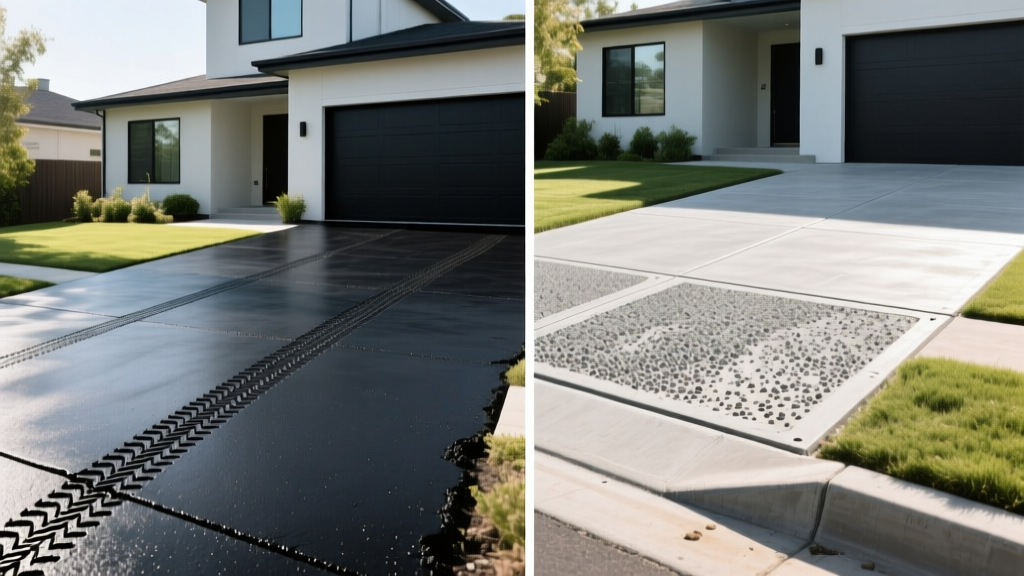
Choosing between a black top vs concrete driveway requires looking past the initial paving quote and understanding the chemical binders holding your aggregate together. Asphalt (black top) relies on bitumen, a viscous petroleum byproduct that acts as a flexible, waterproof glue. Concrete utilizes Portland cement, a calcined limestone and clay powder that undergoes a hydration reaction to form a rigid, high-compression stone matrix.
This fundamental difference in binder chemistry dictates how each material handles thermal expansion, vehicular shear stress, and long-term UV degradation. In 2026, material science has introduced Portland-Limestone Cement (PLC) which reduces the carbon footprint of concrete driveways by up to 10% without sacrificing compressive strength, while Warm Mix Asphalt (WMA) technologies allow asphalt paving at lower temperatures, improving compaction density in cooler shoulder seasons.
Quick Decision Matrix
- Choose Black Top If: Your budget is strictly capped below $10/sq ft, you live in a region with rapid freeze-thaw cycles where rigid slabs heave, or you need a usable surface within 48 hours.
- Choose Concrete If: You park heavy RVs or boats (requiring >5,000 PSI load bearing), you want a 40+ year lifespan, your HOA mandates light-colored paving to reduce urban heat island effects, or you desire stamped/decorative finishes.
2026 Installed Cost Breakdown
The financial comparison of a black top vs concrete driveway extends far beyond the day-one installation. While asphalt is significantly cheaper to install, its mandatory maintenance schedule narrows the lifetime cost gap. Below is the current national average pricing for a standard 600-square-foot residential driveway, assuming moderate site grading and standard soil conditions.
| Cost Factor | Black Top (Asphalt) | Concrete |
|---|---|---|
| Subgrade Excavation & Base Prep | $1.50 - $2.50 / sq ft | $2.00 - $3.50 / sq ft |
| Material & Installation | $5.50 - $9.00 / sq ft | $10.00 - $18.00 / sq ft |
| Decorative Finishing (Optional) | N/A | $4.00 - $12.00 / sq ft |
| Total Initial Installed Cost | $7.00 - $11.50 / sq ft | $12.00 - $21.50 / sq ft |
| Mandatory 20-Year Maintenance | $3.50 - $5.00 / sq ft (Sealcoating) | $0.80 - $1.50 / sq ft (Penetrating Sealer) |
According to data aggregated by the Portland Cement Association, while concrete demands a premium upfront, its 30-to-50-year lifecycle often results in a lower cost-per-year of service compared to asphalt, which typically requires full-depth reclamation after 20 to 25 years.
Climate Performance and Thermal Dynamics
The Albedo Effect and Heat Deflection
Surface albedo—the measure of how much solar radiation a material reflects—drastically impacts driveway performance and local microclimates. Fresh asphalt has an albedo of roughly 0.05 to 0.10, meaning it absorbs up to 95% of solar energy. On a 95°F summer day, an unprotected black top driveway can reach surface temperatures exceeding 150°F. This extreme heat softens the bitumen binder, making the surface susceptible to permanent rutting from stationary vehicle loads (like car tires sitting in the same spot for weeks).
Concrete, conversely, boasts an albedo of 0.30 to 0.50. It reflects significantly more sunlight, keeping surface temperatures up to 30°F cooler than asphalt. This makes concrete the superior choice in southern climates where UV degradation and thermal softening destroy asphalt binders prematurely.
Freeze-Thaw Cycles and Base Heaving
In northern climates, the black top vs concrete driveway debate shifts to flexibility. Asphalt is a viscoelastic material; it bends slightly with minor subgrade shifts caused by frost heave. Concrete is entirely rigid. If the soil beneath a concrete slab expands unevenly during freezing, the slab will crack unless it is properly jointed and reinforced. However, modern concrete mix designs utilize air-entraining admixtures (per ASTM C260) that create microscopic air bubbles, giving the freezing water inside the concrete capillaries room to expand without spalling the surface.
Subgrade Preparation: The Hidden Failure Point
Both materials will fail catastrophically if placed on poorly compacted soil. The Federal Highway Administration notes that over 70% of premature pavement distress originates in the subgrade or base layers, not the surface material.
- For Asphalt: Demand a 6-to-8-inch crushed aggregate base (typically 3/4-inch minus gravel) compacted to 95% Standard Proctor density. Asphalt is only as strong as the base beneath it; it has virtually no structural bridging capacity over soft soils.
- For Concrete: A 4-to-6-inch compacted granular subbase is required to provide uniform support and prevent moisture from being trapped directly beneath the slab, which can lead to mud boils and slab settling.
Structural Specifications: What to Put in Your Contract
Never accept a contractor's verbal assurance of "standard thickness." Your contract must explicitly state the following material specifications to ensure structural integrity.
⚠️ Warning: Asphalt Binder Grades
Ensure your contractor uses the correct Performance Grade (PG) bitumen for your climate. For example, a PG 64-22 binder is engineered to resist rutting at 64°C and thermal cracking down to -22°C. Using a cheaper, mismatched binder grade is a common cause of premature alligator cracking.
Concrete Driveway Specs
- Compressive Strength: Minimum 4,000 PSI at 28 days (ASTM C94).
- Thickness: 4 inches for standard passenger vehicles; 5 to 6 inches for driveways supporting RVs, dump trailers, or boat hoists.
- Reinforcement: 5/8-inch steel rebar on 2-foot centers, or 6x6 W2.9xW2.9 welded wire mesh placed in the upper third of the slab.
- Jointing: Control joints cut to a depth of 25% of the slab thickness, spaced in feet no more than 2 to 3 times the slab thickness in inches (e.g., a 4-inch slab needs joints every 8 to 12 feet).
Black Top Driveway Specs
- Surface Course: 2.5 to 3 inches of compacted Hot Mix Asphalt (HMA) or Superpave mix.
- Binder Course: For heavy-load driveways, an additional 1.5-inch binder course beneath the surface layer is highly recommended.
- Compaction: Must be rolled with a vibratory steel drum roller followed by a pneumatic tire roller to achieve a minimum of 92% theoretical maximum density.
Maintenance Realities and Failure Modes
"The biggest misconception homeowners have is that concrete is 'maintenance-free.' While it doesn't need the frequent, messy sealcoating of asphalt, unsealed concrete will absorb de-icing salts and chlorides, leading to rebar corrosion and surface scaling within a decade." — Pavement Engineering Guidelines, National Asphalt Pavement Association
Asphalt Maintenance Timeline
Asphalt begins oxidizing and losing its volatile oils the moment it is exposed to UV light and oxygen, turning from a rich black to a brittle gray. You must apply a coal tar or asphalt emulsion sealcoat 90 days after installation, and repeat this process every 3 to 5 years. Failure to do so results in raveling (loss of aggregate) and water infiltration that destroys the base layer.
Concrete Maintenance Timeline
Concrete requires a breathable, penetrating silane/siloxane sealer applied every 5 to 7 years. Unlike asphalt sealers that sit on top of the surface and create a wear layer, siloxane sealers penetrate the pores and react chemically to repel water and chlorides while allowing internal moisture vapor to escape. Never use a topical acrylic sealer on exterior concrete driveways; it will trap moisture, turn white, and peel within a single winter.
Final Verdict: Aligning Material with Application
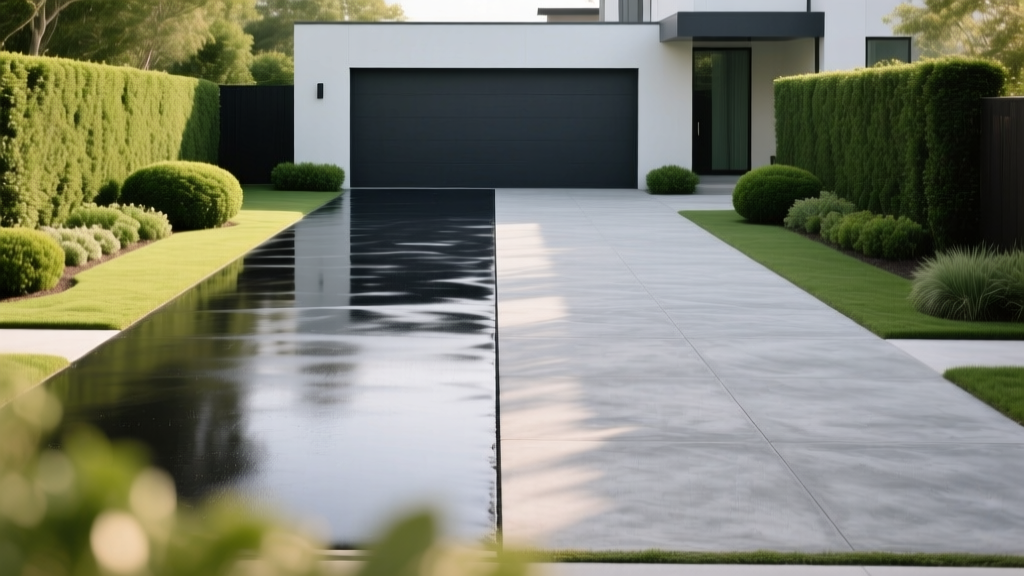
There is no universal winner in the black top vs concrete driveway debate; the correct choice is dictated by your specific site conditions and financial timeline. If you are building in a heavily wooded, shaded lot where tree roots will inevitably shift the subgrade, asphalt's flexibility and lower repair costs make it the pragmatic choice. If you are paving a wide, sun-exposed approach in a hot climate, and plan to remain in the home for decades, concrete's thermal stability, structural rigidity, and superior lifespan offer the highest long-term return on investment.
Written by
David NakamuraDavid Nakamura is a licensed architect (AIA) and construction technology writer focused on sustainable building methods, mass timber engineering, and high-performance building envelopes. He holds a Master of Architecture from the University of Washington and is a certified Passive House Consultant (CPHC). David spent eight years at the Seattle firm Mithun, where he led the design of three LEED Platinum projects, before founding his own practice specializing in net-zero residential design. He serves on the editorial advisory board of GreenBuilder Magazine and has authored peer-reviewed papers on cross-laminated timber (CLT) connections for the Journal of Structural Engineering. In his spare time, David teaches woodworking at Pratt Fine Arts Center and kayaks the Puget Sound.
More from David Nakamura
View all
Construction Cost
Labor Cost to Build a Deck Per Sq Ft: 2026 Installation Guide
Discover the exact labor cost to build a deck per sq ft in 2026. This installation guide breaks down contractor rates, complexity factors, and hidden fees.
Aug 4, 2026

Construction Cost
How Much Does It Cost to Build a 3 Bedroom House? Financing Guide
Learn exactly how much it costs to build a 3 bedroom house and explore 2026 financing options, construction loan types, and budget frameworks for your build.
Aug 4, 2026

Construction Cost
Cost to Build a Tennis Court: 2026 Guide
How much does it cost to build a tennis court in 2026? Breakdowns for asphalt, concrete, and synthetic surfaces plus fencing and lighting.
Jul 30, 2026