Concrete Roads vs Asphalt: Troubleshooting and Repair Guide
Compare concrete roads vs asphalt repair protocols. Diagnose pavement distress, evaluate slab jacking vs infrared patching, and analyze lifecycle costs.

Diagnosing Pavement Distress: Rigid vs. Flexible Mechanics
When evaluating concrete roads vs asphalt from a maintenance perspective, the fundamental difference lies in their structural mechanics. Concrete is a rigid pavement that distributes loads across a wide area of the subgrade through slab action. Asphalt is a flexible pavement that relies on the structural integrity of its underlying aggregate base and subgrade layers to prevent deformation. Consequently, their failure modes and troubleshooting protocols are entirely distinct.
Failure Mode Comparison Matrix
| Distress Type | Concrete (Rigid) | Asphalt (Flexible) |
|---|---|---|
| Load-Related | Transverse/Longitudinal cracking, corner breaks | Alligator (fatigue) cracking, rutting |
| Environmental | Joint spalling, faulting, D-cracking | Thermal cracking, raveling, oxidation |
| Moisture/Subgrade | Pumping, void-induced settlement | Potholes, edge cracking, base stripping |
Concrete Road Troubleshooting & Repair Protocols
Concrete pavement repair focuses on restoring load transfer efficiency across joints and stabilizing the slab foundation. The National Concrete Pavement Technology Center emphasizes that proactive joint maintenance is the single most cost-effective intervention for rigid pavements.
1. Joint Spalling and Faulting
Faulting occurs when one slab edge drops relative to the adjacent slab, typically exceeding the critical threshold of 0.125 inches. This destroys ride quality and accelerates spalling (the breaking away of concrete at the joint).
- Troubleshooting: Check for incompressible materials (rocks, debris) in the joint sealant reservoir causing lock-up during thermal expansion.
- Repair (Sealing): Route the joint to a clean 1/2-inch by 1/2-inch reservoir. Blow out with high-pressure, oil-free compressed air. Install a closed-cell polyethylene backer rod and fill with a hot-poured silicone sealant (e.g., Crafco 790 or Dow Corning 888) meeting ASTM C1512 standards.
- Repair (Faulting): If faulting exceeds 0.125 inches, diamond grinding is required to restore the longitudinal profile. Grinding removes 1/8 to 1/4 inch of the higher slab edge. Cost: $3.50 to $6.00 per square yard.
2. Void-Induced Slab Settlement (Slab Jacking)
When water infiltrates through failed joints, it washes away the subbase fines (pumping), creating voids under the slab. Heavy axle loads then cause the unsupported slab to crack or settle.
- Mapping: Use ground-penetrating radar (GPR) or tap the slab with a sounding hammer to map void perimeters.
- Drilling: Drill 5/8-inch injection holes in a staggered pattern, typically 4 to 6 feet apart, avoiding the slab edges by at least 12 inches.
- Injection: Inject two-part HDPE structural foam (e.g., Alchemy-Spetec Deep Lift). The material expands 15-20 times its liquid volume, generating up to 7,000 psf of lifting force.
- Monitoring: Use a laser transit or digital level to monitor the lift in real-time, stopping injection once the slab reaches the target grade.
- Patching: Plug the 5/8-inch holes with a rapid-setting, non-shrink hydraulic cement grout.
Cost: $5.00 to $8.50 per square foot. Curing time: 15 minutes before opening to heavy traffic.
Asphalt Road Troubleshooting & Repair Protocols
Asphalt repair is highly dependent on the temperature and the depth of the distress. The Asphalt Institute categorizes asphalt distresses into surface, intermediate, and structural failures, each requiring a different mill-and-fill or patching approach.
1. Alligator Cracking and Base Failure
Interconnected longitudinal and transverse cracks resembling alligator skin indicate that the underlying aggregate base or subgrade has failed, usually due to moisture intrusion and repeated heavy loading. Patch-sealing the surface is a temporary band-aid that will fail within months.
- Troubleshooting: Extract a core sample to measure the depth of moisture penetration and check for stripping (separation of the asphalt binder from the aggregate).
- Repair (Full-Depth Reclamation): Mill out the distressed asphalt to a depth of 4 to 6 inches. Pulverize the remaining failing base material and mix it with a stabilizing agent (Portland cement or foamed asphalt). Compact the new stabilized base and overlay with 2 inches of hot-mix asphalt (HMA) using a polymer-modified PG 64-22 binder for high rut-resistance.
2. Surface Rutting and Raveling
Rutting (longitudinal depressions in the wheel path) confined to the top 1.5 inches is a mix-design issue, not a subgrade issue. Raveling (loss of aggregate from the surface) indicates binder oxidation.
- Troubleshooting: Place a 4-foot straightedge across the rut. If the rut is deeper than 0.5 inches, it requires milling before overlay to prevent reflective cracking.
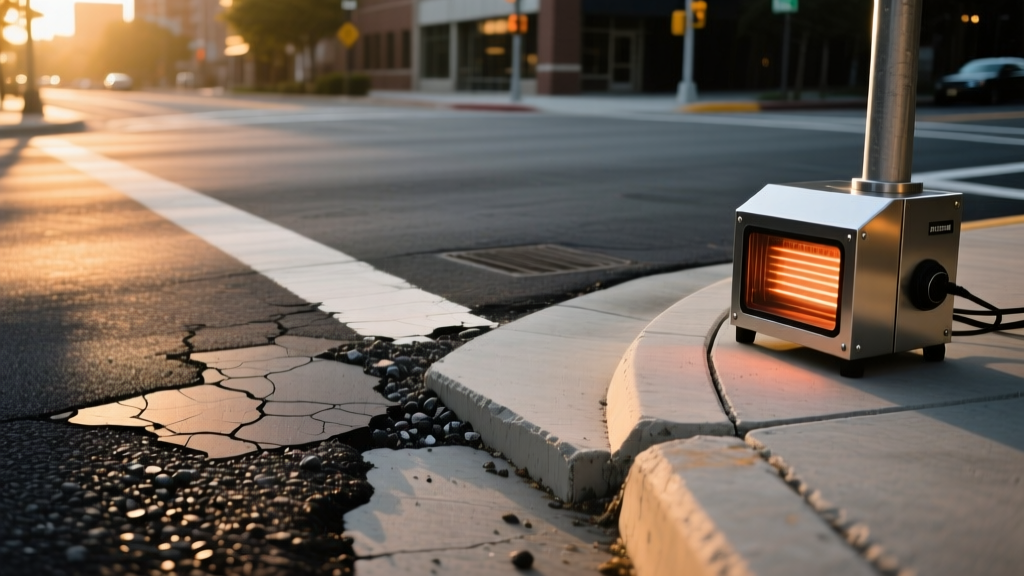
- Repair (Infrared Thermal Patching): For localized raveling or shallow potholes, use an infrared heater to soften the existing asphalt to 300°F. Rake the material, add a small amount of fresh HMA and rejuvenator, and compact. This creates a seamless, thermal bond with the surrounding mat, eliminating the water-intrusion seams common in cold-patch 'throw-and-go' repairs. Cost: $3.00 to $5.00 per square foot.
20-Year Maintenance & Repair Cost Matrix
When comparing concrete roads vs asphalt for municipal or private infrastructure planning, initial installation costs only tell half the story. The Federal Highway Administration (FHWA) lifecycle cost analysis models show that rigid pavements require higher initial capital but significantly lower cumulative maintenance expenditures over a 40-year design life.
| Metric | Concrete (Rigid) | Asphalt (Flexible) |
|---|---|---|
| Initial Installation | $7.00 - $11.00 / sq ft | $4.50 - $7.50 / sq ft |
| First Major Intervention | Year 15-20 (Joint resealing, localized slab replacement) | Year 8-12 (Mill and 2-inch overlay) |
| 20-Year Cumulative Maintenance | $1.50 - $3.00 / sq ft | $4.00 - $7.00 / sq ft |
| Primary Repair Equipment | Diamond grinders, HDPE injection rigs, concrete saws | Milling machines, infrared heaters, vibratory rollers |
Advanced Intervention: Concrete Overlays on Failed Asphalt
When an asphalt road suffers from chronic, recurring base failures that make continuous mill-and-fill operations economically unviable, the ultimate troubleshooting solution is an unbonded concrete overlay, often referred to as 'whitetopping'.
This technique involves milling the top 1 to 2 inches of the severely distressed asphalt to establish a precise grade, then pouring a 4- to 6-inch layer of high-strength concrete directly over the remaining asphalt. The existing asphalt acts as a stable, moisture-resistant base layer. To prevent random thermal cracking in the new concrete, joints are saw-cut at a tight grid—typically 6 feet by 6 feet. This intentionally induces micro-cracking at the joints, distributing the thermal and load stresses evenly across thousands of small 'slabs' rather than a few massive ones.
Whitetopping bridges over localized soft spots in the subgrade that would quickly destroy a new asphalt overlay, effectively converting a failing flexible pavement into a permanent rigid pavement with a 30+ year remaining service life.
Written by
Sarah WhitfieldSarah Whitfield is a chartered quantity surveyor (MRICS) and construction cost analyst with 15 years of experience in material pricing, procurement strategy, and project budgeting. She earned her degree in Construction Management from the University of Reading (UK) and has worked on projects ranging from $2M custom homes to $180M mixed-use developments across North America and Europe. Sarah currently leads cost estimating for BuildMat Insight, maintaining a proprietary database of 4,000+ material price points updated quarterly. She is a frequent contributor to RSMeans cost data panels and has presented at the International Cost Engineering Council (ICEC) congress. Based in Denver, CO, Sarah is an avid trail runner and volunteer mentor for Women in Construction.
More from Sarah Whitfield
View all
Wood & Lumber
What Are the Different Types of Wood? A Builder's Guide
Compare structural softwoods, finish hardwoods, and engineered lumber. Analyze Janka ratings, MOE values, and 2026 pricing for construction.
Aug 4, 2026

Walls & Panels
Steel Framing vs Wood Framing: Corrosion and Moisture Defense
Compare steel framing vs wood framing for moisture resistance. Learn about galvanized coatings, condensation risks, and corrosion protection strategies.
Jul 21, 2026

Stone & Masonry
How to Cut Stone Veneer: Wet Saw vs Grinder Comparison
Compare the best tools for cutting stone veneer. We review wet saws, angle grinders, and chop saws to help you achieve clean, chip-free cuts.
Jul 21, 2026