What Are the Different Types of Concrete Finishes? A Technical Guide
Explore the technical specifications, F-number tolerances, and ASTM standards for different types of concrete finishes in commercial and residential flatwork.

Flatwork Tolerance and F-Number Specifications
Before selecting a surface treatment, structural engineers and architects must define the geometric tolerances of the slab. The American Concrete Institute (ACI) utilizes the F-Number system, outlined in ACI 117 and ACI 302.1R, to quantify floor flatness (FF) and levelness (FL). Standard commercial flatwork requires a minimum Overall FF of 20 and FL of 15. However, high-tolerance defined-traffic aisles, such as those in Very Narrow Aisle (VNA) warehouses utilizing wire-guided forklifts, demand an FF of 50 and FL of 35 or higher. The chosen finish must not compromise these tolerances; for instance, aggressive broom finishing can artificially lower FF numbers by introducing surface undulations if not executed with precision-guided floats.
Technical Breakdown of Standard Concrete Finishes
Concrete finishing is not merely an aesthetic choice; it dictates the surface abrasion resistance, coefficient of friction, and long-term durability of the slab. Below are the exact technical parameters for the most specified finishes in modern construction.
Broom Finish (Exterior and Slip-Resistant Applications)
Specified for exterior walkways, bridge decks, and municipal ramps, the broom finish relies on macro-texture to provide slip resistance. The technical target is a macro-texture depth of 0.04 to 0.08 inches, measured via the ASTM E965 sand patch test.
- Tooling: Use a 1/16-inch to 1/8-inch diameter polypropylene bristle broom. Nylon bristles are too stiff and will tear the surface paste; natural bristles absorb too much water and flatten out.
- Execution Timing: Brooming must occur after bleed water has evaporated but before the surface plasticity drops below the point of deformation. Dragging the broom too early causes ridge slumping; dragging too late causes surface tearing and aggregate dislodgement.
- Directionality: Brooming should be pulled transversely (perpendicular to the primary direction of travel) to maximize water channeling and hydroplaning resistance.
Steel Troweled and Burnished Finish (Interior and Commercial)
Steel troweling densifies the top 1/8-inch of the concrete matrix, creating a low-porosity, high-abrasion surface. For heavy-duty industrial floors, specifications often require compliance with ASTM C779 (Standard Test Method for Abrasion Resistance of Horizontal Concrete Surfaces), targeting a maximum depth of wear of 0.020 inches at 60 minutes.
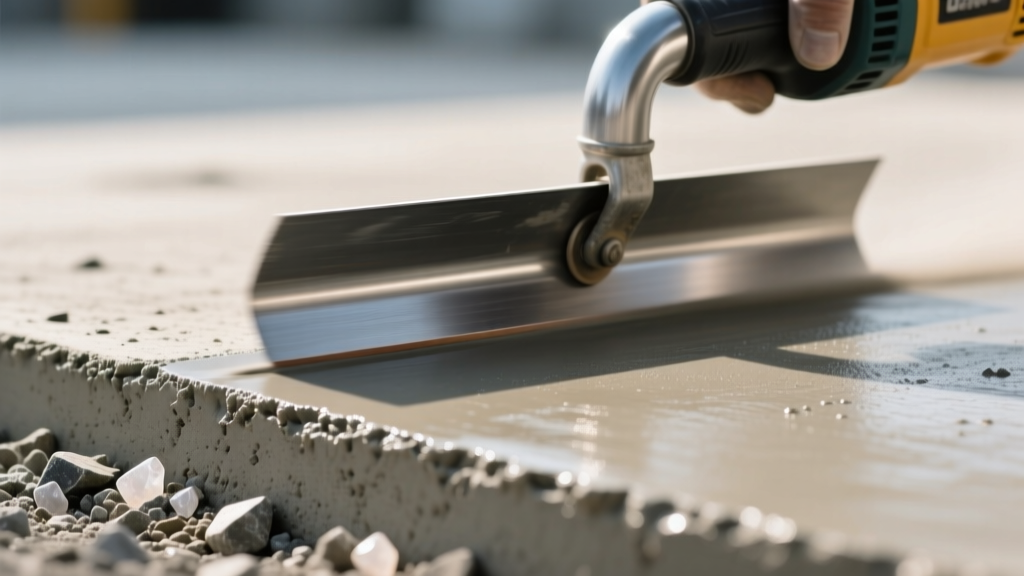
Burnished Finishes: A subset of steel troweling, burnishing involves high-speed rotary trowels (150+ RPM) equipped with composite or steel blades tilted at a steep angle (15 to 20 degrees). This friction-generates heat, vitrifying the cement paste and achieving a gloss level of 40-60 on a 60-degree gloss meter without the application of topical sealers.
Exposed Aggregate (Decorative and Heavy Traffic)
Exposed aggregate finishes remove the surface cement paste to reveal the underlying coarse aggregate, providing exceptional skid resistance and hiding surface wear. The technical specification requires an exposure depth equal to exactly one-third of the maximum aggregate diameter (e.g., exposing 1/4-inch of a 3/4-inch stone).
- Chemical Retarders: A surface retarder (typically a sugar-based or phosphonate solution) is sprayed at a rate of 200 to 300 square feet per gallon immediately after final floating. This penetrates 1/4-inch and delays the hydration of the surface paste by 12 to 24 hours.
- Wash-off Window: The washing process must begin when the underlying concrete has achieved sufficient compressive strength (typically 500 to 1,000 psi) to lock the aggregate in place, but before the retarded surface paste carbonates and hardens. Water pressure must be strictly regulated between 1,500 and 2,500 PSI to avoid dislodging the coarse aggregate.
Stamped and Imprinted (Architectural Flatwork)
Stamped concrete utilizes polyurethane mats to impart textures (e.g., slate, cobblestone) into the plastic surface. The structural integrity of stamped concrete relies heavily on the release agent and subsequent sealing specifications.
- Release Agents: Liquid or powdered release agents must be applied at 3 to 5 pounds per 100 square feet. This prevents the polyurethane mats from bonding to the cement paste and introduces secondary color variations.
- Sealer Mil-Thickness: Stamped concrete must be sealed with a solvent-based acrylic or polyurethane sealer. The specification must mandate a dry film thickness (DFT) of 2.0 to 3.0 mils. Applying thicker than 4.0 mils traps moisture vapor, causing the sealer to blush (turn white) and lose adhesion.
Finish Selection Matrix: Performance vs. Application
The following matrix provides a comparative framework for specifying finishes based on quantifiable performance metrics.
| Finish Type | Slip Resistance (DCOF) | Abrasion Resistance | Typical FF/FL Requirement | Primary Failure Mode |
|---|---|---|---|---|
| Broom | High (> 0.60) | Moderate | FF 20 / FL 15 | Ridge slumping, scaling |
| Steel Trowel | Low (0.42 - 0.50) | High | FF 35 / FL 25 | Delamination, crazing |
| Burnished | Very Low (< 0.40) | Very High | FF 50 / FL 35 | Blade marks, dusting |
| Exposed Agg. | Very High (> 0.70) | Extreme | FF 15 / FL 10 | Aggregate pop-outs |
| Stamped | Moderate (0.50 - 0.60) | Low (Sealer dependent) | FF 20 / FL 15 | Sealer blushing, flaking |
Note: DCOF (Dynamic Coefficient of Friction) is measured per ANSI A137.1 standards using a tribometer. Values > 0.42 are generally considered safe for level interior surfaces, while exterior slopes require > 0.60.
Critical Curing and Evaporation Rate Specifications
The success of any concrete finish is inextricably linked to the evaporation rate of bleed water and the subsequent curing protocol. According to the Portland Cement Association, finishing operations must be halted if the evaporation rate exceeds 0.2 pounds per square foot per hour. Exceeding this threshold leads to plastic shrinkage cracking, which manifests as shallow, diagonal fissures before the concrete achieves initial set.
Curing Compound Application: For broomed and troweled finishes, ASTM C309 Type 1-D (white-pigmented, resin-based) curing compounds must be applied at exactly 200 square feet per gallon. Applying at 300 sq ft/gal results in a film thickness below 1.0 mil, failing to retain the necessary 95% internal relative humidity required for continuous cement hydration. For exposed aggregate, curing must be delayed until the wash-off process is 100% complete, typically utilizing wet burlap or ASTM C171 sheet curing to avoid trapping curing compound residues in the aggregate voids.
Common Specification Failures and Edge Cases
Even with perfect mix designs, field execution errors compromise the technical specifications of the finish. Recognizing these edge cases is critical for quality assurance inspectors and project managers.
- Surface Crusting and Delamination: Caused by applying a dry-shake hardener or initiating steel troweling while bleed water is still present. The surface seals, trapping water and air. Fix: Strict adherence to the 'footprint test' (1/4-inch max indentation) before any mechanical troweling begins.
- Plastic Shrinkage Cracking in Stamped Concrete: Because stamping requires a stiffer mix (lower slump, typically 3-4 inches) and extended working times, the surface is highly vulnerable to rapid moisture loss. Fix: Mandatory use of evaporation retarders and shading structures during the stamping window.
- Over-Washing Exposed Aggregate: Using water pressure exceeding 3,000 PSI or washing before the concrete reaches 500 psi compressive strength dislodges the coarse aggregate, leaving deep voids that compromise the structural wear surface. Fix: Cast test cylinders and perform field wash-tests on mock-up panels to calibrate exact pressure and timing windows.
Written by
Priya KapoorPriya Kapoor is a real estate market analyst and construction economics researcher with expertise in housing affordability, development feasibility, and infrastructure investment. She holds a Master of Regional Planning from Cornell University and previously worked as a senior analyst at CBRE's Investment Properties group, where she modeled returns for $4B in mixed-use development pipelines. Priya now runs an independent research practice advising developers, municipalities, and REITs on construction cost forecasting and market timing. She publishes the quarterly "BuildMat Market Pulse" report tracking material price indices across 12 commodity categories. Based in Austin, TX, Priya serves on the board of Habitat for Humanity Austin and is a marathon runner.
More from Priya Kapoor
View all
Construction Cost
Cost to Build a 1600 Sq Ft Home in 2026: Full Breakdown
Accurate 2026 cost to build a 1600 sq ft home—material, labor, and regional pricing breakdowns included. Plan your budget with real-time estimates.
Aug 11, 2026

Wood & Lumber
Name the Types of Wood for Pressure Treatment and Preservation
Learn how to name the types of wood best suited for pressure treatment. Compare species treatability, chemical retention levels, and 2026 preservation costs.
Aug 4, 2026

Stone & Masonry
Stone Veneer Suppliers Lindenhurst: 2026 Cost Analysis
Analyze 2026 stone veneer costs in Lindenhurst, NY. Compare local supplier pricing, delivery fees, and Suffolk County installation labor rates.
Aug 4, 2026