Concrete Bricks vs Clay Bricks: 2026 Cost Breakdown Analysis
Compare the true costs of concrete bricks vs clay bricks in 2026. Detailed breakdown of material, labor, maintenance, and lifetime masonry expenses.
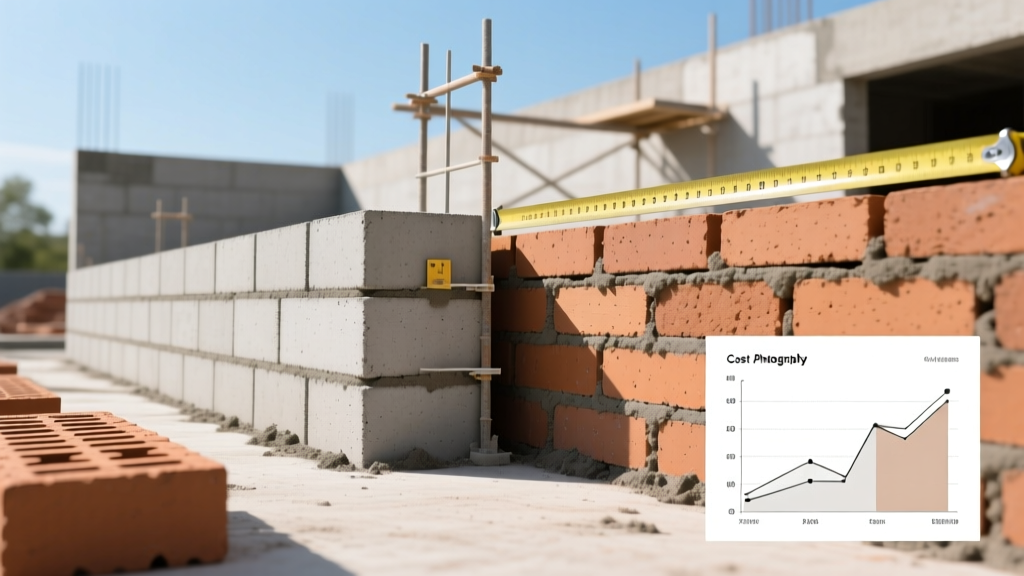
The True Cost of Masonry: Beyond the Per-Brick Price Tag
When evaluating masonry options for structural walls, veneers, or landscaping, builders and homeowners frequently fixate on the unit price of a single brick. However, a comprehensive cost analysis of concrete bricks vs clay bricks requires looking far beyond the initial material purchase. The financial reality of masonry encompasses delivery logistics, waste factors, specialized labor rates, mortar compatibility, and long-term maintenance. In 2026, shifting environmental regulations on cement kilns and clay mining have altered the pricing landscape, making a side-by-side lifecycle cost analysis essential for accurate project budgeting.
2026 Quick Cost Snapshot (Per 1,000 Units)
Standard Concrete Bricks: $550 – $850 (Material Only)
Standard Modular Clay Bricks: $750 – $1,200 (Material Only)
Average Installed Cost (Both): $18.00 – $28.00 per square foot
Material Costs Head-to-Head
The base material cost is where concrete bricks traditionally hold the advantage. Concrete bricks are manufactured using Portland cement, aggregates, and water, cured in high-pressure steam kilns. This process is highly automated and relies on widely available, inexpensive raw materials. Clay bricks, conversely, require mining specific shale and clay deposits, followed by extrusion, drying, and firing in high-temperature kilns (often exceeding 2,000°F), which consumes significantly more energy.
| Cost Metric | Concrete Brick (Standard) | Clay Brick (Modular) |
|---|---|---|
| Unit Price Range | $0.55 – $0.85 | $0.75 – $1.20 |
| Cost per Square Foot (Material) | $3.85 – $5.95 | $5.25 – $8.40 |
| Standard Waste Factor | 3% – 5% | 5% – 8% |
| Pallet Weight (Approx.) | 3,200 lbs | 2,800 lbs |
The waste factor is a frequently overlooked variable. Clay bricks are more brittle prior to installation and require more precise cutting for corners and window bucks, leading to higher breakage rates on the job site. Concrete bricks, being more uniform and slightly more impact-resistant during transit, yield a lower waste percentage, preserving your budget on large-scale commercial builds.
Labor, Mortar, and Installation Variables
Masonry labor rates in 2026 average between $85 and $130 per hour, depending on regional unionization and the complexity of the bond pattern. While the physical act of laying a concrete brick versus a clay brick is similar, the ancillary installation requirements differ significantly.
Mortar Matching and ASTM Standards
A critical rule in masonry is that the mortar should never be stronger (higher compressive strength) than the masonry unit. If the mortar is too rigid, thermal expansion and structural settling will cause the bricks themselves to crack rather than the mortar joints, leading to catastrophic wall failure.
- Concrete Bricks (ASTM C55): Typically require Type N or Type S mortar. Concrete bricks have high compressive strength (often 3,000 to 4,000 psi), allowing for stronger mortars that speed up curing times and reduce labor downtime.
- Clay Bricks (ASTM C216): Depending on the firing process, soft-fired clay bricks may require Type O or Type N mortar. Using Type S mortar on a low-compressive-strength clay brick will result in severe spalling within 3 to 5 years.
Furthermore, concrete bricks exhibit higher initial shrinkage rates than clay. According to the National Concrete Masonry Association (NCMA), concrete masonry requires stricter placement of control joints (typically every 20 to 25 feet) to prevent vertical cracking. Installing these control joints and filling them with high-grade polyurethane sealant adds approximately $1.50 to $2.50 per linear foot to the labor and material budget.
Cutting and Tool Wear
Clay bricks, particularly high-density engineering bricks, are notoriously difficult to cut. They rapidly dull standard masonry blades, requiring masons to use specialized diamond-tipped wet saw blades. Concrete bricks are highly abrasive but generally easier to score and split using standard block splitters, reducing tool replacement costs and cutting time on site.
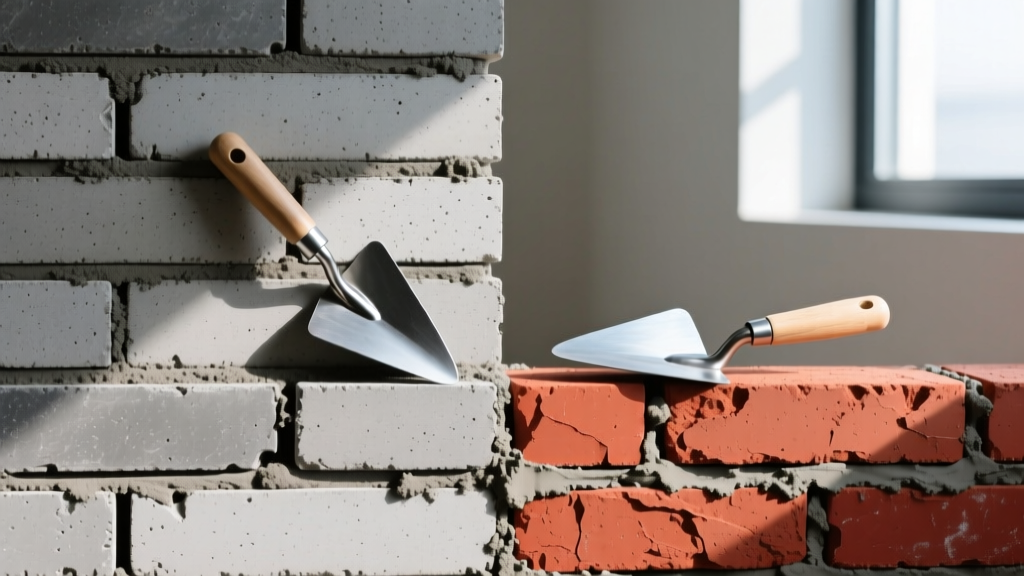
Lifecycle Costs: Maintenance and Failure Modes
The initial installation is only the first phase of the financial commitment. The long-term maintenance profiles of concrete bricks vs clay bricks diverge sharply based on their chemical composition and porosity.
Warning: Freeze-Thaw Spalling Risks
In northern climates, moisture absorption is the primary enemy of masonry. If you are building in a region with severe freeze-thaw cycles, you must specify clay bricks rated for Severe Weathering (SW) per ASTM standards, or concrete bricks with a strict absorption limit. Using standard Moderate Weathering (MW) bricks in a freezing climate will result in the face of the brick popping off (spalling) within 2 to 3 winters, requiring complete wall reconstruction.
The Efflorescence Factor
Efflorescence—the white, powdery salt deposit that appears on masonry surfaces—is significantly more common and persistent on concrete bricks. Because concrete contains soluble salts and Portland cement, moisture migrating through the wall pushes these salts to the surface. While clay bricks can experience efflorescence, it is usually a one-time event tied to the initial curing of the mortar.
Removing severe efflorescence from concrete brick requires specialized chemical cleaners, such as Prosoco Sure Klean #600, and professional power washing. Budget an additional $0.20 to $0.45 per square foot for post-construction cleaning on concrete brick projects, a cost rarely incurred to the same degree with high-quality clay brick.
Color Fastness and UV Degradation
Clay bricks derive their color from the natural minerals in the shale and the firing process. This color is permanent and UV-stable; a red clay brick will remain red for a century. Concrete bricks are colored using synthetic iron-oxide pigments mixed into the concrete slurry. Over a 15 to 20-year period, prolonged UV exposure and acid rain will cause concrete bricks to fade, chalk, and lose their vibrancy. If the aesthetic of an unpainted exterior is paramount, the lifecycle cost of concrete brick must include the application of a penetrating silane/siloxane sealer every 7 to 10 years, costing roughly $0.75 per square foot per application.
Decision Matrix: When to Choose Which Material
Use this framework to determine the most cost-effective material for your specific project parameters:
Choose Concrete Bricks If:
- The budget is strictly constrained: You need the structural benefits and fire resistance of masonry but cannot absorb the 30% material premium of clay.
- The wall will be painted or rendered: If the masonry is acting as a structural substrate for stucco, EIFS, or heavy exterior paint, the aesthetic superiority and UV stability of clay are wasted expenses.
- High structural load capacity is required: Concrete bricks generally offer higher compressive strength out-of-the-box, making them ideal for load-bearing retaining walls and foundation courses.
Choose Clay Bricks If:
- The aesthetic is exposed and permanent: For unpainted facades, historic district renovations, or high-end residential builds where color permanence is non-negotiable. The Brick Industry Association (BIA) extensively documents the century-long lifespan of exposed clay masonry.
- The environment is highly acidic or coastal: Clay bricks possess superior resistance to salt spray and acidic industrial pollution, which can rapidly degrade the cementitious bonds in concrete bricks.
- Minimizing control joints is a priority: Clay bricks exhibit slight moisture expansion rather than shrinkage, allowing for wider spacing between expansion joints, saving on sealant labor and preserving clean sightlines.
Ultimately, the choice between concrete bricks vs clay bricks is not just a matter of upfront capital. It is a strategic calculation balancing initial material savings against labor nuances, environmental exposure, and the inevitable costs of long-term facade maintenance.
Written by
James ThorntonJames Thornton is a construction industry veteran with 25 years of hands-on experience in wood framing, lumber grading, and residential building codes. He started as a framing carpenter in rural Oregon, earned his ICC Residential Building Inspector certification, and eventually became a senior plan reviewer for the City of Portland Bureau of Development Services. James holds a B.S. in Wood Science & Technology from Oregon State University and is a certified lumber grader through the West Coast Lumber Inspection Bureau (WCLIB). He has inspected over 3,000 residential construction sites and authored the city's internal guide on advanced framing techniques (2x6 at 24" O.C.). James lives in Bend, OR, where he builds custom timber-frame cabins and competes in lumberjack sports.
More from James Thornton
View all
Insulation
Best Home Insulation Materials: Complete 2026 Guide
Compare top home insulation materials for 2026. Find R-values, installed costs per square foot, and best uses for fiberglass, spray foam, and mineral wool.
Aug 4, 2026

Sustainable Building
Certify Your Green Building Material for LEED and WELL
Step-by-step guide to certifying a green building material for LEED v5 and WELL v2. Master EPDs, HPDs, and VOC limits for 2026 project specifications.
Aug 4, 2026

Stone & Masonry
Veneer Stacked Stone Panels: Interior Design & Style Showcase
Discover how veneer stacked stone panels transform interiors. Explore modern design profiles, material pairings, and technical installation specs.
Aug 4, 2026