Wood Patio vs Concrete: Cost, Durability, and ROI Compared
Compare wood patio vs concrete for your backyard. Analyze installation costs, lifespan, maintenance needs, and ROI to choose the best patio material.
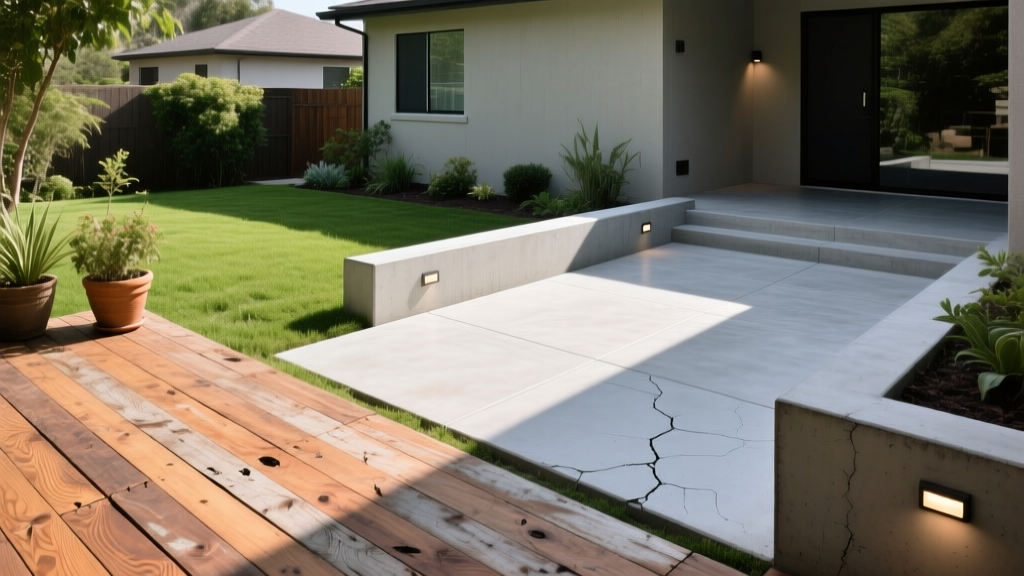
The Core Decision Matrix: Wood Patio vs Concrete
Choosing between a wood patio and a concrete slab fundamentally alters your backyard's microclimate, drainage patterns, and long-term maintenance budget. While wood offers elevated warmth and natural aesthetics, concrete provides ground-level permanence and design versatility. To make an informed decision, you must look beyond surface-level aesthetics and evaluate structural requirements, material science, and lifecycle costs.
| Feature | Wood Patio (Elevated Deck) | Concrete Patio (Slab-on-Grade) |
|---|---|---|
| Average Cost (Installed) | $25 - $55 per sq. ft. | $10 - $25 per sq. ft. |
| Expected Lifespan | 15 - 30 years (depending on species) | 30 - 50+ years |
| Structural Footprint | Piers/Sonotubes below frost line | Monolithic slab or thickened edge |
| Permeability | High (water passes through gaps) | Low (requires slope for drainage) |
| Best Application | Uneven terrain, second-story access | Flat lots, heavy furniture, fire pits |
Upfront Installation and Material Costs
The financial gap between wood and concrete is primarily driven by site preparation and structural framing. Concrete is a volume-based material, while wood is a component-based assembly.
Concrete Patio Cost Breakdown
A standard 400-square-foot concrete patio requires a 4-inch minimum thickness, yielding roughly 5 cubic yards of concrete. In 2026, material and labor economics break down as follows:
- Site Prep & Excavation: $2 - $4 per sq. ft. (Removing topsoil and compacting a 4-inch gravel base).
- Forming & Reinforcement: $3 - $5 per sq. ft. (Using 2x4 forms and 6x6 W1.4xW1.4 welded wire mesh or #3 rebar at 18-inch centers).
- Pouring & Finishing: $5 - $8 per sq. ft. for a standard broom finish.
- Upgrades: Stamped patterns add $8 - $15 per sq. ft.; exposed aggregate adds $4 - $8 per sq. ft.
Total Range: $10 to $18 per sq. ft. for basic finishes; $18 to $30+ per sq. ft. for decorative stamped concrete.
Wood Patio Cost Breakdown
Wood patios (technically decks, as they are elevated to prevent ground-contact rot) require complex load-bearing frameworks. The cost is heavily dictated by the decking species:
- Pressure-Treated Pine: $18 - $28 per sq. ft. (Most economical, but requires annual sealing).
- Cedar / Redwood: $30 - $45 per sq. ft. (Natural rot resistance, but soft and prone to scratching).
- Composite (e.g., Trex, TimberTech): $35 - $55 per sq. ft. (Higher upfront cost, near-zero maintenance).
- Tropical Hardwood (Ipe, Cumaru): $45 - $70+ per sq. ft. (Extremely dense, requires specialized carbide-tipped tools and pre-drilling).
Hidden Cost Factor: Wood structures require concrete footings (sonotubes) poured below the local frost line. In northern climates, this means drilling 36 to 48 inches deep for every support pier, adding $150 to $300 per footing in labor and concrete.
Structural Requirements and Failure Modes
Both materials fail, but they fail in entirely different ways. Understanding these failure modes is critical for long-term satisfaction.
Concrete slabs poured on expansive clay soils without a properly engineered sub-base will inevitably crack and tilt. Wood decks bypass this issue by transferring loads via piers below the frost line, but the joists and decking remain vulnerable to seasonal humidity swings that cause cupping and warping.
Concrete Failure Modes
- Shrinkage Cracking: As concrete cures, it loses moisture and shrinks. Control joints must be cut at intervals of 1.5 times the slab thickness in feet (e.g., a 4-inch slab requires joints every 6 feet) to force cracking in straight, hidden lines.
- Spalling and Scaling: In freezing climates, water penetrates the pores, freezes, and expands. According to the Portland Cement Association, utilizing air-entraining admixtures (creating 4% to 8% microscopic air bubbles per ASTM C260 standards) is mandatory to provide relief valves for expanding ice.
- Settlement: If the sub-grade is not compacted to 95% Proctor density, the slab will sink, creating trip hazards and pooling water.
Wood Failure Modes
- Moisture Trapping: Deck boards installed too tightly (less than 1/8-inch gap) trap water and debris, accelerating rot at the joist connections.
- Hardware Corrosion: Modern pressure-treated wood uses alkaline copper quaternary (ACQ) or copper azole preservatives. As noted in EPA guidelines on treated wood, these chemicals are highly corrosive to standard steel. You must use hot-dipped galvanized (G185) or stainless steel (Grade 305 or 316) fasteners and joist hangers.
- Joist Degradation: The decking may look fine, but the hidden structural joists often rot first if they lack protective flashing tape over the top edges.
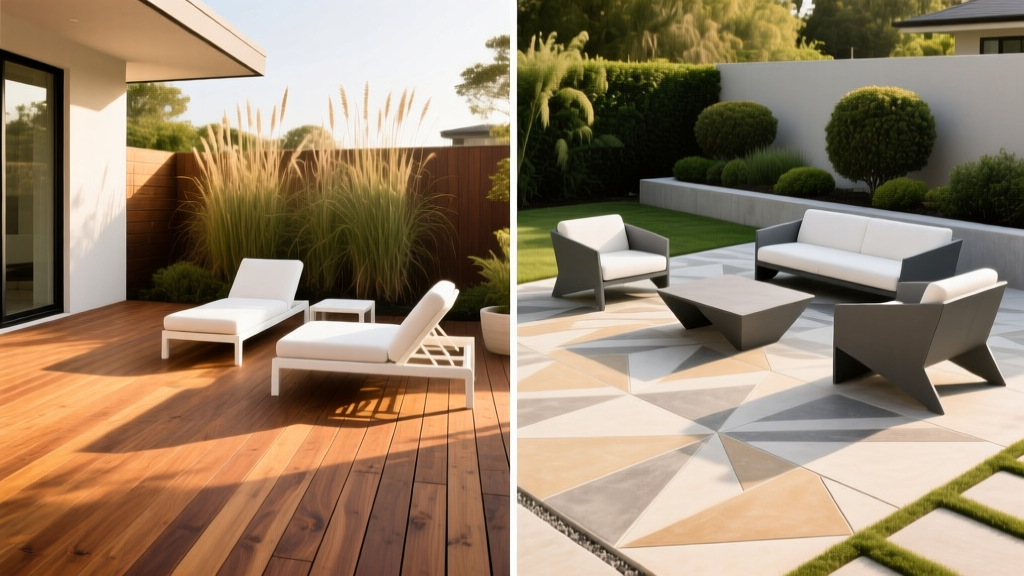
Maintenance Realities: What It Actually Takes
The true cost of a patio emerges in years 3 through 10. Here is the actionable maintenance reality for both materials.
Wood Patio Maintenance Schedule
- Annual Cleaning: Sweep and wash with a specialized deck cleaner (oxygen bleach, not chlorine bleach, which destroys wood lignin and corrodes fasteners).
- Bi-Annual Sealing (Natural Wood): Apply a high-quality penetrating oil or semi-transparent stain (e.g., Cabot Australian Timber Oil or Sikkens Cetol) every 1 to 3 years. Film-forming finishes like polyurethane will peel and require expensive chemical stripping.
- Hardware Inspection: Annually check for popped nails or backing-out screws. Replace with structural screws (e.g., Simpson Strong-Tie or GRK Fasteners) to maintain structural rigidity.
Concrete Patio Maintenance Schedule
- Bi-Annual Cleaning: Power wash (using a minimum 25-degree nozzle tip to avoid etching the surface) to remove algae and dirt.
- Tri-Annual Sealing: Apply a penetrating silane/siloxane sealer every 3 to 5 years. Unlike acrylic surface sealers that turn yellow and peel, siloxane penetrates the pores to repel water while allowing vapor transmission.
- Joint Maintenance: Inspect control joints and fill them with a self-leveling polyurethane sealant (e.g., Sikaflex) to prevent water from infiltrating the sub-base and washing out the gravel.
Environmental Impact and Climate Considerations
Material choice carries distinct ecological footprints. Concrete production is highly carbon-intensive; the calcination of limestone to create Portland cement accounts for roughly 8% of global CO2 emissions. However, a concrete slab's 50-year lifespan and high thermal mass (which can absorb and radiate heat, reducing localized cooling loads) offset some initial impact.
Wood patios act as carbon sinks, sequestering CO2 within the timber. However, the use of chemical preservatives in pressure-treated lumber and the petroleum-based resins in composite decking complicate their end-of-life disposal. Tropical hardwoods like Ipe offer unmatched durability without chemicals, but sourcing them requires strict adherence to FSC (Forest Stewardship Council) certification to ensure they are not contributing to deforestation.
The Final Decision Framework
Do not choose based on aesthetics alone. Use this framework to align the material with your specific property constraints and lifestyle.
- Your lot is relatively flat and requires minimal grading.
- You plan to install heavy features like a masonry outdoor kitchen, a cast-iron fire pit, or a hot tub (wood requires expensive, engineered structural reinforcement for hot tubs).
- You want a seamless, flush transition from your interior flooring to the outdoor space.
- You want to minimize annual weekend maintenance chores.
- Your backyard has a significant slope, making a concrete retaining wall and slab cost-prohibitive.
- You need to elevate the outdoor living space to match a second-story walkout basement or main floor.
- Your soil consists of highly expansive clay that would cause a slab-on-grade to fracture without deep, expensive foundation piers.
- You prefer a warmer, softer surface underfoot that does not radiate intense heat during peak summer sun exposure.
Ultimately, concrete wins on raw longevity and cost-per-year for ground-level applications, while wood remains the superior, adaptable choice for elevated structures and complex topographies. Evaluate your soil report, measure your frost line, and budget for the decade-long maintenance cycle before breaking ground.
Written by
Marcus ChenMarcus Chen is a licensed structural engineer (PE) and building materials analyst with over 12 years of experience across residential, commercial, and industrial construction. He holds a Master of Science in Civil Engineering from UC Berkeley and spent six years at Thornton Tomasetti before transitioning to independent consulting and technical writing. Marcus specializes in material selection for seismic-prone regions, concrete reinforcement strategies, and lifecycle cost analysis. His work has been cited by the American Concrete Institute (ACI) and the Structural Engineers Association of California (SEAOC). When he is not on a job site or at his desk, you will find him hiking the Sierra Nevada or restoring a 1920s craftsman bungalow in Oakland, CA.
More from Marcus Chen
View all
Construction Cost
How Much Did the Eiffel Tower Cost to Build?
How much did the Eiffel Tower cost to build in 1889? We adjust for inflation and compare its budget to modern skyscraper construction.
Aug 4, 2026

Fire Resistance
What Is a Fire Resistant Material? Testing & Certification Guide
Discover what is a fire resistant material through ASTM and UL testing. Learn how fire ratings, certifications, and assemblies work in construction.
Aug 4, 2026

Construction Cost
How Much Did the Burj Khalifa Cost to Build?
How much did the Burj Khalifa cost to build? We break down the $1.5B project and extract 5 money-saving strategies for your next build.
Jul 30, 2026