Concrete vs Asphalt for Expansive Clay Soil: Repair & Troubleshooting
Diagnose and repair driveway failures on expansive clay. Compare concrete vs asphalt for expansive clay soil, including subgrade fixes and costs.

The Geotechnical Reality: Why Expansive Clay Destroys Pavements
Expansive clay soils, primarily those rich in montmorillonite and smectite minerals, possess a crystalline structure that absorbs water at the molecular level. When moisture increases, these soils can swell up to 30% in volume; during droughts, they shrink and consolidate. Geotechnical engineers classify soils with a Plasticity Index (PI) greater than 25 as highly expansive. When evaluating concrete vs asphalt for expansive clay soil, the fundamental challenge is managing this differential volumetric change, which exerts upward swelling pressures exceeding 5,000 pounds per square foot (psf) in extreme cases.
Before initiating repairs, determine if the soil movement is active. Tape a glass tell-tale across the primary crack. If the glass shears within 30 days, the clay subgrade is actively heaving or settling due to seasonal moisture fluctuations. Surface-level repairs will fail until the moisture gradient is stabilized.
Diagnostic Triage: Reading the Failure Patterns
Concrete and asphalt exhibit distinct failure modes when subjected to clay-induced stress. Correctly identifying the distress pattern dictates the repair protocol.
Concrete Failure Mechanics on Clay
- Longitudinal Tenting: The center of the slab lifts while the edges remain anchored, creating an inverted 'V' profile. This indicates moisture accumulation under the slab center, often from a hidden plumbing leak or poor surface drainage.
- Corner Break-Offs: Diagonal cracks at slab corners signal that the clay subgrade has shrunk away from the slab edge, removing support and causing the corner to snap under vehicular loads.
- Map Cracking: A network of fine, interconnected cracks usually indicates a high water-to-cement ratio in the original mix combined with rapid surface drying, exacerbated by minor subgrade shifting.
Asphalt Failure Mechanics on Clay
- Edge Tearing: Longitudinal cracks running parallel to the pavement edge, often accompanied by a slight drop-off. The clay shrinks at the exposed edges, pulling the asphalt mat apart.
- Alligator (Fatigue) Cracking: Interconnected polygons resembling reptile skin. On clay, this occurs when the subgrade softens during wet seasons, causing the flexible asphalt mat to deflect beyond its fatigue limit under traffic loads.
- Reflective Cracking: If the asphalt was laid over an old, cracked concrete base, the clay movement will telegraph the rigid joints directly through the flexible overlay.
Material Performance Matrix on Expansive Clay
When deciding whether to repair or completely replace a failed surface, reference the structural behavior of each material under high-PI soil conditions.
| Material Type | Flexural Response to Heave | Avg. Repair Cost (per sq ft) | Mandatory Subgrade Prep for Replacement |
|---|---|---|---|
| Standard Concrete (4000 psi) | Rigid; fractures when differential settlement exceeds 0.5 inches over 10 ft. | $6.00 - $9.00 (Foam jacking) | 6-inch compacted crushed rock base with vapor barrier. |
| Post-Tensioned Concrete | Highly resistant; internal tendons compress the slab, resisting tensile cracking from heave. | $12.00 - $16.00 (Full replacement) | Grade beams drilled to bedrock or stable strata below the active clay zone. |
| Standard Asphalt (PG 64-22) | Viscoelastic; bends with minor movement but tears if base course fails. | $3.50 - $5.50 (Overlay) | 8-inch aggregate base; optional lime stabilization. |
| Polymer-Modified Asphalt | Highly flexible; elastomeric polymers allow the binder to stretch without fracturing. | $5.00 - $8.00 (Mill & Fill) | Geogrid reinforcement between subbase and base course. |
Troubleshooting & Repairing Concrete on Expansive Soils
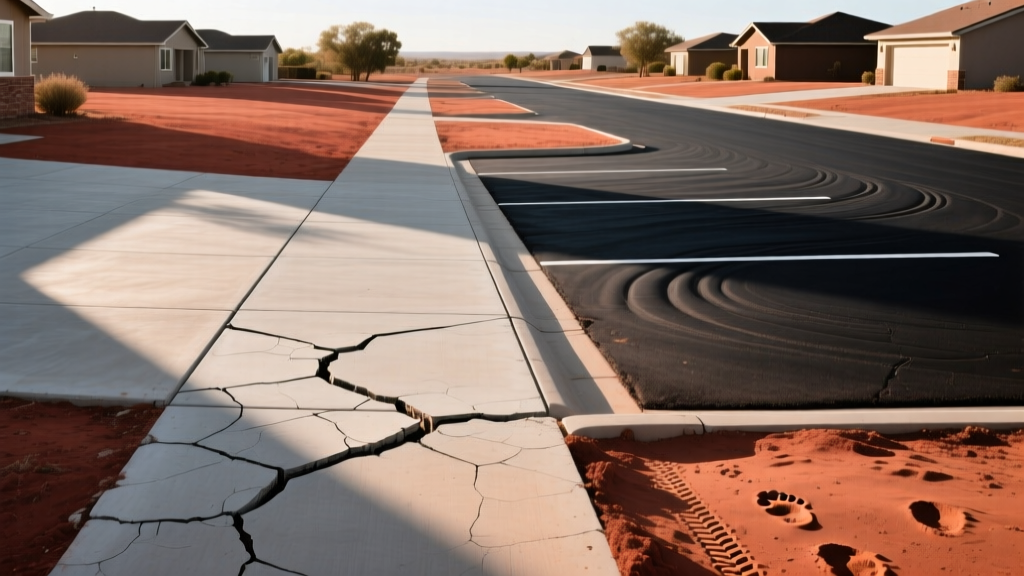
Repairing concrete on active clay requires addressing both the symptom (the sunken or lifted slab) and the root cause (moisture intrusion). Standard mudjacking using cementitious slurry is generally contraindicated on expansive clay, as the heavy slurry (approx. 100 lbs per cubic foot) adds dead load and introduces water, which can trigger further clay swelling.
Protocol 1: Polyurethane Foam Slab Lifting
For sunken concrete slabs where the clay has consolidated, high-density polyurethane foam is the superior repair method.
- Drilling: Drill 5/8-inch injection holes in a grid pattern, spaced 3 to 4 feet apart, avoiding the slab edges to prevent blowouts.
- Injection: Inject a two-part, closed-cell polyurethane resin (e.g., TerraThane or equivalent) with a cured density of 2.5 to 4.0 lb/ft³. The material expands up to 20 times its liquid volume, compacting the loose clay subgrade while lifting the slab.
- Curing & Sealing: The foam cures in 15 seconds. Cut the injection ports flush with the surface and seal the holes with a color-matched polyurethane caulking.
Protocol 2: Crack Stitching for Structural Integrity
If a slab has cracked but the subgrade is now stable, use mechanical stitching to lock the sections together and prevent water infiltration.
- Use a walk-behind concrete saw with a diamond blade to cut 1-inch deep, 6-inch long slots perpendicular to the crack every 12 inches.
- Insert #4 (1/2-inch) deformed rebar or specialized carbon-fiber staples into the slots.
- Fill the slots with a high-modulus, moisture-insensitive epoxy (such as Sikadur-32). This restores the structural continuity of the slab, forcing it to act as a single monolithic unit against future minor clay movements.
Troubleshooting & Repairing Asphalt on Expansive Soils
Asphalt repairs on clay must prioritize base stabilization. Simply patching the surface over a failed clay subgrade will result in the repair failing within one freeze-thaw or wet-dry cycle.
Protocol 1: Full-Depth Reclamation (FDR) with Lime Stabilization
When an asphalt driveway or parking lot exhibits widespread alligator cracking due to clay subgrade failure, FDR is the most cost-effective permanent repair.
- Pulverization: A reclaimer machine pulverizes the existing asphalt surface and the top 4 to 6 inches of the clay subgrade, blending them into a homogeneous mixture.
- Chemical Modification: Spread Type S hydrated lime or quicklime over the pulverized mix at a rate of 3% to 6% by weight. The lime reacts with the silica and alumina in the clay, permanently altering its crystalline structure and reducing its Plasticity Index (PI) below 15, effectively neutralizing its expansive properties.
- Mellowing & Compaction: Allow the lime-treated base to 'mellow' (cure) for 24 to 48 hours. Grade and compact the base to 95% Standard Proctor density, then apply a new 2-inch asphalt wearing course.
For comprehensive guidelines on asphalt pavement distress and base stabilization techniques, refer to the Asphalt Institute's technical resources.
Protocol 2: Geogrid Base Reinforcement
For localized edge failures or areas where lime stabilization is not feasible, install a biaxial geogrid (such as Tensar BX1200). Excavate the failed asphalt and top 4 inches of base. Lay the geogrid directly on the compacted clay subgrade, then backfill with crushed aggregate. The geogrid interlocks with the aggregate, distributing vehicular loads over a wider area and preventing the aggregate from punching down into the soft, wet clay.
The Replacement Threshold: When to Abandon Repairs
Repairing pavements on expansive clay is an exercise in managing tolerances. However, there is a definitive threshold where continuous repair becomes a financial sinkhole, necessitating full demolition and engineered replacement.
The 2-Inch / 10-Foot Rule: If differential movement (the vertical distance between the highest and lowest points of the slab or mat) exceeds 2 inches over any 10-foot span, surface repairs are no longer viable. The internal tensile stresses have permanently compromised the material matrix. At this stage, you must transition to an engineered foundation system.
For concrete, this means replacing standard rebar-reinforced slabs with Post-Tensioned (PT) slabs supported by drilled piers that extend past the active clay zone into stable bedrock. For asphalt, it requires removing the entire pavement structure, over-excavating 24 inches of expansive clay, and replacing it with a non-expansive select fill (such as crushed limestone or sandy loam) compacted in 8-inch lifts.
Understanding the deep geotechnical interaction between your pavement and the soil beneath it is the only way to stop the cycle of seasonal cracking. By matching the repair protocol to the specific failure mechanics of the material, you can extend the service life of your pavement by decades, even in the most hostile soil conditions. For deeper insights into soil management and landscaping around expansive soils, the Colorado State University Extension provides excellent foundational data on moisture control strategies.
Written by
Marcus ChenMarcus Chen is a licensed structural engineer (PE) and building materials analyst with over 12 years of experience across residential, commercial, and industrial construction. He holds a Master of Science in Civil Engineering from UC Berkeley and spent six years at Thornton Tomasetti before transitioning to independent consulting and technical writing. Marcus specializes in material selection for seismic-prone regions, concrete reinforcement strategies, and lifecycle cost analysis. His work has been cited by the American Concrete Institute (ACI) and the Structural Engineers Association of California (SEAOC). When he is not on a job site or at his desk, you will find him hiking the Sierra Nevada or restoring a 1920s craftsman bungalow in Oakland, CA.
More from Marcus Chen
View all
Construction Cost
How Much Did the Eiffel Tower Cost to Build?
How much did the Eiffel Tower cost to build in 1889? We adjust for inflation and compare its budget to modern skyscraper construction.
Aug 4, 2026

Fire Resistance
What Is a Fire Resistant Material? Testing & Certification Guide
Discover what is a fire resistant material through ASTM and UL testing. Learn how fire ratings, certifications, and assemblies work in construction.
Aug 4, 2026

Construction Cost
How Much Did the Burj Khalifa Cost to Build?
How much did the Burj Khalifa cost to build? We break down the $1.5B project and extract 5 money-saving strategies for your next build.
Jul 30, 2026