Paving vs Concrete: Driveway Cost Breakdown & ROI
Compare paving vs concrete costs for 2026. Detailed breakdown of material, labor, base prep, and long-term ROI for driveways and patios.

Defining the Matchup: Segmental Paving vs. Poured Concrete
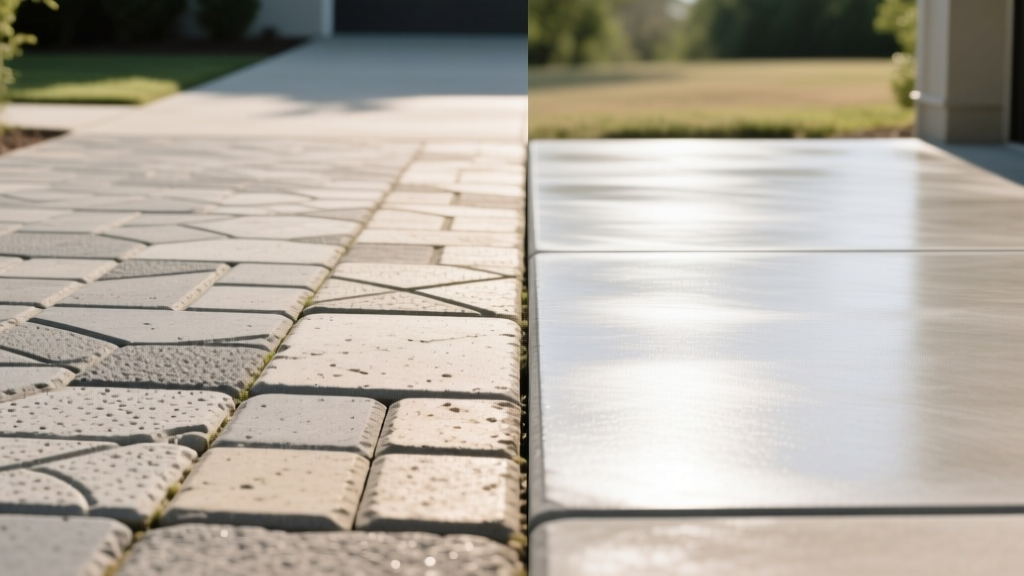
When evaluating hardscape materials for driveways, patios, and walkways, the decision between paving stones and poured concrete hinges on a complex interplay of upfront capital, long-term maintenance, and structural performance. In the construction industry, 'paving' in this context refers to segmental, interlocking units—specifically concrete pavers, clay brick, or natural stone—rather than asphalt or monolithic slabs.
Poured concrete relies on tensile strength and mass, functioning as a single, continuous structural membrane. Segmental paving operates on the principle of interlock and flexibility, distributing vehicular loads laterally through a granular base. Understanding the distinct engineering and economic profiles of both systems is critical for accurate budget forecasting.
Upfront Cost Breakdown: Material, Labor, and Installation
The initial capital required for hardscaping varies wildly based on finish, thickness, and regional labor rates. The following matrix outlines the 2026 national average installed costs per square foot for standard residential applications.
| Material System | Material Cost (per sq. ft.) | Labor & Equipment (per sq. ft.) | Total Installed Cost (per sq. ft.) |
|---|---|---|---|
| Standard Poured Concrete (4-inch, broom finish) | $3.50 - $5.00 | $4.50 - $7.00 | $8.00 - $12.00 |
| Stamped / Colored Concrete | $5.50 - $9.00 | $7.00 - $12.00 | $12.50 - $21.00 |
| Concrete Pavers (80mm vehicular grade) | $4.00 - $8.00 | $6.50 - $11.00 | $10.50 - $19.00 |
| Clay Brick Pavers | $7.00 - $12.00 | $7.50 - $12.00 | $14.50 - $24.00 |
| Natural Stone (Bluestone / Cobblestone) | $15.00 - $30.00 | $10.00 - $18.00 | $25.00 - $48.00 |
The Subgrade Reality: Base Preparation Costs
A common misconception is that pavers are inherently cheaper to install because they do not require concrete trucks and finishing crews. In reality, base preparation is the great equalizer. Both systems require a heavily compacted subgrade to prevent differential settlement.
According to guidelines from the National Concrete Masonry Association (NCMA), a vehicular paver driveway requires 6 to 8 inches of compacted ASTM D2940 aggregate base, topped with 1 inch of coarse, sharp concrete sand for bedding. Poured concrete requires a minimum 4-inch compacted gravel base. While the raw material cost for the gravel base is similar ($1.50 to $2.50 per square foot), the labor to laser-grade and compact the bedding sand for pavers is highly meticulous, often negating the savings from avoiding a concrete pour.
Long-Term Economics: Maintenance, Repair, and Lifespan
Upfront costs only tell half the financial story. The lifecycle cost of hardscaping is dictated by how the material responds to environmental stress, specifically freeze-thaw cycles, soil expansion, and heavy point-loads.
Poured Concrete: The Crack Inevitability
Concrete cures through an exothermic hydration process, which inherently causes shrinkage. Even with perfectly placed control joints (cut every 10 to 12 feet and to a depth of 25% of the slab thickness), random cracking is a matter of 'when,' not 'if.' Furthermore, in climates with severe freeze-thaw cycles, the National Ready Mixed Concrete Association (NRMCA) mandates an air-entrained mix (4% to 7% microscopic air bubbles) to prevent surface scaling. If a standard non-air-entrained mix is used in northern climates, surface spalling will occur within 3 to 5 years.
- Sealing: $0.50 - $1.00 per sq. ft. every 2-3 years.
- Crack Repair: Epoxy injection or routing/sealing costs $3 to $5 per linear foot.
- Slabjacking (Mudjacking): If the subgrade washes out and the slab sinks, lifting it via polyurethane foam injection costs $5 to $8 per square foot.
- Lifespan: 25 to 40 years before structural replacement is required.
Segmental Pavers: Flexibility and Joint Maintenance
Pavers do not crack; they shift. Because they are individual units bedded in sand, they absorb ground heave and settlement without fracturing. However, this flexibility introduces a different maintenance profile centered around the joints.
- Polymeric Sand Reapplication: The joints must be swept and re-sealed with polymeric sand every 3 to 5 years to prevent weed growth and ant excavation. Cost: $0.75 - $1.25 per sq. ft.
- Settlement Repair: If a section settles, the pavers are simply pulled up, the base re-compacted, and the pavers re-laid. Material loss is near zero; labor is billed at standard hourly masonry rates ($65 - $95/hr).
- Lifespan: 50+ years. Individual units can be replaced indefinitely.
Environmental Factors: Drainage and Runoff Regulations
Municipal stormwater management codes are increasingly penalizing impermeable surfaces. Standard poured concrete is 100% impermeable, forcing all rainwater and snowmelt into municipal storm drains, which can trigger impact fees or require the installation of secondary retention basins on the property.
Permeable interlocking concrete pavement (PICP) offers a distinct regulatory and environmental advantage. By utilizing open-graded aggregate in the joints and a specialized stone reservoir base, PICP allows water to infiltrate directly into the soil. The U.S. Environmental Protection Agency (EPA) recognizes permeable pavement as a premier green infrastructure tool for reducing urban runoff and filtering heavy metals. While PICP costs 20% to 30% more upfront than standard pavers, it can eliminate the need for costly underground drainage systems or retention ponds, resulting in a net savings for large commercial or high-end residential projects.
Decision Matrix: Which Material Fits Your Project?
Use the following framework to finalize your material selection based on your specific site conditions and financial priorities.
Choose Poured Concrete If:
- You are working with a strict, compressed budget and require the lowest absolute upfront cost per square foot.
- The project involves a large, unbroken area (like a basketball court or expansive pool deck) where the continuous surface of concrete is functionally superior.
- You are utilizing a highly experienced local crew; concrete finishing is an unforgiving art, and poor timing or weather during the pour can ruin the entire slab.
Choose Segmental Pavers If:
- The site features mature trees with aggressive root systems or highly expansive clay soils that guarantee monolithic slabs will eventually crack and heave.
- You anticipate needing access to underground utilities (water lines, irrigation, gas) in the future; pavers can be unzipped and re-laid without leaving ugly patch marks.
- Maximizing property resale value is the primary goal. High-end natural stone or intricate concrete paver patterns consistently yield a higher ROI (often 80% to 100% of project cost) compared to standard broom-finished concrete.
Frequently Asked Questions
Can I install pavers directly over an existing concrete driveway?
Yes, this is known as an overlay installation, but it comes with strict caveats. The existing concrete must be structurally sound, free of heaving, and sloped correctly for drainage. You will lose approximately 2.5 to 3 inches of elevation, which can interfere with garage door thresholds and entryways. Furthermore, you cannot use a traditional sand base; instead, pavers must be adhered to the concrete using a specialized exterior masonry adhesive, and the perimeter must be secured with a mortar curb.
Does stamped concrete cost the same as concrete pavers?
In the current market, heavily detailed stamped concrete often exceeds the cost of standard concrete pavers, landing in the $15 to $21 per square foot range. Stamped concrete requires expensive polyurethane mat sets, integral color hardeners, and secondary release agents. While it mimics the look of stone, it retains the structural vulnerabilities of a monolithic slab, meaning it will eventually crack, and matching the color during future repairs is nearly impossible.
What is the minimum PSI required for a concrete driveway?
For residential driveways, the concrete mix must achieve a minimum compressive strength of 4,000 PSI at 28 days. The slab should be poured to a minimum thickness of 4 inches, increasing to 6 inches if the driveway will support heavy RVs, dump trucks, or commercial equipment. Wire mesh (6x6 W2.9xW2.9) or #4 fiberglass rebar should be utilized to control thermal cracking.
Written by
Priya KapoorPriya Kapoor is a real estate market analyst and construction economics researcher with expertise in housing affordability, development feasibility, and infrastructure investment. She holds a Master of Regional Planning from Cornell University and previously worked as a senior analyst at CBRE's Investment Properties group, where she modeled returns for $4B in mixed-use development pipelines. Priya now runs an independent research practice advising developers, municipalities, and REITs on construction cost forecasting and market timing. She publishes the quarterly "BuildMat Market Pulse" report tracking material price indices across 12 commodity categories. Based in Austin, TX, Priya serves on the board of Habitat for Humanity Austin and is a marathon runner.
More from Priya Kapoor
View all
Construction Cost
Cost to Build a 1600 Sq Ft Home in 2026: Full Breakdown
Accurate 2026 cost to build a 1600 sq ft home—material, labor, and regional pricing breakdowns included. Plan your budget with real-time estimates.
Aug 11, 2026

Wood & Lumber
Name the Types of Wood for Pressure Treatment and Preservation
Learn how to name the types of wood best suited for pressure treatment. Compare species treatability, chemical retention levels, and 2026 preservation costs.
Aug 4, 2026

Stone & Masonry
Stone Veneer Suppliers Lindenhurst: 2026 Cost Analysis
Analyze 2026 stone veneer costs in Lindenhurst, NY. Compare local supplier pricing, delivery fees, and Suffolk County installation labor rates.
Aug 4, 2026