Concrete Grinder Selection: Matching Machines to Floor Scenarios
Learn how to match the right concrete grinder, diamond tooling, and machine weight to specific floor prep, polishing, and coating removal scenarios.
The Core Mechanics of Scenario Matching
Selecting a concrete grinder is not a one-size-fits-all decision. The machine's weight, rotational speed (RPM), planetary action, and diamond tooling bond must be mathematically matched to the specific floor scenario. A 700-pound planetary grinder designed for high-gloss polishing will fail catastrophically if used for thick mastic removal, while a lightweight single-disc grinder will leave unacceptable undulations on a commercial warehouse floor.
Scenario 1: Coating, Epoxy, and Mastic Removal
When removing VCT adhesive, thick epoxy, or urethane coatings, standard metal-bond diamonds will instantly clog, overheat, and glaze over. The friction generated by soft, tacky materials melts the coating into the diamond matrix, rendering the tool useless within 10 minutes.
The PCD Solution
For coating removal, you must use Polycrystalline Diamond (PCD) tooling. PCD segments feature large, aggressive synthetic diamond shards that act like a microscopic planer, scraping and fracturing the coating rather than grinding it.
- Machine Fit: A high-torque, low-RPM single-disc grinder or a heavy planetary grinder (e.g., Lavina 25X or Husqvarna PG 530) operating between 400 and 600 RPM.
- Tooling Cost: PCD segments are expensive, typically ranging from $90 to $160 per segment. However, they remove coatings 5x faster than scarifiers and prevent the micro-pitting associated with shotblasting, saving hours of subsequent patching labor.
- Technique: Run the machine at a slight tilt or use a specialized scraper plate to keep the PCDs cutting at an aggressive angle without digging into the concrete substrate.
Scenario 2: Surface Profiling for Thin-Film Overlays
If the goal is to prepare a floor for a thin-film epoxy, polyaspartic, or cementitious overlay, the objective shifts from removal to profiling. The International Concrete Repair Institute (ICRI) categorizes surface roughness using the Concrete Surface Profile (CSP) scale, ranging from CSP 1 (very smooth) to CSP 9 (heavily scarified).
| Target CSP | Ideal Application | Recommended Grinder & Tooling |
|---|---|---|
| CSP 1-2 | Thin mil epoxy seals, stains | Planetary grinder with 30/40 grit soft-bond metal diamonds. |
| CSP 3-4 | Self-leveling underlayments, thick epoxies | Planetary grinder with 16/20 grit hard-bond metal diamonds or light shotblasting. |
| CSP 5-6 | Polymer overlays, heavy-duty urethane cements | Scarifier or heavy planetary grinder with T-Rex style carbide cutters. |
Scenario 3: Architectural Polished Concrete
Polishing is a multi-step mechanical abrasion process that requires immense downward pressure to properly burnish the concrete surface. A lightweight grinder will simply bounce off the floor during the final resin polishing steps, resulting in a dull, hazy finish.
Weight and Planetary Action
For high-gloss architectural polishing (800 to 3,000 grit), you need a heavy planetary grinder weighing between 800 and 1,200 lbs. Machines like the Husqvarna PG 820RC (weighing over 1,000 lbs) provide the necessary 10 to 15 pounds of downforce per square inch of tooling. The planetary rotation—where the main head spins in one direction while the satellite discs spin in the opposite direction—ensures a perfectly flat floor without directional scratches.
The Grit Progression Sequence
- Grinding (30-40 Metal): Exposes aggregate and removes surface contaminants.
- Honing (100-200 Hybrid): Transitions the scratch pattern from deep metal cuts to finer scratches; densifier is typically applied after the 200-grit step to harden the calcium silicate hydrate matrix.
- Polishing (400-3000 Resin): Burnishes the surface to the desired gloss level. Resin bonds require high machine weight to create the necessary friction for a glass-like finish.
Scenario 4: Perimeter Edging and Tight Confines
Planetary grinders cannot reach within 2 to 4 inches of walls, columns, or cabinets. Attempting to force a large machine into corners damages baseboards and leaves unground halos that will ruin the final coating or polish.
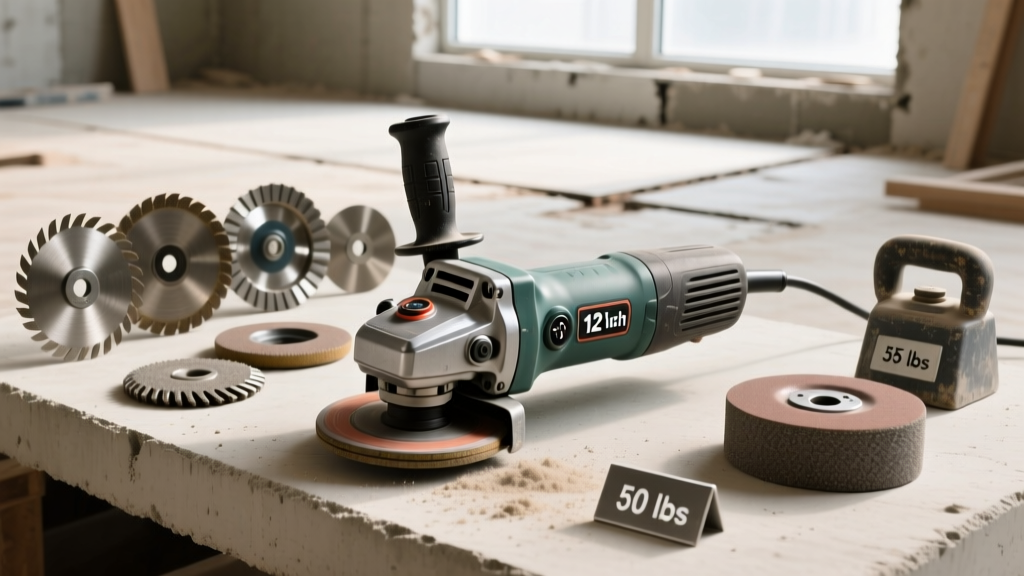
For edge work, a 5-inch or 7-inch hand-held concrete grinder equipped with a floating dust shroud is mandatory. The Bosch 1773AK (5-inch) or Makita 9564CV (7-inch) are industry standards. Edge grinders operate at high RPMs (up to 10,000 RPM) and require specialized turbo-cup diamond wheels. Because they lack the mass of a walk-behind grinder, the operator must apply manual downward pressure, making fatigue a significant factor on large commercial jobs. For extensive perimeter work, consider a remote-controlled edge grinder or a specialized swing-arm edger to maintain consistent downforce.
Dust Extraction: The Non-Negotiable Variable
Grinding concrete generates respirable crystalline silica dust, which causes silicosis. Under the OSHA 1926.1153 Respirable Crystalline Silica Standard, contractors must strictly adhere to Table 1 engineering controls. Dry grinding without a HEPA-filtered dust extractor is a severe regulatory violation and a massive health hazard.
2026 Rental vs. Purchase Economics
Deciding whether to rent or buy a concrete grinder depends on your annual square footage volume and the diversity of your projects. The used equipment market has stabilized in 2026, making certified pre-owned planetary grinders a viable middle ground.
| Acquisition Method | Estimated Cost (20" Planetary) | Best Use Case |
|---|---|---|
| Daily Rental | $150 - $250 / day | Residential contractors doing 1-2 garage floors per month. Tooling costs are usually extra. |
| Certified Pre-Owned | $6,500 - $9,000 | Growing contractors transitioning into commercial polishing or large-scale prep. |
| New Commercial | $12,000 - $18,000+ | Dedicated concrete polishing firms running machines 20+ days a month. Includes warranty and dealer support. |
Matching the exact grinder weight, RPM, and tooling bond to your specific scenario eliminates rework, prevents tooling burnout, and ensures compliance with OSHA safety standards. Always test the substrate hardness first, calculate your CFM requirements for dust extraction, and select the machine architecture that aligns with your end-goal profile.