Types of Concrete Patio Finishes vs. Pavers: Cost & Durability
Compare types of concrete patio finishes against pavers and decking. Analyze costs, failure modes, stamped vs. exposed aggregate, and long-term ROI.

The Baseline: Types of Concrete Patio Finishes Defined
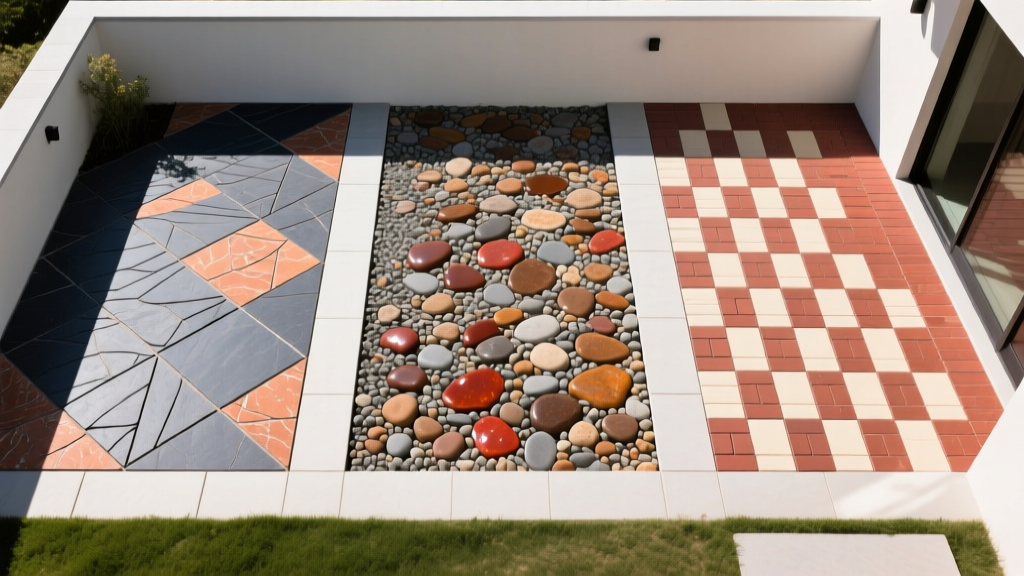
Selecting a patio surface requires moving beyond basic aesthetics to evaluate structural integrity, thermal properties, and long-term maintenance. When evaluating the various types of concrete patio finishes, contractors and homeowners must weigh the initial pour specifications against the final surface treatment. Each finish alters the concrete’s slip resistance, curing requirements, and susceptibility to environmental degradation.
Quick Cost Snapshot (Per Square Foot Installed)
- Broom Finish: $6 – $8 (Standard 3000 PSI mix)
- Acid Stained: $8 – $12 (Requires chemical reaction and sealing)
- Exposed Aggregate: $10 – $14 (Requires surface retarders and power washing)
- Stamped Concrete: $12 – $18 (Requires 4000 PSI mix, color hardeners, and release agents)
A standard broom finish remains the most economical choice, providing essential slip resistance through surface scoring. However, for high-traffic entertainment areas, decorative finishes dominate. Exposed aggregate achieves its texture by applying a chemical surface retarder (such as Euclid Chemical’s Eucosil) immediately after screeding, which delays the set of the top 1/4 inch of cement paste. This paste is later washed away to reveal the underlying gravel matrix. Stamped concrete, conversely, demands a higher-strength 4000 PSI mix to withstand the mechanical pressure of polyurethane stamping mats without deforming the slab edges.
Head-to-Head: Concrete Finishes vs. Hardscape Alternatives
While poured concrete offers a continuous monolithic surface, segmental alternatives like interlocking pavers and composite decking present distinct structural behaviors. Understanding these differences is critical for sites with expansive soils or poor drainage.
Stamped Concrete vs. Interlocking Concrete Pavers
The most common debate in hardscaping is poured stamped concrete versus interlocking pavers. Pavers, governed by standards from the Interlocking Concrete Pavement Institute (ICPI), are individual units laid over a compacted aggregate base and bedding sand. Because they are not grouted together, pavers are classified as flexible pavements. When the subgrade shifts due to frost heave or tree root growth, pavers flex and can be individually removed and releveled.
Stamped concrete is a rigid pavement. While control joints are cut into the slab to dictate where cracking occurs, the American Concrete Institute (ACI) notes that micro-cracking outside of these joints is virtually inevitable over a 20-year lifespan. Furthermore, repairing a cracked stamped patio requires saw-cutting and replacing entire panels, which rarely results in a seamless color match due to UV fading of the original release agents. Pavers cost between $15 and $25 per square foot, making them 20% to 40% more expensive upfront than stamped concrete, but their zero-cost crack repair offers a superior lifecycle value in regions with severe freeze-thaw cycles.
Exposed Aggregate vs. Composite Decking
For elevated or ground-level entertainment spaces, composite decking (such as Trex or TimberTech) is frequently compared to exposed aggregate concrete. Composite boards, priced at $20 to $35 per square foot including substructure, offer a splinter-free, low-maintenance surface. However, composite materials suffer from high thermal expansion and heat retention. Dark-capped composite boards can reach surface temperatures of 140°F in direct summer sunlight.
Exposed aggregate concrete, while heavy and requiring extensive subgrade preparation, maintains a significantly lower surface temperature due to its high thermal mass and the reflective properties of the exposed quartz or limestone chips. For ground-level applications where budget allows for earthmoving, exposed aggregate provides a permanent, heat-resistant alternative to composite decking, though it lacks the elevated vantage point and under-deck storage of a framed structure.
Performance and Lifecycle Matrix
The following matrix compares the operational characteristics of the primary patio materials, highlighting maintenance intervals and structural lifespans.
| Material | Expected Lifespan | Maintenance Cycle | Freeze-Thaw Resilience |
|---|---|---|---|
| Broom Finish Concrete | 30+ Years | Seal every 3-5 years | High (with air entrainment) |
| Stamped Concrete | 20-25 Years | Reseal every 2-3 years | Moderate (surface spalling risk) |
| Interlocking Pavers | 40+ Years | Re-sand joints every 5 years | Excellent (flexible system) |
| Composite Decking | 25-30 Years | Annual cleaning required | High (immune to frost heave) |
Hidden Failure Modes and Specification Fixes
Surface failures rarely originate from the finish itself; they are almost always traced back to mix design, subgrade preparation, or improper curing. According to data from the National Ready Mixed Concrete Association (NRMCA), specifying the correct parameters mitigates 90% of premature patio degradation.
- Delamination in Stamped Concrete: When stamping occurs on a hot, windy day, the surface crusts over while bleed water remains trapped beneath. Troweling seals this water in, leading to blistering and delamination within the first year. Fix: Specify the use of an evaporation retarder (like Eucosil) during finishing, and strictly prohibit troweling until all bleed water has evaporated.
- Efflorescence in Pavers: White, powdery salt deposits migrate to the surface of pavers when moisture moves through the bedding sand. Fix: Utilize polymeric sand for jointing rather than standard masonry sand, and ensure the sub-base includes proper lateral drainage to prevent hydrostatic pressure from pushing moisture upward.
- Pop-outs in Exposed Aggregate: Small, cone-shaped fractures occur when porous chert or shale particles in the aggregate mix absorb water, freeze, and expand. Fix: Require ASTM C33 compliant aggregates from the batch plant, specifically screening out soft, porous materials, and mandate a 6% to 8% air-entrainment level for exterior flatwork.
- Acid Stain Failure on Fly-Ash Mixes: Acid stains react with calcium hydroxide in the cement. Modern mixes often replace 20% to 30% of Portland cement with fly ash to improve workability, which drastically reduces calcium hydroxide, resulting in weak, blotchy stain colors. Fix: Limit fly ash replacement to a maximum of 10% for slabs intended for acid staining, or switch to a water-based acrylic stain which relies on pigments rather than chemical reactions.
Subgrade and Reinforcement Requirements
No decorative finish will survive a compromised subgrade. For all poured concrete patio finishes, the subgrade must consist of a minimum 4-inch layer of compacted, crushed angular gravel (not rounded river rock, which fails to lock together). The slab itself should be a minimum of 4 inches thick, poured at a 0.45 water-to-cement ratio to maximize surface density.
Expert Specification Rule: Control joints must be cut to a depth of exactly one-quarter the slab thickness (1 inch deep for a 4-inch slab). The spacing of these joints should never exceed 10 feet, and ideally should follow a 1.5 to 2 multiplier of the slab thickness in inches, converted to feet (e.g., a 4-inch slab requires joints every 6 to 8 feet). Failure to adhere to this spacing guarantees random, uncontrolled cracking.
Final Specification Recommendation
For budgets prioritizing initial cost and monolithic structural strength, a broom finish or exposed aggregate concrete patio offers the highest ROI, provided strict air-entrainment and joint-spacing rules are followed. For sites with heavy clay soils, poor drainage, or extreme frost lines, interlocking pavers represent a superior long-term investment despite the higher initial capital outlay, as their flexible nature eliminates the costly reality of rigid slab replacement. Stamped concrete should be reserved strictly for visually prominent, low-traffic zones where the owner is committed to a rigorous biennial resealing schedule using high-quality, breathable acrylic sealers to prevent moisture entrapment and subsequent spalling.
Written by
Priya KapoorPriya Kapoor is a real estate market analyst and construction economics researcher with expertise in housing affordability, development feasibility, and infrastructure investment. She holds a Master of Regional Planning from Cornell University and previously worked as a senior analyst at CBRE's Investment Properties group, where she modeled returns for $4B in mixed-use development pipelines. Priya now runs an independent research practice advising developers, municipalities, and REITs on construction cost forecasting and market timing. She publishes the quarterly "BuildMat Market Pulse" report tracking material price indices across 12 commodity categories. Based in Austin, TX, Priya serves on the board of Habitat for Humanity Austin and is a marathon runner.
More from Priya Kapoor
View all
Construction Cost
Cost to Build a 1600 Sq Ft Home in 2026: Full Breakdown
Accurate 2026 cost to build a 1600 sq ft home—material, labor, and regional pricing breakdowns included. Plan your budget with real-time estimates.
Aug 11, 2026

Wood & Lumber
Name the Types of Wood for Pressure Treatment and Preservation
Learn how to name the types of wood best suited for pressure treatment. Compare species treatability, chemical retention levels, and 2026 preservation costs.
Aug 4, 2026

Stone & Masonry
Stone Veneer Suppliers Lindenhurst: 2026 Cost Analysis
Analyze 2026 stone veneer costs in Lindenhurst, NY. Compare local supplier pricing, delivery fees, and Suffolk County installation labor rates.
Aug 4, 2026