Types of Concrete Admixtures vs. Traditional Mix Adjustments
Compare types of concrete admixtures against traditional mix adjustments. Discover cost, performance, and environmental trade-offs for modern pours.
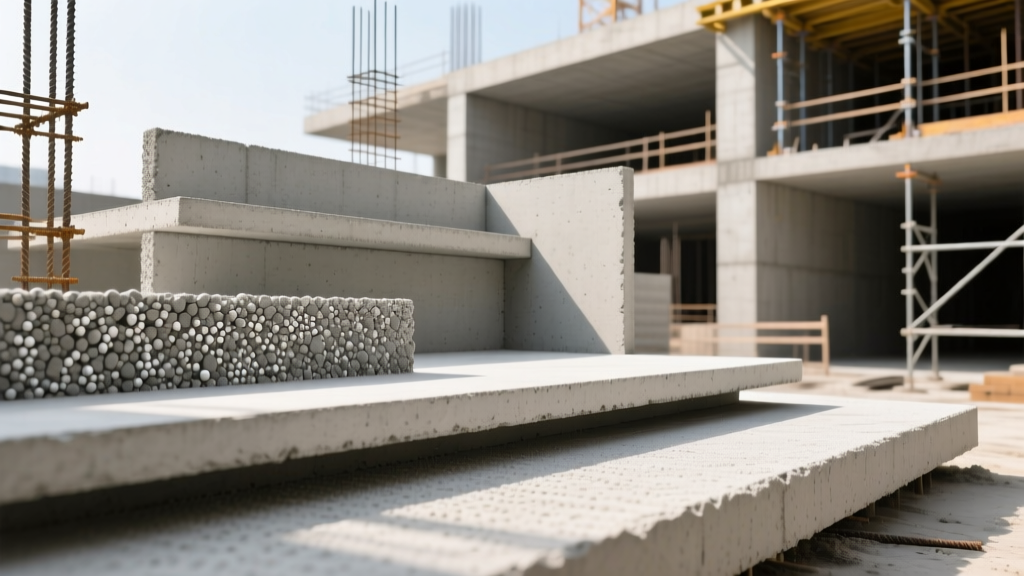
The Core Dilemma: Chemical Admixtures vs. Physical Adjustments
Concrete mix design is a rigorous balancing act of strength, workability, durability, and cost. When a baseline mix fails to meet specific project requirements—such as achieving a low water-to-cement (w/c) ratio, surviving freeze-thaw cycles, or setting within a tight window—engineers face a critical fork in the road. They must choose between introducing specific types of concrete admixtures (chemical or mineral) or physically altering the base mix proportions and job-site conditions.
While the ASTM C494 standard strictly classifies chemical admixtures into distinct functional categories, many of the problems these chemicals solve can theoretically be addressed through traditional, non-chemical means. However, the economic, environmental, and performance trade-offs between these two approaches are rarely equivalent. This guide compares the most common types of concrete admixtures against their traditional physical alternatives to help you make data-driven mix design decisions.
Decision Framework: When to Use Admixtures
Choose Chemical Admixtures when: You need precise, predictable control over set times, require w/c ratios below 0.40 without sacrificing workability, or are operating in moderate weather where physical temperature control is cost-prohibitive.
Choose Physical/Traditional Adjustments when: You have abundant local materials, are managing massive thermal mass pours where internal heat generation is the primary concern, or lack reliable access to high-quality, ASTM-certified liquid admixtures.
Achieving High Strength: Superplasticizers vs. Increasing Cement Content
To achieve high-strength concrete (typically 4,000 to 8,000+ psi at 28 days), the w/c ratio must be reduced. Traditionally, this was done by simply adding more Portland cement to the mix while keeping water constant. Today, High-Range Water Reducers (HRWR), specifically Polycarboxylate Ether (PCE) superplasticizers, offer a radically different approach.
PCEs work through steric hindrance—polymer side chains physically push cement particles apart, maintaining high flowability (slump) even with drastically reduced water content. Let us compare the use of PCE superplasticizers against the traditional method of adding 100 lbs of extra Type I/II cement per cubic yard (CY) to drop the w/c ratio from 0.50 to 0.40.
| Metric | PCE Superplasticizer (ASTM C494 Type F) | Adding 100 lbs Extra Cement/CY |
|---|---|---|
| Material Cost Impact | +$4.50 - $7.00 per CY (dosed at 4-6 oz/100lb cement) | +$14.00 - $18.00 per CY (based on $140-$180/ton cement) |
| Workability (Slump) | Increases to 8-10 inches; highly flowable | Decreases; mix becomes harsh and sticky |
| Heat of Hydration | Neutral or slightly reduced | Significantly increased (thermal cracking risk) |
| CO2 Footprint | Negligible increase | Adds ~90 lbs of CO2 per CY of concrete |
The Verdict: According to the Federal Highway Administration's High-Performance Concrete guidelines, relying on extra cement to boost strength is an outdated practice that invites thermal cracking and unnecessary carbon emissions. PCE superplasticizers are the undisputed superior choice for high-strength applications, offering better workability at less than half the cost of additional cement.
Freeze-Thaw Durability: Liquid AEAs vs. Air-Entraining Cement
Concrete exposed to freezing temperatures requires a microscopic air-void system to relieve internal hydraulic pressure when pore water expands. The two primary methods to achieve this are liquid Air-Entraining Admixtures (AEAs) conforming to ASTM C260, or using pre-blended Air-Entraining Portland Cement (ASTM C175).
Liquid AEAs (Vinsol Resin / Synthetics)
- Precision: Dosage can be adjusted at the batch plant in real-time based on aggregate moisture and temperature.
- Void Structure: Synthetic AEAs produce highly stable, closely spaced micro-bubbles (10-50 micrometers).
- Drawback: Requires calibrated dispensing equipment and rigorous QA/QC testing at the truck.
Air-Entraining Cement (ASTM C175)
- Convenience: No liquid dispensers required at the batch plant; air is built into the powder.
- Volatility: Air content fluctuates wildly based on fly ash carbon content (LOI), sand gradation, and mixing time.
- Drawback: If air content is low, you still must add liquid AEA, negating the initial convenience.
The Verdict: For structural flatwork, bridge decks, and exterior paving, liquid AEAs are the industry standard. The inherent variability of the raw materials (particularly the unpredictable loss on ignition in supplementary cementitious materials like fly ash) makes pre-blended air-entraining cement too risky for critical infrastructure. Liquid AEAs allow the batch operator to dial in the exact 5% to 7% air volume required on a load-by-load basis.
Controlling Set Times: Chemical Modifiers vs. Thermal Management
Modifying the hydration rate is essential for extreme weather concreting. The traditional method relies on thermal manipulation: using flaked ice or liquid nitrogen to cool the mix in summer, and heated water or steam curing in winter. The modern alternative utilizes chemical retarders (like lignosulfonates or hydroxycarboxylic acids) and non-chloride accelerators (like calcium nitrate).
Summer Pours: Retarders vs. Flaked Ice
Replacing a portion of the mixing water with flaked ice effectively lowers the initial mix temperature by up to 15°F. However, ice requires specialized handling, dedicated silos, and extended mixing times to ensure complete melting. A liquid retarder, dosed at just 2 to 4 oz per 100 lbs of cement, delays the initial set by 1 to 3 hours without requiring any thermal infrastructure. While ice addresses the temperature of the fresh concrete, retarders address the chemical reaction rate directly, making them more effective for preventing cold joints in large continuous pours.
Winter Pours: Accelerators vs. Heated Enclosures
Historically, calcium chloride was the accelerator of choice, but its severe corrosion risk to embedded rebar has led to its ban in most structural applications. Modern non-chloride accelerators (NCAs) safely speed up early strength gain. However, NCAs do not generate heat; they only speed up the ambient reaction. In sub-freezing temperatures (below 32°F / 0°C), chemical accelerators must still be paired with physical thermal management—such as insulated blankets or heated enclosures—to prevent the pore water from freezing before the concrete reaches its critical strength of 500 psi. Therefore, in extreme cold, chemical and physical methods are not alternatives, but mandatory complements.
Mitigating Shrinkage: SRAs vs. Prolonged Wet Curing
Drying shrinkage is the primary cause of cracking in concrete slabs-on-grade. The traditional, universally prescribed method to prevent this is continuous wet curing (using wet burlap, sprinklers, or ponding) for a minimum of 7 days. This keeps the internal relative humidity high, preventing the capillary tension that pulls the concrete matrix inward.
Shrinkage-Reducing Admixtures (SRAs) offer a chemical alternative. SRAs are typically glycol-ether based compounds that lower the surface tension of the pore water within the concrete. By reducing surface tension by up to 50%, the capillary stresses that cause shrinkage are drastically minimized, reducing long-term drying shrinkage by 40% to 60%.
The Portland Cement Association notes that while SRAs are excellent for mitigating shrinkage in environments where continuous wet curing is logistically impossible (such as arid climates or multi-story elevated decks), they do not replace the need for initial curing entirely. A hybrid approach—using an SRA combined with a high-quality, dissipating resin curing compound—yields the most crack-resistant slabs.

Economic and Environmental Impact Analysis
The shift toward advanced types of concrete admixtures is heavily driven by sustainability mandates. The cement industry accounts for approximately 8% of global CO2 emissions. Every physical alternative that requires increasing the cementitious content of a mix directly inflates the project's embodied carbon.
- Cost Efficiency: While liquid admixtures represent a specialized procurement line item, they typically reduce the overall cost per cubic yard by allowing for the optimization of aggregate gradations and the reduction of Portland cement volume.
- Water Conservation: In arid regions, the traditional alternative of 7-day wet curing consumes thousands of gallons of potable water per 10,000 square feet of slab. Utilizing SRAs combined with internal curing agents (like pre-wetted lightweight fine aggregates) can reduce external water curing requirements by up to 80%.
- Logistical Overhead: Physical alternatives like steam curing, liquid nitrogen dosing, and ice plants require massive capital expenditure and high energy consumption. Chemical admixtures shift the complexity from the job site to the chemical manufacturing plant, streamlining on-site operations.
Frequently Asked Questions
Can I combine multiple types of concrete admixtures in a single mix?
Yes, multi-admixture systems are standard in modern high-performance concrete. However, chemical incompatibility is a real risk. For example, combining certain lignosulfonate retarders with polycarboxylate superplasticizers can cause severe slump loss or flash setting. Always require your admixture supplier to provide a certified compatibility matrix and conduct trial batches using the exact job-site materials before the day of the pour.
Do mineral admixtures like fly ash and slag count as chemical alternatives?
No. Fly ash, slag cement, and silica fume are classified as Supplementary Cementitious Materials (SCMs), not chemical admixtures. While they do alter the fresh and hardened properties of concrete (acting as physical fillers and pozzolans), they are batched as bulk powders replacing a percentage of the Portland cement, whereas chemical admixtures are liquid or dry compounds dosed in very small quantities (typically less than 2% by weight of cement) to modify the hydration chemistry.
What is the shelf life of liquid concrete admixtures?
Most liquid admixtures (like PCEs and standard retarders) have a shelf life of 12 to 18 months when stored in opaque, climate-controlled tanks between 40°F and 90°F. If the liquid freezes, the active polymers can precipitate out of the solution. While some can be reconstituted with mechanical agitation and mild heat, freezing often permanently degrades the chemical efficacy, making proper winter storage of job-site totes a critical quality control measure.
Written by
James ThorntonJames Thornton is a construction industry veteran with 25 years of hands-on experience in wood framing, lumber grading, and residential building codes. He started as a framing carpenter in rural Oregon, earned his ICC Residential Building Inspector certification, and eventually became a senior plan reviewer for the City of Portland Bureau of Development Services. James holds a B.S. in Wood Science & Technology from Oregon State University and is a certified lumber grader through the West Coast Lumber Inspection Bureau (WCLIB). He has inspected over 3,000 residential construction sites and authored the city's internal guide on advanced framing techniques (2x6 at 24" O.C.). James lives in Bend, OR, where he builds custom timber-frame cabins and competes in lumberjack sports.
More from James Thornton
View all
Insulation
Best Home Insulation Materials: Complete 2026 Guide
Compare top home insulation materials for 2026. Find R-values, installed costs per square foot, and best uses for fiberglass, spray foam, and mineral wool.
Aug 4, 2026

Sustainable Building
Certify Your Green Building Material for LEED and WELL
Step-by-step guide to certifying a green building material for LEED v5 and WELL v2. Master EPDs, HPDs, and VOC limits for 2026 project specifications.
Aug 4, 2026

Stone & Masonry
Veneer Stacked Stone Panels: Interior Design & Style Showcase
Discover how veneer stacked stone panels transform interiors. Explore modern design profiles, material pairings, and technical installation specs.
Aug 4, 2026