2026 Concrete Paver Cost Estimator & Material Calculator
Calculate your 2026 concrete paver project costs. Get exact material quantities, base depths, polymeric sand ratios, and labor rates for patios and driveways.
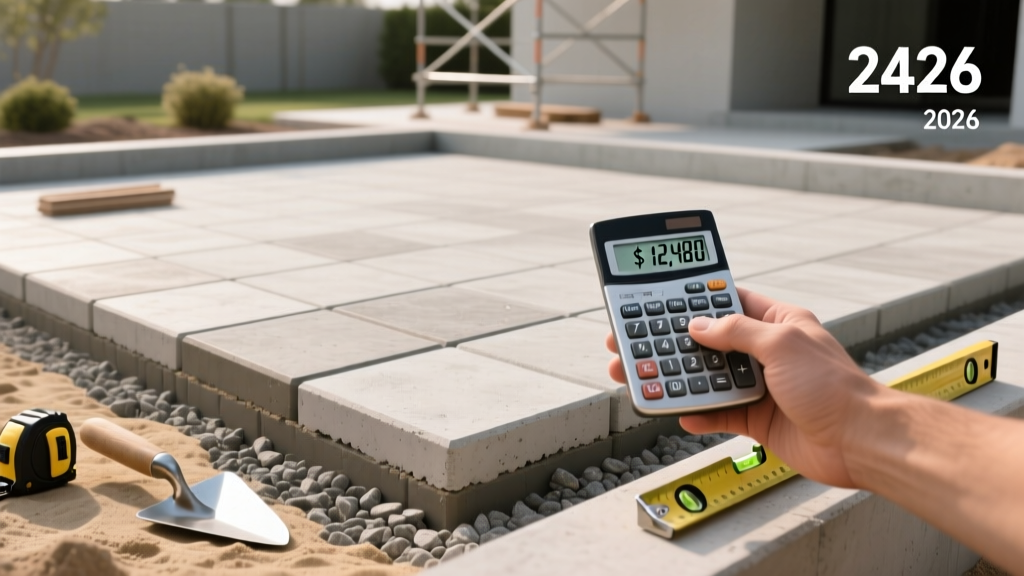
The 2026 Concrete Paver Material Cost Matrix
Estimating a concrete paver installation requires calculating three distinct material layers: the pavers themselves, the structural base, and the jointing system. The cost of the concrete pavers is only the surface-level expense. Below is the 2026 pricing matrix for the most common paver categories, factoring in recent supply chain adjustments and manufacturing shifts toward high-density, porcelain-overlay hybrids.
| Paver Category | Material Cost (per sq. ft.) | Standard Waste Factor | Best Application |
|---|---|---|---|
| Standard Smooth (e.g., Belgard Mega-Arbel) | $3.50 - $5.50 | 5% - 7% | Large patios, straight-lay patterns |
| Tumbled / Antiqued (e.g., Pavestone Old Towne) | $5.50 - $8.50 | 8% - 10% | Traditional landscapes, herringbone patterns |
| Permeable (e.g., Aqua-Roc) | $6.50 - $10.00 | 5% - 8% | Driveways, eco-friendly municipal zones |
| Porcelain-Top Concrete (e.g., Techo-Bloc Milestone) | $11.00 - $18.00 | 10% - 12% | High-end modern patios, pool coping |
Base Aggregate & Bedding Sand Quantity Calculator
The structural integrity of any concrete paver system relies entirely on the sub-base. According to guidelines from the National Concrete Masonry Association (NCMA), a standard pedestrian patio requires a minimum 4-to-6-inch compacted Class II road base, while vehicular driveways demand 8-to-12 inches.
The Compaction Multiplier (Crucial for Ordering)
When ordering Class II road base (a mix of crushed rock and fines), you must account for the compaction factor. Loose gravel yields approximately 30% less volume once compacted with a vibratory plate compactor. Calculation Rule: Multiply your required compacted volume by 1.3 to determine the tonnage to order from the quarry.
- Patio (6-inch base): 1 ton of compacted Class II covers ~55 sq. ft. Order 1.3 tons per 55 sq. ft.
- Driveway (10-inch base): 1 ton of compacted Class II covers ~33 sq. ft. Order 1.3 tons per 33 sq. ft.
Never use mason sand or play sand for the 1-inch bedding layer directly beneath the pavers. Mason sand is rounded and washes out easily. You must specify ASTM C33 concrete sand, which has sharp, angular grains that lock together and prevent washout during heavy rain. One ton of ASTM C33 sand covers approximately 200 sq. ft. at a 1-inch depth.
Permeable Concrete Pavers: A Different Calculation
If your project utilizes permeable concrete pavers to manage stormwater runoff, the standard base calculation is entirely void. Permeable systems cannot use Class II road base because the 'fines' (small dust particles) will clog the drainage voids.
Instead, permeable installations require an open-graded aggregate base, typically ASTM No. 57 stone (for the reservoir base layer) and ASTM No. 8 stone (for the bedding layer). Furthermore, the base depth must be calculated based on the soil's percolation rate and the local 100-year storm rainfall volume, often requiring 12 to 18 inches of No. 57 stone. Always consult a civil engineer or refer to the American Concrete Institute (ACI) permeable pavement guidelines for site-specific hydrological calculations.
Edge Restraint & Jointing Sand Calculations
Without rigid edge restraint, concrete pavers will spread and fail under load. Calculate your linear footage to order the correct restraint system, and measure your joint widths to estimate polymeric sand requirements.
| Component | Coverage / Specification | 2026 Estimated Cost |
|---|---|---|
| Plastic Edge Restraint (e.g., SnapEdge) | Sold in 8-ft sections; requires 12-inch spikes every 12 inches | $3.50 - $5.00 per linear ft. |
| Poured Concrete Curb (Hidden edge) | 6-inch wide by 8-inch deep trench filled with concrete | $8.00 - $12.00 per linear ft. |
| Polymeric Sand (e.g., Techniseal PRO HP) | 50 lb. bag covers ~120 sq. ft. (tight joints) or ~60 sq. ft. (wide joints) | $45.00 - $65.00 per 50 lb. bag |
| Geotextile Fabric (e.g., Mirafi 500X) | Placed between subgrade and base; include 10% overlap | $0.40 - $0.70 per sq. ft. |
Labor Rates & Hidden Site-Prep Costs
Material costs are highly predictable; labor and site preparation are where budgets typically fracture. In 2026, landscape contractors are pricing labor based on site accessibility and soil conditions.
- Standard Patio Installation (Pedestrian): $12.00 - $18.00 per sq. ft. (Includes excavation, base prep, laying, and sanding).
- Driveway Installation (Vehicular): $18.00 - $28.00 per sq. ft. (Requires heavier machinery, deeper excavation, and thicker edge restraints).
- Soil Haul-Off & Disposal: Excavating a 400 sq. ft. patio to a depth of 8 inches generates roughly 10 cubic yards of soil. At $400-$600 per dump truck load (including tipping fees), expect to add $1,200 - $2,400 to the project cost.
- Subgrade Amendment: If soil testing reveals heavy expansive clay, you must excavate an additional 4 inches and replace it with a stabilized subgrade or geogrid reinforcement, adding $2.50 - $4.00 per sq. ft.
Step-by-Step Estimation Workflow
To generate a bulletproof estimate for a concrete paver project, follow this sequential framework:
- Calculate Gross Area: Measure the total square footage and add the pattern-specific waste factor (e.g., 10% for a 45-degree herringbone layout).
- Determine Base Volume: Multiply the gross area by the required base depth (e.g., 0.5 feet for a 6-inch patio base), then apply the 1.3x compaction multiplier to find the loose tonnage required.
- Map the Perimeter: Measure the exact linear footage of the perimeter to order edge restraint and calculate the volume for a hidden concrete curb if specified by the engineer.
- Assess Joint Widths: Select the paver style and measure the joint gap. Use the manufacturer's coverage chart to calculate the exact number of polymeric sand bags required, adding 1 extra bag for waste and touch-ups.
- Factor in Logistics: Calculate the volume of excavated soil to be removed and the number of delivery pallets. Standard paver pallets weigh 3,500+ lbs and require a forklift or a truck-mounted Moffett for offloading; if site access restricts this, add manual offloading labor hours.
Pro Tip for 2026: When ordering polymeric sand, ensure you are purchasing the current year's manufacturing batch. Polymeric sand binders degrade if stored in unclimate-controlled warehouses for more than 12 months, leading to joint washout and hazing on the paver surface. Always check the date code on the bag before accepting delivery.