Paving Stones vs Concrete Cost: Technical Specs & Pricing
Compare paving stones vs concrete cost with 2026 technical specs, ASTM standards, base requirements, and lifecycle maintenance data.

Rigid vs. Flexible Pavement Engineering
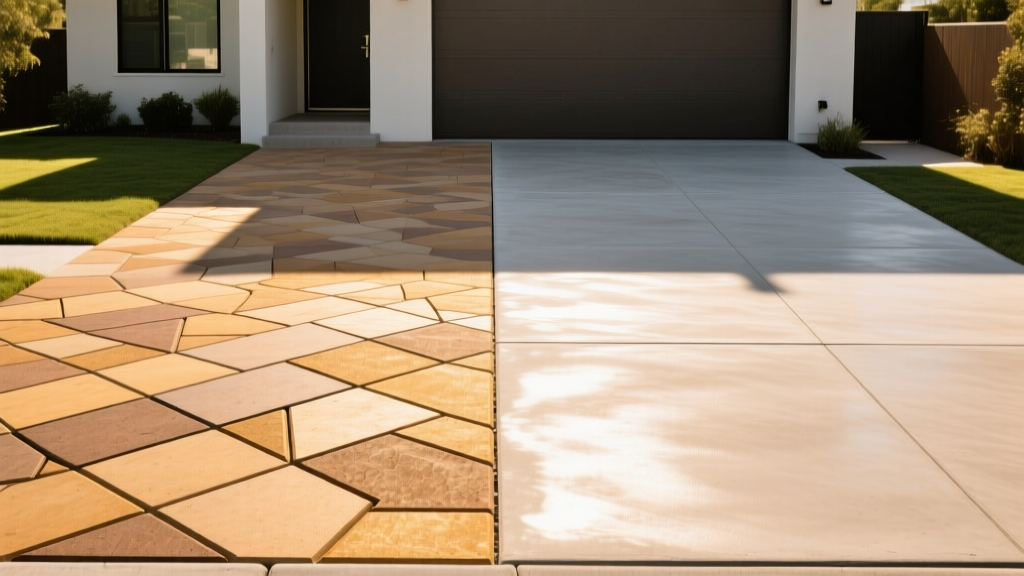
When evaluating paving stones vs concrete cost, surface material pricing is only a fraction of the engineering equation. The fundamental cost divergence stems from structural classification: poured concrete is a rigid pavement, while interlocking concrete pavers function as a flexible pavement. Rigid pavements distribute loads across a wide area of the subgrade through slab action, relying on the tensile strength of the concrete matrix. Flexible pavements distribute loads vertically through particle-to-particle contact within the aggregate base, relying on mechanical interlock rather than tensile rigidity.
This structural distinction dictates entirely different subgrade preparation protocols, material thicknesses, and long-term maintenance trajectories. Understanding these technical specifications is mandatory for accurate lifecycle cost forecasting in 2026.
Material Specifications and ASTM Standards
Both systems utilize cementitious materials, but their manufacturing and performance standards are governed by different ASTM specifications.
Interlocking Concrete Pavers (ASTM C936)
Manufactured in a controlled plant environment using zero-slump concrete, pavers are subjected to high-pressure vibration and compression. According to the National Concrete Masonry Association (NCMA) and ASTM C936 standards, structural pavers must meet the following minimums:
- Compressive Strength: Minimum 8,000 psi (poured driveways typically specify 3,500 to 4,000 psi).
- Water Absorption: Maximum 5% (critical for freeze-thaw durability).
- Thickness: 60mm (2.36 inches) for pedestrian and light vehicular traffic; 80mm (3.15 inches) for heavy vehicular loads and commercial applications.
- Abrasion Resistance: Maximum 15mm depth of wear via the Böhme abrasion test.
Poured Concrete Slabs (ASTM C94)
Ready-mixed concrete is batched per National Ready Mixed Concrete Association (NRMCA) guidelines and ASTM C94. For residential and light commercial driveways, the standard technical specification requires:
- Compressive Strength: 3,500 psi minimum at 28 days (4,000 psi recommended for heavy RV/truck loads).
- Air Entrainment: 4% to 6% microscopic air bubbles to provide expansion chambers for freezing water, preventing spalling.
- Slab Thickness: 4 inches minimum (5 to 6 inches required for heavy axle loads).
- Aggregate Size: 3/4-inch maximum crushed stone.
- Slump: 4 to 5 inches for optimal workability without compromising water-cement ratio strength.
Subgrade and Base Preparation: The Hidden Cost Driver
The most significant variable in the paving stones vs concrete cost analysis is the aggregate base. Because pavers are a flexible system, they require a substantially thicker, highly engineered base to prevent differential settlement.
Paver Base Specifications (ICPI Standards)
Pavers require a 6-inch to 8-inch base of ASTM D2940 graded aggregate, compacted to 95% modified Proctor density. Over highly expansive clay soils, a non-woven geotextile fabric must be placed between the subgrade and base to prevent clay migration and base contamination. A 1-inch layer of ASTM C33 coarse concrete sand is screeded over the base as a bedding layer.
Poured Concrete Base Specifications
Poured concrete requires only a 4-inch compacted subbase of granular fill or crushed stone. The rigid slab bridges minor subgrade inconsistencies, reducing the volume of imported aggregate and compaction labor required prior to the pour.
2026 Paving Stones vs Concrete Cost Matrix
The following matrix breaks down the installed cost per square foot for a standard 500-square-foot residential driveway, incorporating 2026 material, labor, and base preparation rates.
| Cost Component | Poured Concrete (4-inch, Broom Finish) | Stamped Concrete | 60mm Concrete Pavers |
|---|---|---|---|
| Base Prep & Aggregate | $1.50 - $2.50 | $1.50 - $2.50 | $3.50 - $5.50 |
| Material Cost | $3.00 - $4.50 | $4.00 - $6.00 | $4.50 - $8.00 |
| Labor & Equipment | $3.50 - $5.50 | $8.00 - $12.00 | $8.00 - $14.00 |
| Sealing / Joint Sand | $0.00 (Curing compound) | $1.50 - $2.50 | $2.00 - $3.50 (Polymeric) |
| Total Installed (Per Sq. Ft.) | $8.00 - $12.50 | $15.00 - $23.00 | $18.00 - $31.00 |
Degradation Mechanics and Lifecycle Maintenance
Initial installation cost is only one side of the financial ledger. The degradation mechanics of both materials dictate their 20-year lifecycle costs.
Concrete Failure Modes
Poured concrete fails primarily through tensile cracking and surface spalling. Even with control joints cut every 10 to 15 feet, thermal expansion and subgrade settlement will eventually cause uncontrolled micro-fractures. Furthermore, the application of chloride-based de-icing salts in winter months causes a chemical reaction that scales the surface mortar, exposing the aggregate beneath. Repairing a cracked or spalled concrete slab requires full-depth saw-cutting and patching, which rarely matches the original aesthetic.
Paver Failure Modes
Pavers do not crack; they shift. The primary failure mode is joint sand washout or polymeric sand degradation, leading to weed intrusion and loss of mechanical interlock. If the edge restraint (typically a poured concrete beam or heavy-duty plastic secured with 10-inch galvanized spikes) fails, the perimeter pavers will creep outward, causing a cascading unzipping effect across the driveway. However, because pavers are modular, localized base settlement can be corrected by lifting the affected units, re-grading the base, and reinstalling them with zero visual evidence of repair.
Technical Decision Framework
Use the following engineering parameters to select the optimal system for your specific site conditions.
Choose Poured Concrete If:
- The native soil is highly stable, well-draining sandy loam or bedrock.
- The project budget is strictly constrained, and aesthetic customization (like stamping) is secondary to function.
- The surface will be subjected to continuous static heavy loads (e.g., heavy machinery parking) where flexible joints might creep.
- Maintenance interventions (like re-sanding joints) are unacceptable to the property owner.
Choose Concrete Pavers If:
- The site features expansive clay soils prone to seasonal heaving and settlement.
- Utility lines (water, gas, fiber) run beneath the surface, requiring future access without destroying the pavement.
- The design requires complex curves, radii, or integration with permeable drainage systems.
- Freeze-thaw cycling is extreme; the modular nature allows for frost heave correction without slab replacement.
Edge Case: Permeable Systems and Stormwater Management
For sites governed by strict municipal stormwater runoff regulations, permeable pavements are often mandated. According to EPA green infrastructure guidelines, permeable interlocking concrete pavers (PICP) utilize open-graded aggregate bases that store and infiltrate water directly into the soil. While pervious poured concrete exists, it is highly susceptible to clogging from fine sediments and requires rigorous vacuum-sweeping maintenance. PICP systems, conversely, allow for the removal and washing of the surface stones and joint aggregate if clogging occurs, making pavers the technically superior and more resilient choice for permeable driveway applications despite a 20% to 30% higher initial installation cost.
Written by
David NakamuraDavid Nakamura is a licensed architect (AIA) and construction technology writer focused on sustainable building methods, mass timber engineering, and high-performance building envelopes. He holds a Master of Architecture from the University of Washington and is a certified Passive House Consultant (CPHC). David spent eight years at the Seattle firm Mithun, where he led the design of three LEED Platinum projects, before founding his own practice specializing in net-zero residential design. He serves on the editorial advisory board of GreenBuilder Magazine and has authored peer-reviewed papers on cross-laminated timber (CLT) connections for the Journal of Structural Engineering. In his spare time, David teaches woodworking at Pratt Fine Arts Center and kayaks the Puget Sound.
More from David Nakamura
View all
Construction Cost
Labor Cost to Build a Deck Per Sq Ft: 2026 Installation Guide
Discover the exact labor cost to build a deck per sq ft in 2026. This installation guide breaks down contractor rates, complexity factors, and hidden fees.
Aug 4, 2026

Construction Cost
How Much Does It Cost to Build a 3 Bedroom House? Financing Guide
Learn exactly how much it costs to build a 3 bedroom house and explore 2026 financing options, construction loan types, and budget frameworks for your build.
Aug 4, 2026

Construction Cost
Cost to Build a Tennis Court: 2026 Guide
How much does it cost to build a tennis court in 2026? Breakdowns for asphalt, concrete, and synthetic surfaces plus fencing and lighting.
Jul 30, 2026