Concrete Patio Paint Lifespan: Durability & Failure Analysis
Analyze the true lifespan of concrete patio paint. Explore durability factors, MVTR failure modes, ICRI surface profiles, and 10-year ROI metrics.
The Reality of Concrete Patio Paint Lifespan
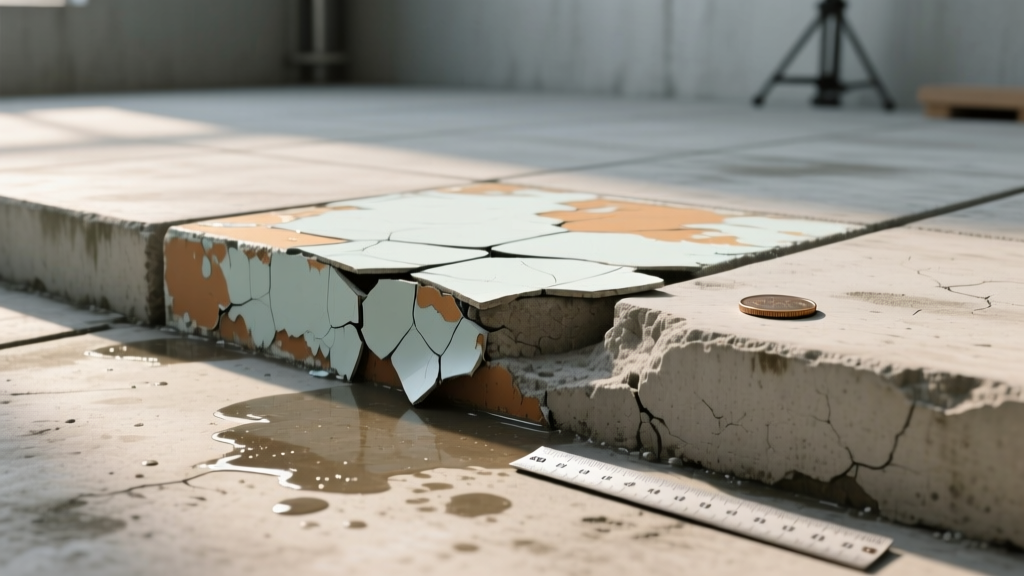
Homeowners and facility managers frequently approach concrete patio paint with the expectation of a permanent, set-and-forget finish. The empirical reality of polymer chemistry and concrete substrate dynamics tells a different story. When evaluating the true lifespan of concrete patio paint, we must separate marketing claims from material science. A standard 1-part acrylic latex coating applied directly to an unprofiled exterior slab will typically exhibit catastrophic adhesion failure within 12 to 18 months. Conversely, a properly specified, multi-component polyaspartic system applied over a mechanically profiled substrate can exceed a 15-year service life.
The durability of any patio coating is not dictated solely by the paint itself, but by the tripartite relationship between the coating's tensile strength, the substrate's moisture vapor transmission rate (MVTR), and the environmental thermal cycling it endures. Below is a baseline analysis of expected lifespans for the primary coating chemistries available in the 2026 market.
| Coating Chemistry | Expected Lifespan (Exterior) | UV Stability | Avg. Installed Cost (per sq. ft.) |
|---|---|---|---|
| 1-Part Acrylic Latex | 1 – 3 Years | Excellent | $0.75 – $1.50 |
| 2-Part Water-Based Epoxy | 3 – 5 Years | Poor (Chalking) | $3.00 – $5.00 |
| 100% Solids Epoxy + Urethane Topcoat | 7 – 10 Years | Good (with topcoat) | $5.50 – $7.50 |
| Polyaspartic / Polyurea | 15+ Years | Excellent | $8.00 – $12.00 |
Primary Failure Modes: Why Patio Paint Peels and Flakes
To engineer a durable concrete patio paint system, one must first understand the exact mechanisms of failure. Over 80% of exterior concrete coating failures are substrate-related, not product-related.
Hydrostatic Pressure and MVTR
Concrete is a highly capillary, porous material. As ground temperatures fluctuate, moisture is drawn upward through the slab via capillary action. When this moisture vapor encounters an impermeable coating film (like a standard epoxy or thick acrylic), it condenses at the concrete-coating interface. This creates localized hydrostatic pressure that exceeds the tensile bond strength of the paint, resulting in blistering and delamination. According to research published by Building Science Corporation, measuring this moisture is critical; standard surface moisture meters are entirely unreliable for predicting subsurface vapor drive.
⚠️ The MVTR Threshold Rule
Before specifying any high-build concrete patio paint, conduct an ASTM F1869 Calcium Chloride test or an ASTM F2170 in-situ relative humidity probe test. Standard epoxies will fail if the MVTR exceeds 3 lbs / 1,000 sq. ft. / 24 hours. If your slab tests between 3 and 10 lbs, you must utilize a moisture-mitigating high-build epoxy primer before applying your aesthetic topcoat.
Thermal Expansion Mismatch
Exterior concrete slabs experience significant thermal expansion and contraction. A rigid 100% solids epoxy has a coefficient of thermal expansion (CTE) that differs vastly from the concrete substrate. When the patio surface temperature spikes to 130°F in direct summer sunlight, the concrete expands. If the coating lacks sufficient elastomeric flexibility, it will micro-fracture, allowing water ingress that accelerates freeze-thaw spalling in winter.
Substrate Profiling: The ICRI CSP Standard
The single most critical determinant of concrete patio paint longevity is surface preparation. The International Concrete Repair Institute (ICRI) utilizes Concrete Surface Profile (CSP) chips, numbered 1 through 9, to quantify surface roughness.
- CSP 1-2 (Acid Etching / Light Sanding): Yields a microscopic profile suitable only for thin, breathable 1-part acrylic stains. Epoxies applied to CSP 1-2 will delaminate under thermal stress.
- CSP 3-5 (Diamond Grinding / Shot Blasting): The mandatory profile for 2-part epoxies, polyurethanes, and polyaspartics. This opens the concrete pores, increasing the surface area by up to 300% and allowing the polymer to achieve a mechanical interlock.
- CSP 6-9 (Scarification / Heavy Shot Blasting): Required for thick, cementitious overlays or high-build elastomeric waterproofing membranes.
Proper surface preparation is non-negotiable. As outlined in the durability guidelines by the Portland Cement Association, the physical condition and porosity of the concrete surface directly dictate the mechanical bond and long-term performance of any applied chemical coating.
Environmental Degradation: UV and Thermal Shock
Exterior patios are subjected to relentless ultraviolet (UV) radiation and ozone exposure. The chemical structure of the paint determines its resistance to these elements.
The Epoxy UV Vulnerability
Standard epoxies contain aromatic rings in their polymer backbone. When exposed to UV light, these rings undergo photo-oxidation, leading to a phenomenon known as "chalking." The coating loses its gloss, turns yellow, and eventually degrades into a fine powder, losing up to 2 mils of thickness per year. Epoxies should never be used as a final topcoat on an exterior patio.
Aliphatic vs. Aromatic Topcoats
To protect an epoxy base coat, or to serve as a standalone system, you must specify an aliphatic polyurethane or polyaspartic topcoat. Aliphatic polymers possess a linear molecular structure that is inherently immune to UV degradation. While aromatic polyurethanes are cheaper and cure faster, they will yellow and embrittle within 24 months of exterior exposure. Always verify the product's Technical Data Sheet (TDS) explicitly states "Aliphatic" before purchasing for outdoor use.
Cost vs. Lifespan ROI Matrix
Evaluating concrete patio paint purely on initial material cost is a false economy. The 10-year Total Cost of Ownership (TCO) reveals the true financial impact of your coating selection, factoring in labor, surface preparation, and reapplication intervals.
| System Type | Initial Cost (500 sq. ft.) | Reapplications in 10 Years | 10-Year TCO | Downtime / Curing |
|---|---|---|---|---|
| DIY Acrylic Latex | $450 | 3 to 4 | $1,800 - $2,250 | 24 hours per coat |
| Pro Epoxy + Urethane | $3,250 | 1 | $3,250 | 3 - 5 days |
| Polyaspartic Flaked | $5,500 | 0 | $5,500 | 24 hours total |
While the polyaspartic system demands a premium upfront investment, its rapid curing time (often walkable in 4 hours and drivable in 24 hours) and zero-maintenance 15-year lifespan make it the superior ROI for high-traffic exterior patios where downtime is a critical factor.
Step-by-Step Substrate Profiling Protocol
To ensure your concrete patio paint achieves its maximum rated lifespan, follow this strict preparation sequence:
- Degrease and Clean: Use an alkaline degreaser and a stiff-bristle mechanical scrubber to remove organic stains, oils, and efflorescence. Power wash at a minimum of 3,000 PSI.
- Mechanical Profiling: Rent a planetary diamond grinder equipped with 30-grit to 40-grit metal-bonded diamonds. Grind the entire surface to achieve an ICRI CSP 3 or 4 profile. Do not rely on acid etching, as it leaves a latent chemical residue that inhibits polymer cross-linking.
- Moisture Testing: Perform ASTM F1869 calcium chloride tests. Tape the test kit to the slab for exactly 72 hours. If the weight gain exceeds 3 lbs, apply a moisture-vapor barrier epoxy primer.
- Patch and Repair: Utilize a 100% solids epoxy patching compound mixed with silica sand to fill spalls and control joints. Feather edges to prevent telegraphing through the topcoat.
- Solvent Wipe: Immediately before applying the prime coat, wipe the slab with denatured alcohol or a dedicated concrete prep solvent to remove micro-dust generated by grinding.
Maintenance Protocols to Extend Coating Life
Even the most robust polyaspartic or urethane concrete patio paint requires basic maintenance to preserve its slip resistance and aesthetic clarity. Avoid using metal-bladed snow shovels or ice melters containing ammonium sulfate or ammonium nitrate, which will chemically attack the polymer matrix. Instead, use plastic-bladed shovels and calcium magnesium acetate (CMA) based de-icers. Clean the patio bi-annually using a pH-neutral cleaner and a soft-bristle broom; avoid high-pressure washing above 2,500 PSI, which can mechanically score the clear topcoat and compromise its UV inhibitors. By adhering to these substrate preparation and maintenance standards, you transition concrete patio paint from a temporary cosmetic band-aid into a permanent, high-performance architectural finish.