Mortar Mixer vs Concrete Mixer: Technical Specs and Selection
Compare mortar mixer vs concrete mixer technical specs. Learn RPM, torque, paddle designs, and aggregate limits to choose the right equipment.

Core Mechanical Architecture: Tilting Drum vs. Stationary Tub
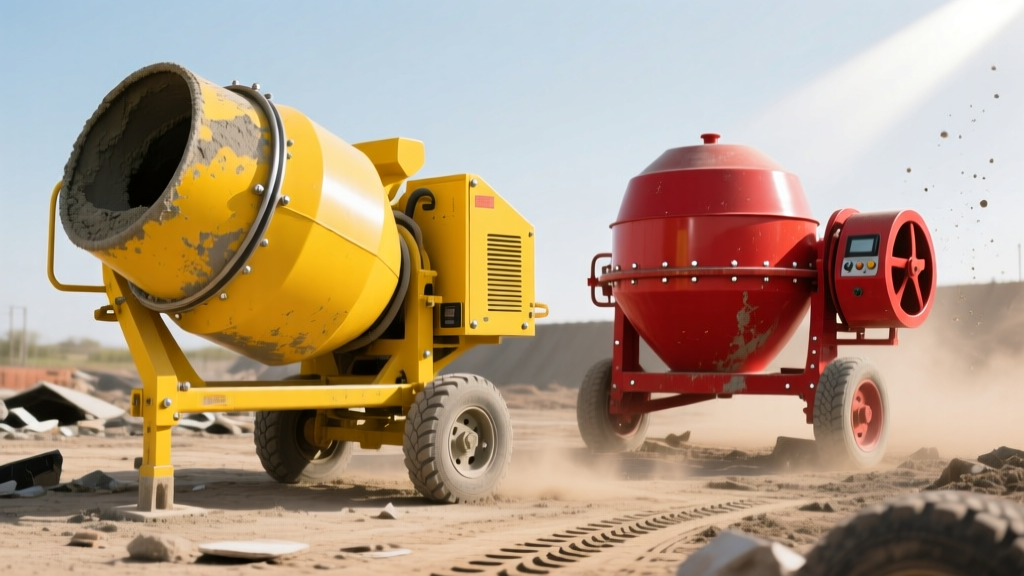
The fundamental divergence between a concrete mixer and a mortar mixer lies in their mixing mechanics, which are engineered to handle vastly different material rheologies. Concrete is a heterogeneous, non-Newtonian fluid with high internal friction due to coarse aggregate. Mortar is a highly viscous, cohesive paste lacking coarse gravel.
A standard portable concrete mixer utilizes a tilting drum equipped with two to four internal helical fins. As the drum rotates, the fins lift the heavy aggregate and cementitious materials to the apex of the drum, allowing gravity to drop them back into the batch. This free-fall action is necessary to fracture aggregate clumps and ensure uniform coating of the coarse stone with cement paste.
Conversely, a mortar mixer features a stationary, U-shaped steel or polyethylene tub. Inside, a central horizontal shaft rotates, driving a series of paddles or ribbon blades. This design relies on forced shear action rather than gravity. The blades physically push, fold, and shear the sticky sand-cement mixture against the stationary tub walls, which is the only effective way to achieve homogeneity in high-viscosity, low-slump mixes like Type S masonry mortar or Portland cement stucco.
Drive Train Specifications: RPM, Torque, and Motor Winding
Matching the motor to the mixing action is where equipment selection often fails on commercial job sites. The torque curves and RPM requirements for these two machines are fundamentally opposed.
| Specification | Standard Concrete Mixer (6-9 cu ft) | Standard Mortar Mixer (6-9 cu ft) |
|---|---|---|
| Motor Type | Split-phase or capacitor-start induction | High-torque capacitor-start/run induction |
| Horsepower (HP) | 1/2 HP to 3/4 HP (120V) | 3/4 HP to 1.5 HP (120V/240V) |
| Operating RPM | 20 to 28 RPM (Drum rotation) | 15 to 22 RPM (Shaft rotation) |
| Drive Mechanism | Ring gear and pinion (external) | Heavy-duty chain/sprocket or direct gear |
| Torque Profile | Moderate torque, higher RPM for lifting | Extreme low-end torque for shearing paste |
Because mortar mixers must shear dense, sticky material without the assist of gravity, they require motors wound for high starting and running torque. Attempting to mix a 9-cubic-foot batch of Type M mortar in a standard 1/2 HP concrete mixer will cause the motor to overheat, trip the thermal overload protector, or permanently burn out the windings within minutes.
Aggregate Tolerances and Blade Geometry
The physical geometry of the mixing blades dictates the maximum allowable aggregate size. According to guidelines published by the Portland Cement Association, proper aggregate gradation and mixing energy are critical for structural integrity.
Concrete Mixer Fins
The helical fins inside a concrete drum are typically 3 to 5 inches high and constructed from 10- to 12-gauge stamped steel. They are designed to accommodate coarse aggregate up to 3/4-inch (and occasionally 1-inch) in diameter. The wide spacing between the fins allows large stones to pass freely without jamming the rotation.
Mortar Mixer Paddles and Ribbons
Mortar mixers utilize either paddle-style or ribbon-style blades mounted closely to the tub wall (often with less than 1/4-inch clearance). Paddle blades are ideal for standard brick and block mortars. Ribbon blades feature a continuous helical steel strip that excels at cutting through fibrous materials, making them mandatory for stucco, EIFS base coats, and fiber-reinforced mortars.
Mortar mixers connect the drive sprocket to the paddle shaft using a mechanical shear pin (typically a 1/4-inch or 5/16-inch unhardened Grade 2 steel bolt). If a rogue piece of gravel or a hardened chunk of mortar jams the paddle, the pin is designed to snap, saving the motor and gearbox from catastrophic failure. Never replace a broken shear pin with a hardened Grade 5 or Grade 8 bolt. Doing so will transfer the kinetic shock directly into the gearbox, resulting in stripped gears or a fractured drive shaft.
Batch Yields and Mixing Cycle Times
Equipment manufacturers rate mixers by total volume, but working capacity is vastly different. Understanding these metrics prevents overloading, which is the leading cause of premature motor failure and inconsistent mix quality.
- Concrete Mixer Yield: A 9-cubic-foot drum has a maximum working batch size of approximately 5.5 to 6 cubic feet (roughly two 80-lb bags of concrete per cubic foot of yield). The remaining 30-40% of the drum volume is required for the material to tumble. Mixing time for a standard 3000 PSI concrete batch is typically 3 to 5 minutes after all water is added.
- Mortar Mixer Yield: A 6-cubic-foot mortar tub has a working capacity of about 4 to 4.5 cubic feet. Because the tub does not tilt and relies on blade shear, filling it past the top edge of the paddle shaft will result in dead zones where dry sand accumulates. Mixing time for masonry mortar is generally 3 to 4 minutes, but stucco may require 5 to 7 minutes to fully integrate polymers and fibers.
Maintenance Protocols and Wear Components
Proper maintenance extends the lifecycle of heavy mixing equipment from a single season to over a decade. The maintenance profiles for these two machines target entirely different wear points.
Mortar Mixer Scraper Blades
The stationary tub of a mortar mixer relies on edge scrapers to prevent material from baking onto the walls. Modern commercial mixers use polyurethane or heavy rubber scraper blades bolted to the outer edges of the paddles. These scrapers wear down at a rate of approximately 1/16-inch per 50 hours of continuous use. When the gap between the scraper and the tub wall exceeds 1/8-inch, mixing efficiency drops by up to 25%, and batch times increase. Inspect and adjust these scrapers weekly, and replace the polyurethane elements annually.
Concrete Mixer Drum Care
Concrete drums do not use internal scrapers. Instead, they rely on the abrasive action of the gravel to keep the fins clean during operation. Between batches, the drum must be cleaned. A common and destructive mistake is using motor oil or diesel fuel to coat the drum to prevent sticking. This contaminates subsequent batches and violates OSHA safety and environmental guidelines for concrete handling. Always use a commercially approved, water-based form release agent or a light mist of cooking oil for small-scale DIY applications.
Application Decision Matrix
Use the following matrix to specify the correct equipment for your specific scope of work. Cross-referencing the mix design with the machine architecture ensures optimal yield and equipment longevity.
| Application / Mix Type | Max Aggregate Size | Required Equipment | Blade / Fin Specification |
|---|---|---|---|
| Standard Concrete (3000-4000 PSI) | 3/4' Crushed Stone | Tilting Drum Concrete Mixer | Standard Helical Fins |
| Sand Topping / Deck Mud | 3/8' Coarse Sand | Mortar Mixer (or Concrete Mixer) | Paddle or Ribbon Blades |
| Type N / S / M Masonry Mortar | Masonry Sand (<1/4') | Stationary Tub Mortar Mixer | Paddle Blades |
| Portland Cement Stucco / EIFS | Plaster Sand + Fibers | Stationary Tub Mortar Mixer | Ribbon Blades (Mandatory) |
| Grout (High Slump) | Pea Gravel (3/8') | Concrete Mixer (High RPM) | Standard Helical Fins |
| Self-Leveling Underlayment | None (Powder/Water) | High-Shear Paddle Drill | N/A (Use specialized drill) |
Selecting the correct mixer is not merely a matter of convenience; it is a strict technical requirement dictated by the rheology of the cementitious matrix. Deploying a mortar mixer for coarse concrete will result in jammed shafts and destroyed gearboxes, while using a concrete drum for high-viscosity stucco will yield unmixed dry pockets and structural failures in the applied finish. Match the drive torque, blade geometry, and aggregate tolerance to your specific mix design to ensure structural compliance and equipment survival.
Written by
David NakamuraDavid Nakamura is a licensed architect (AIA) and construction technology writer focused on sustainable building methods, mass timber engineering, and high-performance building envelopes. He holds a Master of Architecture from the University of Washington and is a certified Passive House Consultant (CPHC). David spent eight years at the Seattle firm Mithun, where he led the design of three LEED Platinum projects, before founding his own practice specializing in net-zero residential design. He serves on the editorial advisory board of GreenBuilder Magazine and has authored peer-reviewed papers on cross-laminated timber (CLT) connections for the Journal of Structural Engineering. In his spare time, David teaches woodworking at Pratt Fine Arts Center and kayaks the Puget Sound.
More from David Nakamura
View all
Construction Cost
Labor Cost to Build a Deck Per Sq Ft: 2026 Installation Guide
Discover the exact labor cost to build a deck per sq ft in 2026. This installation guide breaks down contractor rates, complexity factors, and hidden fees.
Aug 4, 2026

Construction Cost
How Much Does It Cost to Build a 3 Bedroom House? Financing Guide
Learn exactly how much it costs to build a 3 bedroom house and explore 2026 financing options, construction loan types, and budget frameworks for your build.
Aug 4, 2026

Construction Cost
Cost to Build a Tennis Court: 2026 Guide
How much does it cost to build a tennis court in 2026? Breakdowns for asphalt, concrete, and synthetic surfaces plus fencing and lighting.
Jul 30, 2026