Types of Concrete Curbing: Mix Designs, Specs, and Costs Guide
Explore the main types of concrete curbing, from extruded slip-form to cast-in-place. Compare mix designs, PSI specs, slump rates, and 2026 costs.

Introduction to Concrete Curbing Mix Designs
Concrete curbing serves as the critical transition zone between pavement structures, landscaping, and drainage systems. While often treated as an afterthought in site planning, the structural integrity of a curb relies entirely on its mix design and placement method. A curb must resist lateral earth pressure, deicing chemicals, freeze-thaw cycling, and occasional vehicular impact. Selecting the correct type of concrete curbing requires matching the placement technique—extruded, cast-in-place, or decorative—with a highly specific mix design. Using a standard driveway mix in a slip-form extruder will result in immediate structural collapse, while using a zero-slump extrusion mix in wooden forms will leave severe honeycombing and voids.
Extruded (Slip-Form) Concrete Curbing
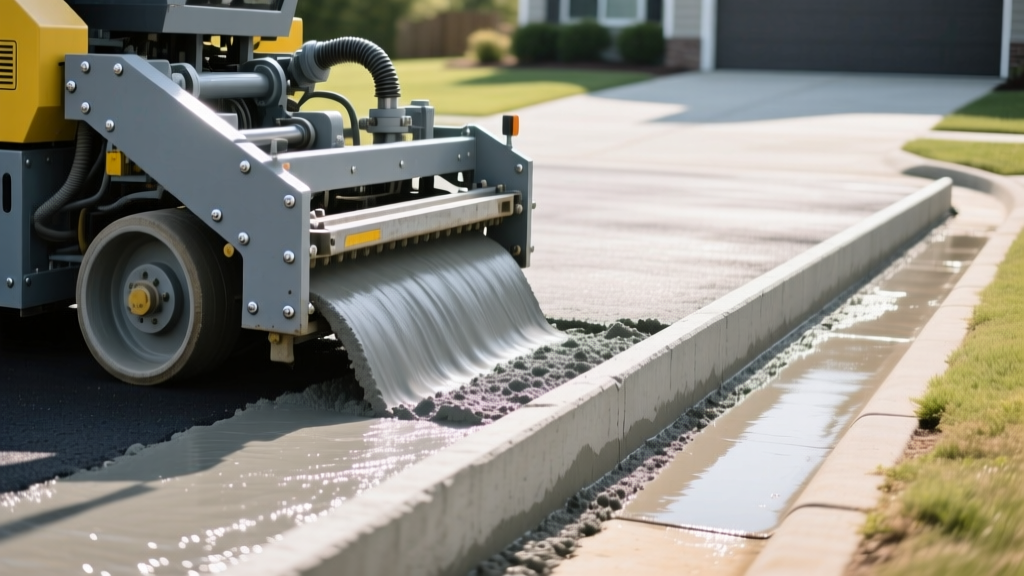
Extruded curbing is the most common method for commercial parking lots, roadways, and long residential perimeters. A slip-form paver continuously feeds concrete through an auger into a steel mold, extruding a continuous profile. Because the curb must support its own weight immediately upon exiting the mold, the mix design is highly specialized.
Mix Design Specifications for Extrusion
- Slump: Zero to 1.5 inches. The mix must be exceptionally stiff and cohesive.
- Maximum Aggregate Size: 3/8 inch to 1/2 inch. Larger 3/4-inch aggregates will jam the extruder auger and tear the surface finish.
- Target Compressive Strength: 3,000 to 4,000 PSI at 28 days.
- Air Entrainment: 5% to 8% (per ASTM C260) is mandatory in climates subject to freeze-thaw cycles to create microscopic voids that relieve internal hydraulic pressure.
Contractors often utilize a high sand-to-gravel ratio (frequently 60:40 or even 70:30) to increase the mortar volume, which acts as the 'glue' holding the extruded shape together before hydration sets. As of 2026, the average installed cost for extruded curbing ranges from $5.50 to $8.50 per linear foot, heavily dependent on the profile size (e.g., standard 6x6 inch vs. barrier profiles).
Cast-in-Place (Formed) Concrete Curbing
Cast-in-place curbing involves setting wood, steel, or plastic forms, placing reinforcement, and pouring concrete into the cavity. This method is specified for high-stress environments, such as loading docks, areas expecting heavy truck traffic, or complex radii where slip-form machines cannot easily maneuver.
Mix Design Specifications for Formed Curbs
Unlike extruded mixes, formed curbing requires a workable mix that can flow around rebar and consolidate tightly against the formwork to produce a smooth finish.
- Slump: 4 to 5 inches. High-range water reducers (superplasticizers) should be used to achieve this workability without increasing the water-cement ratio.
- Maximum Aggregate Size: 3/4 inch is standard, providing better interlock and higher ultimate strength.
- Target Compressive Strength: 4,000 to 5,000 PSI.
- Reinforcement: Typically two continuous #4 (1/2-inch) steel rebars, or macro-synthetic fibers (e.g., Fibermesh) dosed at 3 to 5 lbs per cubic yard to control plastic shrinkage cracking.
The labor intensity of setting and stripping forms makes cast-in-place curbing significantly more expensive, typically costing between $14.00 and $22.00 per linear foot in 2026. However, the resulting structural capacity and surface finish are vastly superior to extruded alternatives.
Stamped and Decorative Concrete Curbing
Used primarily in high-end residential landscaping, commercial plazas, and theme parks, stamped curbing mimics the appearance of natural stone, brick, or cobblestone. The structural base is identical to cast-in-place curbing, but the surface treatment requires specific chemical admixtures.
Decorative Mix Adjustments
To achieve deep, crisp stamp impressions without tearing the concrete surface, the mix must remain plastic for an extended period. Contractors utilize retarding admixtures to delay the initial set by 1 to 2 hours. Integral liquid colors (such as those conforming to ASTM C979) are batched directly into the truck, requiring a strict water-cement ratio (w/c) of 0.40 or lower to prevent color dilution and surface efflorescence. Following the stamping process, a secondary color release agent is applied, which must be washed off 24 to 48 hours later before sealing with a UV-stable acrylic or polyurethane sealer.
Comparison Matrix: Curbing Types & Specifications
| Feature | Extruded (Slip-Form) | Cast-in-Place (Formed) | Stamped / Decorative |
|---|---|---|---|
| Slump Tolerance | 0 - 1.5 inches | 4 - 5 inches | 4 - 5 inches |
| Max Aggregate | 3/8' or 1/2' | 3/4' | 3/4' (Pea gravel preferred) |
| Target PSI (28-day) | 3,000 - 4,000 PSI | 4,000 - 5,000 PSI | 4,000+ PSI |
| Primary Reinforcement | None or Micro-fibers | #4 Rebar or Macro-fibers | Macro-fibers + Wire Mesh |
| Avg. Cost / Linear Foot | $5.50 - $8.50 | $14.00 - $22.00 | $18.00 - $28.00 |
| Best Application | Parking lots, long perimeters | Heavy-duty aprons, tight radii | Landscaping, pedestrian plazas |
Critical Mix Design Parameters for Durability
Regardless of the placement method, the longevity of concrete curbing is dictated by its resistance to environmental degradation. According to guidelines published by the Portland Cement Association, improper mix proportions are the leading cause of premature curb failure.
Expert Warning on Water-Cement Ratios: Never allow the ready-mix driver to add water to the truck on-site to 'make it flow better' for formed curbs. Increasing the w/c ratio above 0.45 drastically increases capillary porosity, allowing deicing salts (chlorides) to penetrate the matrix and corrode internal steel reinforcement, leading to spalling within 3 to 5 years.
The Role of Air Entrainment
In northern climates, air entrainment is non-negotiable. The American Concrete Institute (ACI) mandates specific air content targets based on aggregate size and exposure conditions. For curbing exposed to deicing chemicals, a total air content of 6% to 8% provides the necessary microscopic 'relief valves' for expanding ice crystals. Field testing via a pressure meter (ASTM C231) should be conducted on every truck before placement begins.
Troubleshooting Common Curbing Failures
Plastic Shrinkage Cracking
Cause: Rapid moisture evaporation from the surface of extruded curbing due to high winds (>15 mph) or low humidity before final set.
Fix: Apply an alcohol-based evaporation retardant (e.g., MasterKure) immediately behind the extruder. Do not over-trowel the surface, as this draws bleed water and weakens the top layer.
Frost Heave and Settlement
Cause: Placing curbing directly on uncompacted topsoil or expansive clay without a proper base.
Fix: Excavate to a depth of 6 inches below the curb bottom and replace with compacted, well-draining aggregate base (e.g., 3/4-inch crushed stone) compacted to 95% Proctor density.
Surface Spalling / Scaling
Cause: Finishing the concrete while bleed water is still present on the surface, trapping water under a dense crust that flakes off during the first freeze.
Fix: Wait until all bleed water has evaporated before floating or troweling. Use a bull float or darby for initial leveling, avoiding excessive working of the surface paste.
Random Transverse Cracking
Cause: Lack of control joints in cast-in-place curbing, causing tensile stresses from thermal contraction to exceed the concrete's tensile strength.
Fix: Tool control joints every 5 feet or saw-cut joints to a depth of 1/4 the curb thickness within 12 hours of placement to force cracking at predetermined, hidden locations.
Sourcing and Specification Standards
When drafting project specifications for concrete curbing, referencing established standards ensures compliance and durability. Specify Portland cement conforming to ASTM C150 (Type I or II for general use, Type III if early form removal is required). Aggregates must meet ASTM C33 standards, ensuring they are clean, hard, and free of organic debris or excessive clay coatings that interfere with the cement paste bond.
For municipal and Department of Transportation (DOT) projects, contractors must also adhere to specific geometric profiles (such as the standard AASHTO barrier curb or mountable curb profiles) and provide batch tickets verifying the exact mix proportions, w/c ratio, and admixture dosages before the pour commences. By aligning the correct placement method with rigorous mix design parameters, engineers and contractors can deliver curbing systems that withstand decades of environmental and mechanical stress.
Written by
Elena RodriguezElena Rodriguez is a civil engineer and technical writer specializing in concrete technology, masonry systems, and ASTM/ACI compliance. She earned her B.S. in Civil Engineering from Texas A&M University and spent a decade at a materials testing laboratory, performing over 2,000 concrete compressive strength tests and masonry prism evaluations. Elena is an ACI-certified Field Testing Technician (Grade I) and a member of ASTM Committee C12 on Natural Building Stone. She currently consults on forensic engineering cases involving concrete failures and moisture intrusion. Based in San Antonio, TX, Elena is a proud member of the Society of Women Engineers (SWE) and coaches her daughter's FIRST Robotics team.
More from Elena Rodriguez
View all
Walls & Panels
Cost Analysis: Light Gauge Steel Framing Advantages and Disadvantages
Evaluate light gauge steel framing advantages and disadvantages through a strict cost analysis lens, comparing material, labor, and lifecycle expenses.
Aug 4, 2026

Walls & Panels
Gypsum Board Types: Exact Specifications, Thickness & Dimensions
Compare standard, Type X, and moisture-resistant gypsum board types. Get exact specifications, thicknesses, dimensions, and ASTM standards for your project.
Aug 4, 2026

Fire Resistance
Best Fire-Resistant Outdoor Decking Materials: 2026 Buyer Guide
Discover the best fire-resistant outdoor decking materials for 2026. Compare Class A PVC, aluminum, and hardwood options for WUI compliance and safety.
Aug 4, 2026