Cost of Pavers vs Concrete: Troubleshooting & Repair Guide
Diagnose hardscape failures and compare the cost of pavers vs concrete repair. Includes 2026 pricing, mudjacking, polymeric sand, and replacement tips.

Symptom Diagnosis: Why Your Hardscape is Failing
Before comparing the cost of pavers vs concrete repairs, you must accurately diagnose the failure mode. Hardscapes rarely fail due to the surface material itself; they fail because of subgrade movement, water intrusion, or thermal expansion. Misdiagnosing the root cause leads to recurring repairs and wasted capital. Use the diagnostic matrix below to identify your specific failure.
| Visible Symptom | Concrete Slab Root Cause | Interlocking Paver Root Cause |
|---|---|---|
| Uneven Surface / Trip Hazards | Soil erosion, frost heave, expansive clay, tree root intrusion | Base washout, improper sub-base compaction, edge restraint failure |
| Surface Degradation | Spalling, freeze-thaw scaling, de-icing salt chemical attack | Efflorescence, UV fading, moss/lichen growth in joints |
| Water Pooling | Improper slope (less than 1/4" per foot), slab settling | Clogged joint sand, failed drainage aggregate, settled base |
| Structural Cracking | Lack of control joints, shrinkage, overload stress | Rare (pavers are flexible); indicates catastrophic base failure |
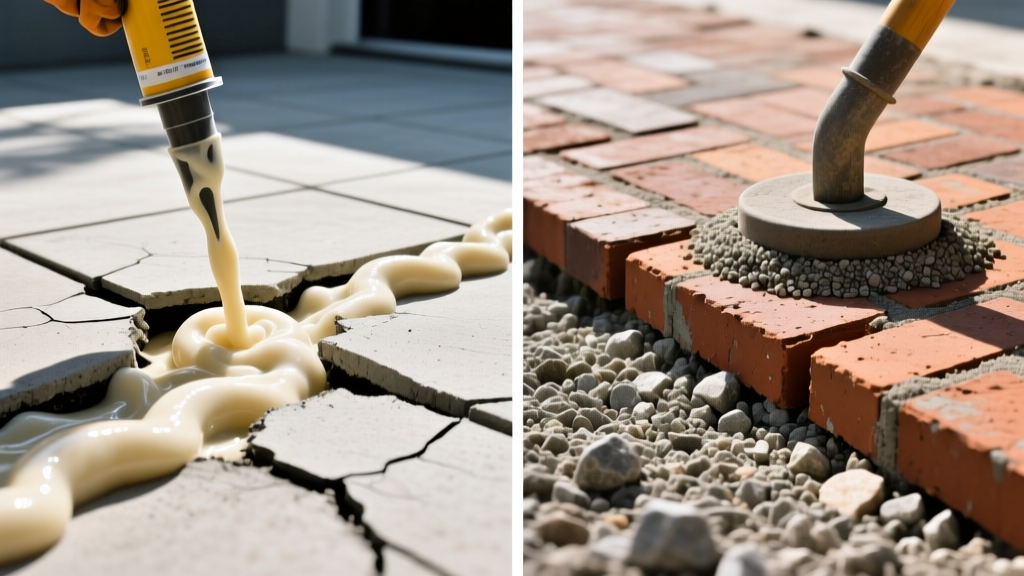
2026 Repair Cost Breakdown: Concrete vs. Pavers
When evaluating the cost of pavers vs concrete, contractors often only quote full replacement. However, targeted repairs can extend the life of your hardscape by 10 to 15 years at a fraction of the cost. According to recent industry data from Angi's concrete cost guides and paver pricing reports, material and labor rates have shifted significantly in 2026.
Concrete Slab Repair Methods & Costs
Concrete repair is highly dependent on whether the damage is cosmetic or structural. The Portland Cement Association notes that properly maintained concrete can last 50+ years, but localized failures require specific interventions.
- Polyurethane Foam Injection (Slabjacking): The gold standard for lifting settled concrete. High-density closed-cell foam (e.g., Alchemy-Spetec AP Lift 44) is injected through 5/8-inch holes. It cures in 15 minutes, weighs only 2-4 lbs per cubic foot (preventing further soil compression), and costs $5 to $9 per sq ft.
- Cement Slurry Mudjacking: A traditional method using a limestone/cement slurry. It requires larger 1.5-inch drill holes and adds significant weight to the subgrade, which can exacerbate settling in weak soils. Costs $3 to $6 per sq ft.
- Structural Crack Routing and Epoxy Injection: For cracks wider than 1/4 inch that are not actively moving. The crack is routed out and filled with structural epoxy. Costs $250 to $800 per job, depending on linear footage.
- Surface Resurfacing: For spalling and scaling where the structural integrity is intact. A polymer-modified micro-topping (e.g., Quikrete Concrete Resurfacer) is applied at 1/8-inch thickness. Costs $3 to $5 per sq ft for materials and labor.
Paver Patio Repair Methods & Costs
The primary advantage of interlocking concrete pavers is their flexibility. Because they are not a monolithic slab, they do not crack under stress. However, their joints and base require specific troubleshooting protocols.
- Edge Restraint Failure: If pavers are spreading and losing interlock at the perimeter, the edge restraint has failed. Plastic or aluminum spikes often pull out in freeze-thaw climates. The permanent fix is removing the perimeter stones and pouring a concrete restraint curb (often called a soldier course curb). Cost: $8 to $12 per linear foot.
- Joint Sand Washout: Standard joint sand washes away, leading to weed growth and paver shifting. You must power wash the joints, allow 24-48 hours of complete drying, and sweep in a high-performance polymeric sand (e.g., Alliance Gator MAXX G2). Cost: $1.50 to $3.50 per sq ft.
- Localized Base Settlement: If a specific area has sunken more than 1 inch, the crushed stone base has washed out or compacted improperly. You must pull the pavers, excavate 6-8 inches of subgrade, install geotextile fabric, add crushed angular aggregate (ASTM No. 57 or 8), compact with a plate compactor to 95% Proctor density, and relay. Cost: $6 to $12 per sq ft for the affected area.
The Replacement Tipping Point: Decision Matrix
Knowing when to stop repairing and start replacing is critical for budget management. Use this decision framework to determine if the cost of pavers vs concrete justifies a full teardown.
The 40% Rule: If the estimated cost of localized repairs exceeds 40% of the cost to completely replace the hardscape, replacement is the mathematically sound decision. Furthermore, if you are switching materials (e.g., tearing out failing concrete to install pavers), factor in the $2 to $4 per sq ft cost of concrete demolition and hauling.
When to Replace Concrete:
- The slab exhibits "D-cracking" (a series of small cracks parallel to the joints), indicating the aggregate inside the concrete is failing from freeze-thaw cycles. No surface repair will fix this.
- There are more than three major structural cracks intersecting in a single 10x10 section.
- The slab has settled more than 3 inches, making polyurethane lifting cost-prohibitive compared to replacement.
When to Replace Pavers:
- More than 30% of the patio area has differential settlement exceeding 1.5 inches, indicating a systemic failure of the entire sub-base rather than a localized washout.
- The pavers themselves are severely degraded, spalling, or heavily stained beyond the reach of chemical cleaners.
- You are trying to eliminate the recurring maintenance cost of re-sanding joints every 3 to 5 years.
Hidden Lifecycle Costs: Sealing and Long-Term Upkeep
The initial installation and immediate repair costs only tell half the story. To accurately weigh the cost of pavers vs concrete over a 20-year lifecycle, you must account for mandatory maintenance.
Concrete Maintenance: Poured concrete is relatively low-maintenance. It requires cleaning and the application of a penetrating silane/siloxane sealer every 3 to 5 years to prevent water intrusion and freeze-thaw scaling. Sealing costs roughly $1.50 to $2.50 per sq ft. Over 20 years, a 500 sq ft patio will cost approximately $1,500 to $2,500 in sealing maintenance.
Paver Maintenance: Pavers require more frequent intervention. In addition to sealing (which enhances color and prevents stains, costing $2.00 to $3.50 per sq ft), paver joints must be monitored. Even with premium polymeric sand, heavy rainfall and power washing will eventually degrade the joints. Expect to re-sand and re-seal a paver patio at least twice in a 20-year period, adding $2,500 to $4,500 in lifecycle maintenance for a 500 sq ft area.
Ultimately, while pavers offer easier localized troubleshooting and a more aesthetic, flexible surface, concrete wins on long-term lifecycle maintenance costs. Your choice should hinge on your local climate's freeze-thaw severity, soil stability, and your willingness to perform periodic joint maintenance.
Written by
Elena RodriguezElena Rodriguez is a civil engineer and technical writer specializing in concrete technology, masonry systems, and ASTM/ACI compliance. She earned her B.S. in Civil Engineering from Texas A&M University and spent a decade at a materials testing laboratory, performing over 2,000 concrete compressive strength tests and masonry prism evaluations. Elena is an ACI-certified Field Testing Technician (Grade I) and a member of ASTM Committee C12 on Natural Building Stone. She currently consults on forensic engineering cases involving concrete failures and moisture intrusion. Based in San Antonio, TX, Elena is a proud member of the Society of Women Engineers (SWE) and coaches her daughter's FIRST Robotics team.
More from Elena Rodriguez
View all
Walls & Panels
Cost Analysis: Light Gauge Steel Framing Advantages and Disadvantages
Evaluate light gauge steel framing advantages and disadvantages through a strict cost analysis lens, comparing material, labor, and lifecycle expenses.
Aug 4, 2026

Walls & Panels
Gypsum Board Types: Exact Specifications, Thickness & Dimensions
Compare standard, Type X, and moisture-resistant gypsum board types. Get exact specifications, thicknesses, dimensions, and ASTM standards for your project.
Aug 4, 2026

Fire Resistance
Best Fire-Resistant Outdoor Decking Materials: 2026 Buyer Guide
Discover the best fire-resistant outdoor decking materials for 2026. Compare Class A PVC, aluminum, and hardwood options for WUI compliance and safety.
Aug 4, 2026