Types of Concrete Coatings: Technical Specs & Failures
Compare types of concrete coatings with exact technical specs, mil thickness, ASTM standards, and chemical resistance data for industrial floors.

Substrate Profiling: The ICRI CSP Standard
The performance of any floor coating system is dictated by the mechanical interlock achieved during surface preparation. According to guidelines established by the International Concrete Repair Institute (ICRI), concrete surfaces must be profiled to a specific Concrete Surface Profile (CSP) ranging from 1 (smooth) to 9 (heavily scarified). Selecting the correct types of concrete coatings requires matching the coating chemistry to the required CSP.
- CSP 1-2 (Acid Etching / Fine Grinding): Required for thin-film penetrating sealers, waterborne acrylics, and aliphatic polyurethane topcoats (2-5 mils DFT).
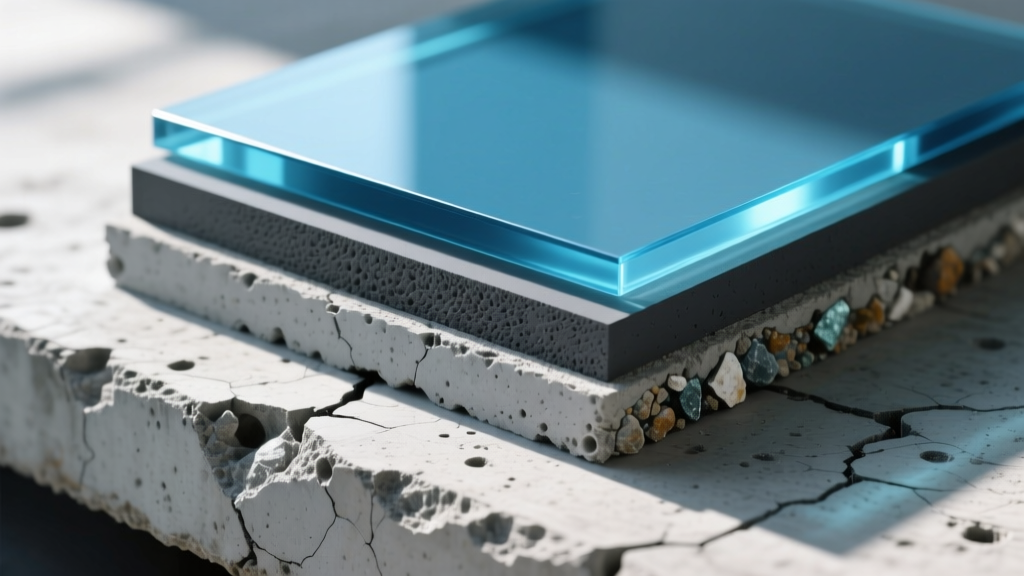
- CSP 3-5 (Diamond Grinding / Light Shot Blasting): The standard specification for 100% solids epoxy primers, self-leveling epoxy overlays, and polyaspartic base coats (10-40 mils DFT). Achieved using 30-grit metal-bond diamonds or S330 steel shot.
- CSP 6-9 (Heavy Shot Blasting / Scarification): Mandatory for cementitious urethane mortar systems (1/8" to 1/4" thickness) used in heavy thermal-shock environments like food processing plants.
100% Solids Epoxy Systems: High-Build Specifications
100% solids epoxies contain no volatile organic compounds (VOCs) or solvents, meaning the Wet Film Thickness (WFT) equals the Dry Film Thickness (DFT). These systems utilize bisphenol-A or bisphenol-F resins combined with cycloaliphatic or polyamine hardeners.
Chemical and Mechanical Metrics
Standard bisphenol-A epoxies offer excellent adhesion and mechanical strength but will chalk and yellow under UV exposure. For environments requiring extreme chemical resistance (e.g., battery rooms or chemical processing), epoxy novolac formulations are specified. Novolacs feature a higher cross-link density, providing resistance to 98% sulfuric acid and 50% sodium hydroxide.
- DFT: 10-16 mils per coat (high-build); 60-120 mils for self-leveling slurries.
- Compressive Strength: 10,000 to 12,000 psi (ASTM C579).
- Tensile Adhesion: >400 psi with 100% concrete failure (ASTM D4541).
- Pot Life: 30-45 minutes at 77°F (25°C) due to exothermic reaction mass.
Aliphatic Polyurethanes: UV and Abrasion Topcoats
Polyurethane coatings are strictly utilized as topcoats over epoxy or polyaspartic base layers. They do not possess the adhesion strength to bond directly to bare concrete, nor do they have the build thickness to fill substrate voids. Aliphatic polyurethanes utilize hexamethylene diisocyanate (HDI) prepolymers, which provide complete UV stability and color retention.
The primary technical advantage of aliphatic polyurethanes is their exceptional abrasion resistance and low coefficient of friction. When tested via the Taber Abraser method (ASTM D4060) using CS-17 wheels under a 1000g load, high-performance polyurethane topcoats exhibit a weight loss of only 20-30 mg after 1,000 cycles, compared to 80-100 mg for standard epoxies. They are applied at a strict DFT of 2 to 4 mils; exceeding this thickness can lead to solvent entrapment and intercoat adhesion failure.
Polyaspartic Esters: Rapid Cure Chemistry
Polyaspartic coatings are aliphatic polyurea derivatives that react an aliphatic polyamine with a polyisocyanate. They were engineered to solve the slow-cure limitations of traditional epoxies and the application sensitivities of pure polyureas. Polyaspartics can be applied in a single coat at 10-20 mils DFT and exhibit a return-to-service time of 2 to 4 hours, even at temperatures as low as 30°F (-1°C).
Because the reaction kinetics are highly tunable by the manufacturer, installers can select specific polyaspartic resins based on ambient conditions. A "fast-set" formulation may have a 15-minute gel time for vertical cove base applications, while a "slow-set" formulation offers a 60-minute gel time for large horizontal flatwork, allowing for back-rolling without leaving lap marks.
Technical Comparison Matrix
| Coating Chemistry | Typical DFT (Mils) | Cure to Foot Traffic (77°F) | Taber Abrasion Loss (mg) | Primary Limitation |
|---|---|---|---|---|
| Waterborne Epoxy | 3 - 5 | 12 - 24 Hours | 120 - 150 | Low chemical/build resistance |
| 100% Solids Epoxy | 10 - 120 | 12 - 18 Hours | 80 - 100 | UV degradation (chalking) |
| Aliphatic Polyurethane | 2 - 4 | 8 - 12 Hours | 20 - 30 | Poor direct-to-concrete adhesion |
| Polyaspartic Ester | 10 - 20 | 2 - 4 Hours | 30 - 40 | High material cost, short pot life |
| Cementitious Urethane | 125 - 250 | 6 - 8 Hours | 40 - 60 | Requires CSP 6-9, aesthetic limits |
Critical Failure Modes: MVT and Amine Blush
Even when specifying the correct types of concrete coatings for the mechanical load, systems frequently fail due to environmental and chemical variables during installation. The American Concrete Institute (ACI) provides extensive documentation on substrate-related failures, with moisture and humidity being the primary culprits.
Moisture Vapor Transmission (MVT) and Osmotic Blistering
When an impermeable coating (like 100% solids epoxy) is applied over a slab with high hydrostatic vapor pressure, water vapor becomes trapped. Soluble salts and alkalis in the concrete pore water create a high-solute concentration beneath the coating. Through osmosis, liquid water is drawn from the environment through the semi-permeable coating film to dilute the salts, generating immense localized pressure that results in blistering and delamination.
Before applying any high-build system, test the slab using the in-situ relative humidity probe method (ASTM F2170). Readings must be below 75% RH for standard epoxies, or below 85% RH for specialized moisture-tolerant primers. If the calcium chloride test (ASTM F1869) exceeds 5 lbs/1,000 sq. ft./24 hours, a dedicated two-part moisture mitigation epoxy primer must be applied at 12-16 mils to seal the capillaries before the primary coating is installed.
Amine Blush in Epoxy Systems
Amine blush (carbamate formation) occurs when the polyamine hardener in an epoxy system reacts with carbon dioxide and moisture in the ambient air, rather than reacting with the epoxy resin. This manifests as a waxy, greasy, or oily film on the surface of the cured epoxy. If left untreated, subsequent topcoats (like polyurethane) will experience catastrophic intercoat adhesion failure, resulting in peeling.
Amine blush is most prevalent in cold, high-humidity environments (below 60°F and >70% RH). To prevent it, maintain strict climate control during the cure cycle. If blush occurs, it cannot be removed with solvents; it must be washed with warm water and aggressively scrubbed with a stiff nylon brush, followed by a solvent wipe and mechanical sanding before topcoating. For high-humidity applications, specify epoxies formulated with cycloaliphatic amines or use polyaspartic base coats, which are entirely immune to amine blush.
Thermal Shock and Coefficient of Thermal Expansion (CTE)
In environments like commercial kitchens or food processing facilities, floors are subjected to extreme thermal shock (e.g., boiling water spills followed by cold washdowns). Standard epoxies have a CTE roughly 3 to 4 times higher than concrete. During rapid temperature drops, the epoxy contracts faster than the substrate, generating shear stresses that exceed the tensile strength of the concrete, resulting in cohesive substrate failure. In these specific scenarios, cementitious urethane mortars must be specified, as their CTE closely matches that of the concrete substrate, and their porous nature allows vapor transmission without blistering.
Written by
Priya KapoorPriya Kapoor is a real estate market analyst and construction economics researcher with expertise in housing affordability, development feasibility, and infrastructure investment. She holds a Master of Regional Planning from Cornell University and previously worked as a senior analyst at CBRE's Investment Properties group, where she modeled returns for $4B in mixed-use development pipelines. Priya now runs an independent research practice advising developers, municipalities, and REITs on construction cost forecasting and market timing. She publishes the quarterly "BuildMat Market Pulse" report tracking material price indices across 12 commodity categories. Based in Austin, TX, Priya serves on the board of Habitat for Humanity Austin and is a marathon runner.
More from Priya Kapoor
View all
Construction Cost
Cost to Build a 1600 Sq Ft Home in 2026: Full Breakdown
Accurate 2026 cost to build a 1600 sq ft home—material, labor, and regional pricing breakdowns included. Plan your budget with real-time estimates.
Aug 11, 2026

Wood & Lumber
Name the Types of Wood for Pressure Treatment and Preservation
Learn how to name the types of wood best suited for pressure treatment. Compare species treatability, chemical retention levels, and 2026 preservation costs.
Aug 4, 2026

Stone & Masonry
Stone Veneer Suppliers Lindenhurst: 2026 Cost Analysis
Analyze 2026 stone veneer costs in Lindenhurst, NY. Compare local supplier pricing, delivery fees, and Suffolk County installation labor rates.
Aug 4, 2026