Best Concrete Driveway Sealer: Scenario and Climate Matching Guide
Match your concrete driveway sealer to your climate and usage. Compare penetrating vs. film-forming sealers, costs, and failure modes for lasting protection.
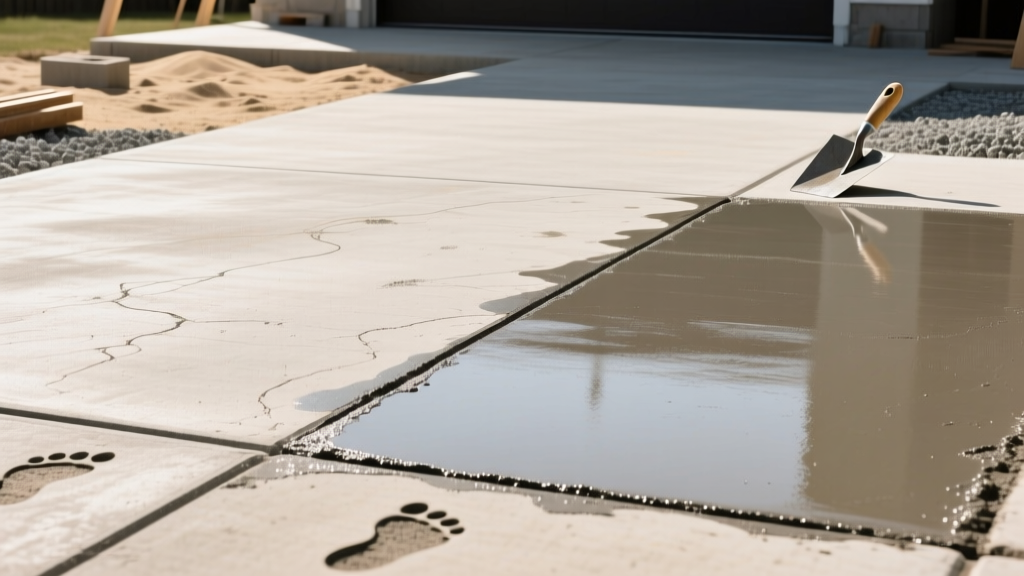
The Cost of the Wrong Choice: Common Sealer Failures
Selecting a concrete driveway sealer is not a one-size-fits-all decision. A product that performs flawlessly in the arid heat of Arizona will catastrophically fail in the freeze-thaw cycles of Minnesota. When homeowners and contractors mismatch the sealer chemistry to the environmental scenario, the result is rarely just a cosmetic issue; it often accelerates the degradation of the concrete substrate itself.
The three most common failure modes stem directly from poor scenario matching:
- Moisture Blushing (White Hazing): Occurs when a film-forming acrylic is applied to a slab with high moisture vapor transmission (MVT). The trapped vapor reacts with the sealer, creating an opaque, cloudy white film that requires chemical stripping to remove.
- Deicer Scaling and Spalling: In northern climates, using a cheap water-repellent surface spray instead of a deep-penetrating siloxane allows chloride ions from road salts to infiltrate the capillary network. According to the Portland Cement Association (PCA), this leads to osmotic pressure buildup and severe surface scaling during freeze-thaw cycles.
- UV Degradation and Yellowing: Applying aromatic polyurethanes or unmodified epoxies in high-sun exposure areas results in rapid ambering and chalking within a single summer season.
Scenario-Matching Matrix: Which Sealer Fits Your Driveway?
Use the decision matrix below to identify the optimal sealer chemistry based on your specific regional climate, concrete finish, and primary performance requirement.
| Scenario / Climate Profile | Concrete Finish Type | Optimal Sealer Chemistry | Primary Benefit |
|---|---|---|---|
| Northern climate, heavy road salt, freeze-thaw cycles | Plain gray, broom finish, or exposed aggregate | Silane/Siloxane Penetrating | Deep chloride resistance, allows vapor out |
| Southern climate, intense UV, high heat | Stamped, colored, or stained concrete | Solvent-Based Acrylic or Aliphatic Polyurethane | UV stability, color enhancement, gloss retention |
| High-traffic approach, frequent oil/gas spills | Smooth trowel or light broom | Aliphatic Polyurethane (Topcoat) | Extreme abrasion and chemical resistance |
| Newly poured slab (under 28 days old) | Any finish type | Silicate Densifier or Breathable Acrylic Cure & Seal | Meets ASTM C156 curing standards without trapping water |
Penetrating Sealers: The Freeze-Thaw and Salt Defense
Penetrating sealers do not leave a surface film. Instead, they chemically react within the concrete's capillary pores to form a hydrophobic barrier. As of 2026, stricter EPA and SCAQMD VOC regulations have pushed manufacturers to perfect water-based penetrating formulas that rival traditional solvent-based options in depth of penetration.
Silane vs. Siloxane: Understanding Molecular Size
While often sold together as hybrid blends, silanes and siloxanes behave differently based on concrete porosity:
- Silanes: Possess the smallest molecular structure, allowing them to penetrate up to 4 inches into highly porous or vertically oriented concrete. They are ideal for dense, machine-troweled surfaces where larger molecules cannot enter.
- Siloxanes: Feature larger molecules that penetrate 1 to 2 inches. They are the gold standard for horizontal driveway slabs with a standard broom finish. Products like Armor SX5000 WB (a high-solids water-based siloxane) provide excellent water absorption reduction without altering the natural traction of the broom finish.
Film-Forming Sealers: Aesthetics, Stamped Concrete, and UV
If your driveway features stamped patterns, integral colors, or acid stains, penetrating sealers will not enhance the visual depth of the concrete. Film-forming sealers are required to provide a wet-look sheen, enrich pigments, and protect the delicate surface layer of decorative concrete from UV fading and physical abrasion.
Acrylics: The Decorative Standard
Acrylic sealers are the most common choice for stamped driveways. They form a protective membrane on the surface. However, the carrier solvent dictates performance:
- Solvent-Based Acrylics (e.g., Armor AR350): These penetrate slightly into the pores before forming a film, resulting in superior adhesion and a deep, wet-look finish. They are highly breathable, reducing the risk of moisture blushing. The trade-off is higher VOC content and a strong odor during application.
- Water-Based Acrylics (e.g., Cryli-Tek 5500): These sit entirely on the surface. While environmentally friendly and low-odor, they are highly susceptible to blushing if applied when the slab's internal moisture content is too high. They generally offer a satin or matte finish rather than a high gloss.
Polyurethanes: The Heavy-Duty Topcoat
For driveways subjected to aggressive turning forces (scuffing from tires) or chemical spills, aliphatic polyurethanes provide a significantly harder, more abrasion-resistant film than acrylics. Unlike aromatic polyurethanes, aliphatic variants contain UV stabilizers that prevent yellowing. Polyurethanes require a perfectly dry, often mechanically profiled (etched or shot-blasted) substrate for proper adhesion, making them more suitable for professional application or highly specific high-wear zones like garage thresholds.
Never apply a non-breathable film-forming sealer (like standard polyurethane or epoxy) over a concrete slab that lacks a sub-slab vapor barrier or exhibits high hydrostatic pressure. The Portland Cement Association notes that trapping moisture vapor beneath an impermeable film will generate immense osmotic pressure, leading to catastrophic delamination and blistering of the sealer within weeks.
Real-World Cost and Coverage Breakdown
Budgeting for a driveway sealer requires looking beyond the per-gallon price. Coverage rates and recoat intervals drastically alter the long-term cost per square foot. Below is a 2026 market pricing guide based on a standard 1,000 sq. ft. residential driveway.
| Sealer Type | Avg. Cost Per Gallon | Coverage Rate (Sq. Ft./Gal) | Material Cost (1,000 Sq. Ft.) | Expected Lifespan |
|---|---|---|---|---|
| Water-Based Siloxane | $45 - $65 | 150 - 200 | $225 - $430 | 5 - 7 Years |
| Solvent-Based Acrylic | $50 - $75 | 100 - 125 | $400 - $750 | 2 - 3 Years |
| Aliphatic Polyurethane | $90 - $130 | 250 - 300 | $300 - $520 | 5 - 10 Years |
Note: Coverage rates vary heavily based on surface porosity. A heavily broomed, porous finish will consume up to 30% more material than a smooth trowel finish.
Application Protocol: Surface Prep and Moisture Testing
The most expensive sealer will fail if the substrate is improperly prepared. Follow this strict protocol to ensure maximum adhesion and penetration.
Step 1: Mechanical Cleaning and Etching
Power washing alone is insufficient for removing embedded dirt, efflorescence, or existing failing sealers. Use a surface cleaner attachment at a minimum of 3,000 PSI. If removing an old acrylic sealer, apply a chemical stripper (like a soy-based mastic remover) and agitate with a stiff-bristle broom before rinsing. For new concrete or when applying polyurethanes, acid etching with a diluted muriatic acid solution (or a safer citric acid alternative) is required to open the pores and provide a mechanical profile.
Step 2: The Plastic Sheet Moisture Test
Before applying any film-forming sealer, verify the slab's moisture content. Tape a 2-foot by 2-foot square of clear, 4-mil plastic sheeting tightly to the concrete in multiple areas of the driveway, ensuring the edges are completely sealed with duct tape. Leave it for 24 hours. If condensation forms under the plastic or the concrete darkens significantly, the slab is retaining too much moisture for a film-forming sealer. You must either wait for extended drying time or switch to a breathable penetrating siloxane.
Step 3: Application Timing and Technique
Apply sealers during the cooler parts of the day—early morning or late afternoon. Applying acrylics in direct, midday heat (surface temperatures above 85°F/29°C) causes the solvents to flash off too rapidly, resulting in a stringy application, roller marks, and poor film formation. Use a 3/8-inch nap lint-free roller for film-forming sealers to ensure an even mil thickness, and always maintain a wet edge to prevent lap marks. For penetrating sealers, a low-pressure pump sprayer (HVLP) followed by back-rolling with a microfiber pad ensures uniform saturation without puddling.