Concrete Pavers for Driveway: 2026 Cost & Material Calculator
Calculate exact costs and materials for concrete pavers for driveway projects in 2026. Includes paver counts, base gravel, sand, and installation pricing.
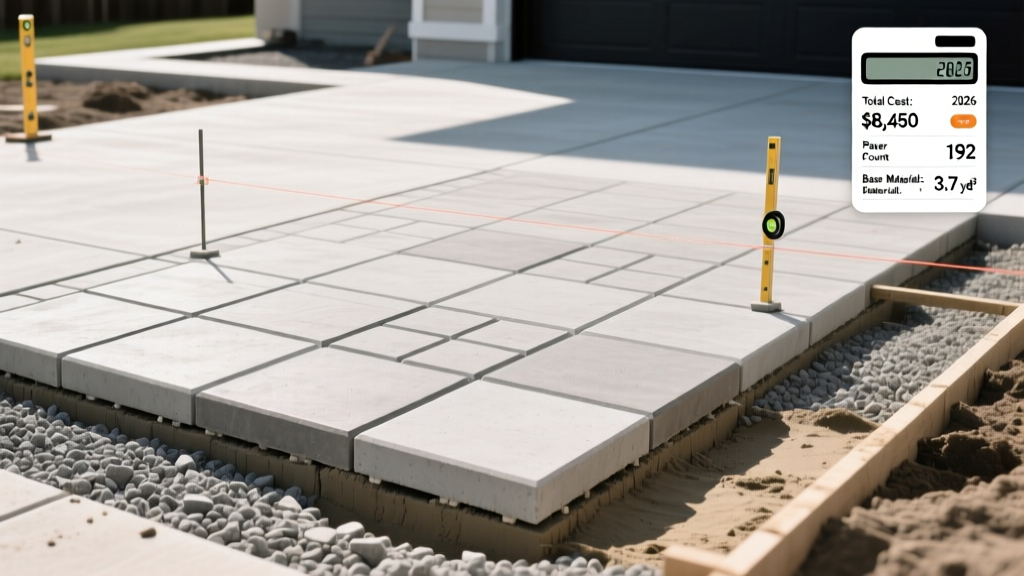
The True Cost of Concrete Pavers for Driveway Projects in 2026
Installing concrete pavers for driveway applications requires a significantly more robust structural foundation than pedestrian patios. Vehicle point-loads, turning radii, and freeze-thaw cycles dictate both the material specifications and the total project cost. In 2026, the national average for a professionally installed paver driveway ranges from $14.50 to $24.00 per square foot, encompassing excavation, base preparation, materials, and labor.
Material vs. Labor Breakdown
Labor typically accounts for 55% to 65% of the total driveway cost. Excavating 12 to 14 inches of subgrade, hauling away spoils, and compacting multiple lifts of aggregate base is highly equipment-intensive. Material costs for the pavers themselves range from $3.50 to $8.50 per square foot, while base aggregates, bedding sand, and edge restraints add another $2.50 to $4.00 per square foot.
Step-by-Step Quantity Calculator for Pavers and Base Materials
Accurate material estimation prevents project delays and minimizes the cost of returning unused pallets. Use the following calculations to determine your exact material requirements.
Step 1: Calculating Paver Counts and Overages
Paver waste factors are dictated by the laying pattern and the geometry of the driveway. Straight-running bond patterns generate the least waste, while herringbone and curved borders require extensive cutting.
- Straight or Running Bond Pattern: Add 5% to 7% waste factor.
- 45-Degree Herringbone Pattern: Add 10% waste factor.
- Curved Driveways or Circular Turnarounds: Add 12% to 15% waste factor.
Formula: (Total Square Footage × 1.10) = Total Pavers to Order.
Step 2: Base Aggregate (Crushed Stone) Volume
According to the National Concrete Masonry Association (NCMA) and legacy ICPI technical specifications, driveways require a minimum of 8 to 12 inches of compacted, open-graded crushed stone (such as ASTM D2940). Clay-heavy soils require the full 12 inches, while well-draining sandy soils may suffice with 8 inches.
Formula for 10-inch base: (Square Footage × 0.83 feet) ÷ 27 = Cubic Yards of Crushed Stone. Multiply cubic yards by 1.4 to get total tons.
Step 3: Bedding Sand and Polymeric Sand
The bedding layer must be exactly 1 inch of ASTM C33 coarse concrete sand. Never use masonry sand, as its fine particles retain moisture and cause frost heave. For the joints, polymeric sand is mandatory for driveways to prevent weed growth and joint erosion from tire friction.
| Material | Specification | Quantity per 100 Sq Ft |
|---|---|---|
| 80mm Driveway Pavers | Includes 10% waste | 110 Sq Ft |
| Base Aggregate | 10" compacted depth | 3.1 Cubic Yards (4.3 Tons) |
| Bedding Sand | ASTM C33, 1" depth | 0.31 Cubic Yards (0.45 Tons) |
| Polymeric Sand | 50 lb bags (standard joints) | 1.5 to 2 Bags |
| Edge Restraint | Heavy-duty PVC/Aluminum | Linear Perimeter Footage |
Driveway-Specific Paver Selections and Pricing
Not all concrete pavers perform equally under vehicular traffic. The surface texture, joint width, and permeability drastically alter both the material cost and the long-term maintenance requirements.
| Paver Type | 2026 Material Cost (per Sq Ft) | Best Application | Maintenance Profile |
|---|---|---|---|
| Standard Smooth-Face | $3.50 - $5.00 | Budget driveways, modern aesthetics | Low; shows tire marks and oil stains easily |
| Tumbled / Antique | $5.50 - $7.50 | Traditional homes, hiding wear and tear | Medium; wider joints require more polymeric sand |
| Permeable (Eco-Friendly) | $6.50 - $9.50 | Municipalities with strict stormwater runoff limits | High; requires annual vacuuming to prevent clogging |
Permeable concrete pavers are increasingly mandated in urban environments to manage stormwater. According to the U.S. Environmental Protection Agency (EPA), permeable pavements significantly reduce runoff volume and filter pollutants, though they require a specialized open-graded aggregate base without fines to allow water infiltration.
Hidden Costs and Edge Cases in Driveway Installations
When estimating your project, standard square-foot calculators often miss the peripheral costs that can inflate a budget by 15% to 20%. Factor in the following edge cases:
If your excavation reveals highly expansive clay or organic topsoil that cannot be fully removed, you must install a biaxial geogrid or a non-woven geotextile fabric between the subgrade and the base aggregate. This adds $0.75 to $1.25 per square foot but prevents the base stone from sinking into the clay over time.
- Heavy Equipment Access: If a skid steer or mini-excavator cannot access the driveway site due to narrow side yards or overhead wires, manual excavation and wheelbarrow transport will increase labor costs by $3.00 to $5.00 per square foot.
- Drainage Integration: Driveways must slope a minimum of 1/8 inch per foot away from the garage. If the topography requires trench drains or catch basins to manage sheet flow, add $800 to $1,500 per drain assembly to your estimate.
- Edge Restraint Spiking: Flexible PVC edge restraints must be secured with 10-inch galvanized steel spikes driven every 12 inches. In areas with heavy frost heave, upgrading to rigid aluminum restraints or pouring a concrete curb adds $4.00 to $7.00 per linear foot.
- Sealing: While not structurally required, applying a wet-look or matte solvent-based sealer protects against oil stains and UV fading. Expect to pay $1.50 to $2.50 per square foot for professional cleaning and sealing 60 days after installation.
Expert Logistics: Ordering, Delivery, and Waste Management
Concrete pavers are exceptionally heavy. A single pallet of 80mm driveway pavers covers approximately 100 to 120 square feet and weighs between 2,800 and 3,200 pounds. Standard residential delivery trucks equipped with a pallet jack can only drop pallets on flat, hard surfaces like an existing asphalt driveway or street.
If the installation site is in the backyard or requires pallets to be moved over soft ground, you must arrange for a truck with an articulating boom crane (moffett forklift), which typically incurs an additional $250 to $400 delivery surcharge. Furthermore, always order all pavers for the project in a single batch. Manufacturing dye lots vary slightly; ordering an additional 50 square feet three weeks later will likely result in a noticeable color mismatch across the driveway surface.
Finally, plan for the disposal of excavated soil. A 500-square-foot driveway excavated to a depth of 12 inches yields roughly 18.5 cubic yards of loose dirt. At an average disposal and hauling rate of $45 to $65 per cubic yard in 2026, soil removal alone will cost between $830 and $1,200. Accurately calculating these logistical variables ensures your concrete pavers for driveway project remains on budget from the first cut to the final sweep of polymeric sand.