Portland Cement vs Concrete: Mix Design Ratios and Key Differences
Understand the core differences in portland cement vs concrete. Learn ASTM mix design ratios, cement types, and structural applications for your next build.

The Fundamental Distinction: Binder vs. Composite
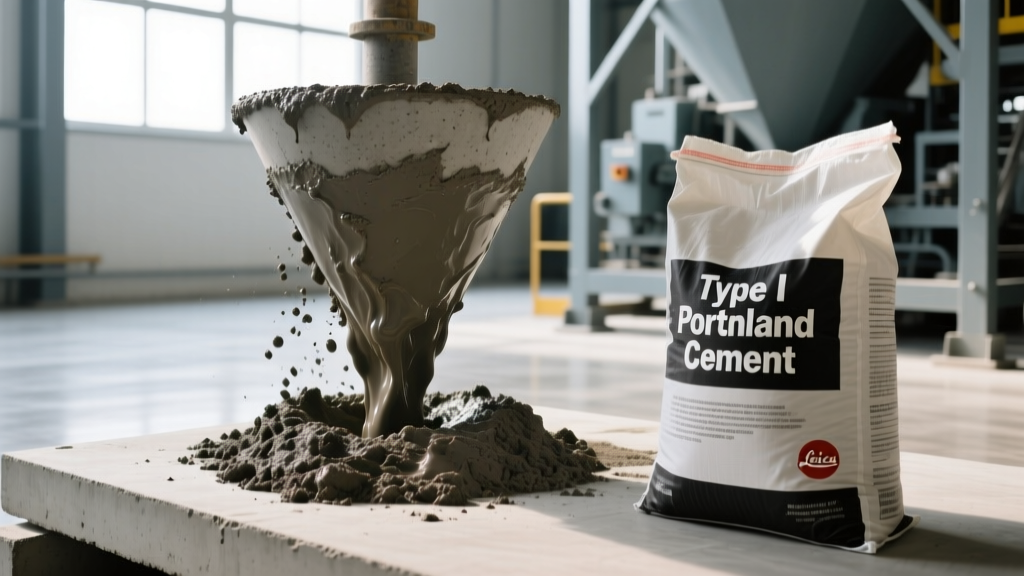
The most pervasive error in construction procurement is using the terms cement and concrete interchangeably. In material science and structural engineering, the distinction is absolute: Portland cement is a manufactured, calcined powder that acts as the chemical binder, while concrete is the final, hardened composite material formed when cement hydrates with water and binds aggregates (sand and gravel).
Equating the two leads to severe specification errors. You do not pour a 'cement sidewalk,' nor do you order a 'cement truck' to deliver structural mass. According to the Portland Cement Association, Portland cement typically constitutes only 10% to 15% of a standard concrete mix by absolute volume. The remaining 85% to 90% consists of water, fine aggregates, coarse aggregates, and chemical admixtures. Understanding this ratio is the first step in mastering mix design and structural specification.
Decoding Portland Cement: ASTM C150 Classifications
Portland cement is produced by heating limestone and clay in a rotary kiln at 1,450°C to form clinker, which is then ground with a small amount of gypsum. The resulting powder's performance is dictated by its Bogue compounds—specifically the ratios of tricalcium silicate (C3S), dicalcium silicate (C2S), tricalcium aluminate (C3A), and tetracalcium aluminoferrite (C4AF).
ASTM C150 standardizes these chemical variations into five distinct types, each engineered for specific environmental and structural demands:
| ASTM Type | Primary Chemical Focus | Blaine Fineness | Structural Application |
|---|---|---|---|
| Type I | Standard C3S/C2S ratio | ~300 m²/kg | General-purpose slabs, footings, and non-exposed structural elements. |
| Type II | Moderate C3A reduction | ~300 m²/kg | Environments with moderate sulfate exposure (e.g., soil with 0.10-0.20% sulfates). |
| Type III | High C3S, ultra-fine grind | >350 m²/kg | Cold-weather concreting, precast plants requiring rapid form removal (high early strength). |
| Type IV | Low C3S, high C2S | ~280 m²/kg | Mass concrete dams and massive piers where heat of hydration must be minimized to prevent thermal cracking. |
| Type V | Extremely low C3A (<5%) | ~300 m²/kg | Severe sulfate environments (e.g., marine structures, alkali-rich soils). |
Concrete Mix Design: Translating Cement into Structural Mass
Once the appropriate Portland cement type is selected, the focus shifts to concrete mix design, governed by ACI 211.1 (Standard Practice for Selecting Proportions for Normal, Heavyweight, and Mass Concrete). The objective is to achieve target compressive strength (f'c), workability (slump), and durability while minimizing cost and shrinkage.
Abrams' Law and the Water-Cement (w/c) Ratio
Formulated in 1918, Abrams' Law remains the bedrock of concrete technology: For a given cement and acceptable materials, the strength of concrete is inversely proportional to the ratio of water to cement.
- w/c = 0.40: Yields high-strength concrete (5,000+ psi). Requires superplasticizers for workability.
- w/c = 0.45: Standard for exterior flatwork exposed to freeze-thaw cycles (per ACI 318 durability requirements).
- w/c = 0.50 - 0.55: Typical for interior slabs-on-grade and non-structural footings (3,000 - 4,000 psi).
A critical failure mode on job sites is 'slump theft'—the unauthorized addition of water to the ready-mix truck chute to improve workability. Adding just one gallon of water per cubic yard to a 0.45 w/c mix can reduce compressive strength by up to 200 psi and significantly increase permeability, inviting chloride ingress and rebar corrosion. If slump is inadequate, specify a mid-range water reducer (ASTM C494 Type A) rather than adding water.
Supplementary Cementitious Materials (SCMs)
Modern mix designs rarely rely on 100% Portland cement. To mitigate the high carbon footprint of clinker production and improve long-term durability, engineers utilize SCMs to replace 15% to 50% of the Portland cement by weight. The Federal Highway Administration heavily advocates for ternary blends in infrastructure projects to combat alkali-silica reaction (ASR) and thermal cracking.
- Class F Fly Ash (15-25% replacement): A byproduct of anthracite coal combustion. It reacts slowly, lowering the peak heat of hydration and dramatically increasing resistance to sulfate attack and ASR. Ideal for mass foundations.
- Slag Cement (30-50% replacement): Ground granulated blast-furnace slag. Produces a denser, less permeable paste with superior late-age strength (56-day and 90-day). Whitens the concrete finish, which is preferred in architectural applications.
- Silica Fume (5-10% replacement): An ultra-fine byproduct of silicon metal production. Particles are 100 times smaller than cement grains. Essential for ultra-high-performance concrete (UHPC) exceeding 15,000 psi, but requires high-range water reducers to maintain workability.
Application-Specific Mix Proportions and Cost Benchmarks
Procurement costs vary wildly depending on whether you are purchasing raw Portland cement for site-mixed applications or ordering batched ready-mix concrete. According to data tracked by the USGS National Minerals Information Center, bulk cement pricing fluctuates based on regional kiln capacity and energy costs, while ready-mix prices are heavily influenced by local aggregate availability and diesel transport costs.
| Application | Target f'c (psi) | w/c Ratio | Cementitious Content (lbs/yd³) | Estimated Material Cost |
|---|---|---|---|---|
| Residential Slab-on-Grade | 3,000 | 0.50 | 470 lbs (Type I) | $145 - $165 / yd³ (Ready-Mix) |
| Exterior Driveway (Freeze-Thaw) | 4,000 | 0.45 | 520 lbs (Type I + 6% Air) | $160 - $185 / yd³ (Ready-Mix) |
| Commercial Structural Columns | 6,000 | 0.38 | 650 lbs (Type III + Silica Fume) | $190 - $230 / yd³ (Ready-Mix) |
| Masonry Mortar / Stucco Base | N/A | Varies | 100% Portland + Lime | $16 - $22 / 94lb Bag (Type S Mortar Cement) |
Specifier Guidelines: Avoiding Procurement Errors
When drafting project specifications or placing orders with batch plants, precision prevents costly delays. Follow these strict protocols:
- Never specify 'cement' when you mean 'concrete'. If a contractor requests '30 yards of cement,' they are technically ordering 30 yards of dry powder, which would cost upwards of $12,000 and require on-site batching. Specify '30 yards of 4,000 psi ready-mix concrete.'
- Define the exposure class, not just the psi. ACI 318 mandates that concrete exposed to deicing chemicals must meet Exposure Class F3, which dictates a maximum w/c ratio of 0.45 regardless of whether the structural engineer only calculated a need for 3,000 psi strength.
- Account for SCM delays in cold weather. If your mix design includes 30% Class F fly ash to reduce costs, be aware that early strength gain will be significantly retarded. In ambient temperatures below 40°F (4°C), substitute fly ash with Type III Portland cement or request an accelerating admixture (ASTM C494 Type C) to prevent freeze damage during the initial curing window.
Mastering the intersection of Portland cement chemistry and concrete mix design requires moving beyond generic rules of thumb. By selecting the precise ASTM cement type, strictly controlling the water-cement ratio, and leveraging SCMs for specific environmental exposures, engineers and contractors can optimize both the structural longevity and the economic efficiency of their built environment.
Written by
Sarah WhitfieldSarah Whitfield is a chartered quantity surveyor (MRICS) and construction cost analyst with 15 years of experience in material pricing, procurement strategy, and project budgeting. She earned her degree in Construction Management from the University of Reading (UK) and has worked on projects ranging from $2M custom homes to $180M mixed-use developments across North America and Europe. Sarah currently leads cost estimating for BuildMat Insight, maintaining a proprietary database of 4,000+ material price points updated quarterly. She is a frequent contributor to RSMeans cost data panels and has presented at the International Cost Engineering Council (ICEC) congress. Based in Denver, CO, Sarah is an avid trail runner and volunteer mentor for Women in Construction.
More from Sarah Whitfield
View all
Wood & Lumber
What Are the Different Types of Wood? A Builder's Guide
Compare structural softwoods, finish hardwoods, and engineered lumber. Analyze Janka ratings, MOE values, and 2026 pricing for construction.
Aug 4, 2026

Walls & Panels
Steel Framing vs Wood Framing: Corrosion and Moisture Defense
Compare steel framing vs wood framing for moisture resistance. Learn about galvanized coatings, condensation risks, and corrosion protection strategies.
Jul 21, 2026

Stone & Masonry
How to Cut Stone Veneer: Wet Saw vs Grinder Comparison
Compare the best tools for cutting stone veneer. We review wet saws, angle grinders, and chop saws to help you achieve clean, chip-free cuts.
Jul 21, 2026