Concrete Pavers vs Brick Pavers: Technical Specs & Load Data
Compare concrete pavers vs brick pavers with exact ASTM specs, compressive strength data, absorption rates, and load-bearing capacities.

Core Material Composition & Manufacturing Standards
Specifying paving materials for commercial or high-traffic residential projects requires moving beyond aesthetic preferences to evaluate structural performance. When evaluating concrete pavers vs brick pavers, the fundamental difference lies in their manufacturing processes and the resulting material matrix. Concrete pavers are manufactured using a zero-slump, high-density concrete mix that is vibro-compacted and extruded. Clay brick pavers are formed from natural shale or clay and fired in kilns at temperatures exceeding 1,800°F (982°C), creating a vitrified ceramic structure.
Governing ASTM Standards
Both materials are governed by strict ASTM International standards that dictate minimum performance thresholds:
- Concrete Pavers (ASTM C936): Standard Specification for Solid Concrete Interlocking Paving Units. This standard mandates a minimum compressive strength of 8,000 psi and a maximum water absorption limit to ensure freeze-thaw durability.
- Clay Brick Pavers (ASTM C902): Standard Specification for Pedestrian and Light Traffic Paving Brick. Brick pavers are classified by weathering resistance. For exterior applications in freezing climates, architects must specify Class SX (Severe Weathering), which requires a minimum compressive strength of 10,000 psi and a maximum saturation coefficient of 0.78.
Compressive Strength & Load-Bearing Matrix
The load-bearing capacity of a paving system is a function of the paver's compressive strength, thickness, and the underlying base preparation. While both materials exceed the requirements for pedestrian traffic, their performance under heavy vehicular loads differs significantly.
| Specification | Concrete Pavers (ASTM C936) | Clay Brick Pavers (ASTM C902 Class SX) |
|---|---|---|
| Minimum Compressive Strength | 8,000 psi | 10,000 psi |
| Average Flexural Strength | 600 - 800 psi | 1,200 - 1,500 psi |
| Standard Pedestrian Thickness | 2-3/8 in. (60 mm) | 2-1/4 in. to 2-5/8 in. (57-67 mm) |
| Standard Vehicular Thickness | 3-1/8 in. (80 mm) | Not typically rated for heavy vehicular |
| Max Water Absorption | 5.0% (or 0.5 g/cm³) | 7.0% (Varies by specific class) |
| Average Weight (per sq. ft.) | 11.5 lbs (60mm) / 15 lbs (80mm) | 10.5 lbs (Standard modular) |
Heavy-Duty Vehicular Warning: For fire lanes, loading docks, or streets subjected to H-20 highway loading (e.g., garbage trucks, fire apparatus), you must specify 3-1/8" (80mm) or 4-3/4" (120mm) concrete pavers. Clay brick pavers lack the standardized thickness options and interlocking shear-transfer geometry required to distribute dynamic point loads from heavy axles without cracking or rutting.
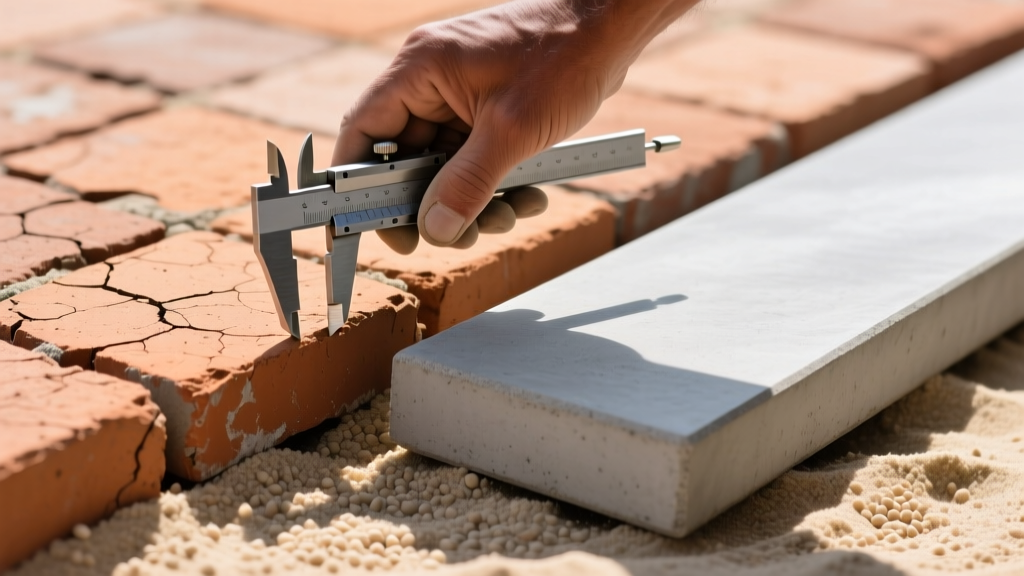
Moisture Absorption & Freeze-Thaw Durability
Freeze-thaw cycling is the primary failure mechanism for paving materials in northern climates. The way concrete and clay react to trapped moisture freezing and expanding dictates their long-term durability.
Failure Modes: Scaling vs. Spalling
Concrete pavers rely on a dense matrix and microscopic air-entrainment to survive freeze-thaw cycles. If the concrete mix lacks proper air voids (typically 4% to 6% air content), the hydraulic pressure from freezing water causes surface scaling, where the top 1/16" of the paver flakes off over time. High-quality manufacturers adhere strictly to ASTM C936 absorption limits to mitigate this.
Clay brick pavers, being a fired ceramic, are inherently more brittle but highly resistant to surface abrasion. However, if a brick paver's absorption rate is too high, water enters the porous clay body. When this water freezes, the internal tensile stress exceeds the brick's modulus of rupture, causing spalling or catastrophic shear cracking. This is why specifying ASTM C902 Class SX (with a strict saturation coefficient) is non-negotiable in freeze-thaw zones.
Efflorescence Profiles
Efflorescence—the white, powdery salt deposit on paving surfaces—affects both materials but through different chemical pathways. Concrete pavers produce primary efflorescence as calcium hydroxide from the cement hydration process migrates to the surface and reacts with atmospheric CO2 to form calcium carbonate. This is typically most severe in the first 12 to 24 months and eventually dissipates. Clay brick pavers are more prone to secondary efflorescence driven by soluble salts (like magnesium or sodium sulfates) present in the raw clay or the underlying base material, which can be more persistent and require specialized chemical cleaners.
Dimensional Tolerances & Installation Specifications
The manufacturing process directly impacts dimensional consistency, which in turn dictates the installation methodology and jointing requirements.
Tolerances and Joint Widths
Concrete pavers are extruded through steel molds and vibro-compacted, resulting in exceptional dimensional uniformity. ASTM C936 allows a maximum dimensional variation of just ±1/16" (1.5 mm). This precision allows for tight joints (typically 1/16" to 1/8") and facilitates complex, interlocking laying patterns like herringbone, which are critical for transferring lateral shear forces in vehicular applications.
Clay brick pavers undergo significant shrinkage and warping during the kiln firing process. ASTM C902 permits larger dimensional tolerances (often ±1/8" or more). Because of this variation, brick pavers require wider joints (1/4" to 3/8") and are generally laid in running bond or stack bond patterns. Attempting a tight herringbone pattern with standard clay brick often results in cumulative alignment errors and uneven joint lines.
Base Preparation & Bedding Sand
Both systems require a properly engineered base. According to guidelines published by the Interlocking Concrete Pavement Institute (ICPI) and the Brick Industry Association (BIA), the structural base must consist of ASTM D2940 graded aggregate, compacted to 95% Standard Proctor density.
- Base Thickness: 4 to 6 inches for pedestrian; 8 to 12+ inches for vehicular, depending on subgrade CBR (California Bearing Ratio).
- Bedding Sand: A 1-inch (25 mm) layer of ASTM C33 washed concrete sand is mandatory. Never use ASTM C144 masonry sand, as the fine particles will wash out into the base, causing settlement and unevenness.
- Edge Restraint: Rigid edge restraints (poured-in-place concrete curbs or heavy-duty spike-in plastic restraints) are required for both materials to prevent lateral creep and loss of interlock.
Cost Analysis & Lifecycle Maintenance
While material costs fluctuate based on regional manufacturing and freight, the total installed cost provides a clearer picture of project feasibility.
- Concrete Pavers: Material costs range from $3.50 to $7.00 per square foot. Total installed costs typically fall between $12.00 and $22.00 per square foot. Maintenance involves re-sanding joints every 3-5 years and occasional sealing to protect against UV fading and oil stains.
- Clay Brick Pavers: Material costs range from $8.00 to $16.00+ per square foot. Total installed costs typically range from $20.00 to $35.00 per square foot. Clay brick is colorfast (UV stable) and rarely requires sealing, but individual units may need replacement if heavy point-loads cause spalling.
Decision Framework: When to Specify Which
Use the following technical criteria to finalize your specification:
Specify Concrete Pavers When:
- The project involves vehicular traffic, fire lanes, or heavy dynamic loads requiring 80mm or 120mm thickness.
- You require complex interlocking patterns (like 45-degree or 90-degree herringbone) to manage shear forces.
- Strict dimensional tolerances are needed for large-format, modern architectural layouts with minimal joint lines.
- Budget constraints require a lower material cost without sacrificing structural load capacity.
Specify Clay Brick Pavers When:
- The project is strictly pedestrian (plazas, walkways, patios) and requires superior UV color stability over a 50+ year lifecycle.
- The design calls for traditional, historic, or rustic aesthetics where slight dimensional variations and tumbled edges are desirable.
- The environment involves high exposure to de-icing salts, as high-quality Class SX clay brick is virtually impervious to salt scaling compared to concrete.
- Surface abrasion resistance is paramount, such as in high-foot-traffic commercial courtyards where concrete surface textures might wear smooth over decades.
By aligning the material specification with the exact ASTM standards, load requirements, and environmental conditions of the site, engineers and architects can eliminate premature paving failures and ensure long-term structural integrity.
Written by
Priya KapoorPriya Kapoor is a real estate market analyst and construction economics researcher with expertise in housing affordability, development feasibility, and infrastructure investment. She holds a Master of Regional Planning from Cornell University and previously worked as a senior analyst at CBRE's Investment Properties group, where she modeled returns for $4B in mixed-use development pipelines. Priya now runs an independent research practice advising developers, municipalities, and REITs on construction cost forecasting and market timing. She publishes the quarterly "BuildMat Market Pulse" report tracking material price indices across 12 commodity categories. Based in Austin, TX, Priya serves on the board of Habitat for Humanity Austin and is a marathon runner.
More from Priya Kapoor
View all
Construction Cost
Cost to Build a 1600 Sq Ft Home in 2026: Full Breakdown
Accurate 2026 cost to build a 1600 sq ft home—material, labor, and regional pricing breakdowns included. Plan your budget with real-time estimates.
Aug 11, 2026

Wood & Lumber
Name the Types of Wood for Pressure Treatment and Preservation
Learn how to name the types of wood best suited for pressure treatment. Compare species treatability, chemical retention levels, and 2026 preservation costs.
Aug 4, 2026

Stone & Masonry
Stone Veneer Suppliers Lindenhurst: 2026 Cost Analysis
Analyze 2026 stone veneer costs in Lindenhurst, NY. Compare local supplier pricing, delivery fees, and Suffolk County installation labor rates.
Aug 4, 2026