Cement vs Concrete vs Asphalt: Technical Specs & Load Limits
Compare cement vs concrete vs asphalt with technical specs, ASTM standards, load limits, and structural data for engineering and construction.

The Fundamental Chemistry: Binder vs. Composite vs. Bitumen
The terms cement, concrete, and asphalt are frequently conflated in non-technical construction discourse, but they represent fundamentally distinct material classes with unique structural behaviors. Understanding the technical specifications of each is critical for structural engineers, pavement designers, and general contractors to prevent catastrophic load failures and premature degradation.
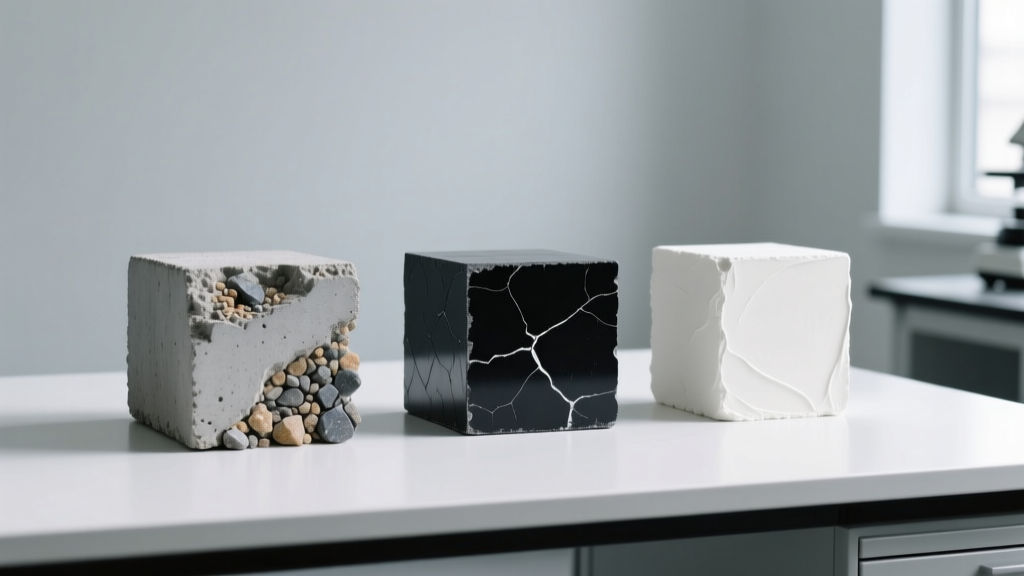
Portland cement is a hydraulic binder. Concrete is a composite material utilizing cement as the glue to bind aggregates. Asphalt (specifically Hot Mix Asphalt or HMA) is a flexible pavement composite utilizing bitumen—a petroleum-derived viscoelastic binder—to coat and bind mineral aggregates. The mechanical performance of each material is governed by entirely different ASTM standards and failure mechanisms.
Material Specification Matrix
The following matrix contrasts the core mechanical properties of pure cement paste, standard structural concrete, and dense-graded asphalt concrete under standard testing conditions (70°F / 21°C).
| Technical Property | Portland Cement (Pure Paste) | Structural Concrete (ACI 318) | Asphalt Concrete (HMA) |
|---|---|---|---|
| Compressive Strength | 4,000 - 8,000 psi | 3,000 - 10,000+ psi | N/A (Measured via Dynamic Modulus: 1,000,000 - 4,000,000 psi) |
| Tensile Strength | ~400 psi | 300 - 600 psi (Modulus of Rupture) | 100 - 200 psi (Indirect Tensile) |
| Modulus of Elasticity (E) | ~2,000,000 psi | 3,000,000 - 5,000,000 psi | Highly temperature-dependent (Viscoelastic) |
| Thermal Expansion Coefficient | 6.0 x 10^-6 /°F | 5.5 x 10^-6 /°F | 1.1 x 10^-5 /°F |
| Primary ASTM Standard | ASTM C150 | ASTM C33 (Aggregates) / ACI 318 | ASTM D6373 / AASHTO M 323 |
| Failure Mode | Brittle fracture, shrinkage cracking | Shear failure, spalling, ASR | Rutting (plastic flow), fatigue cracking |
Cement (The Binder): Technical Limitations & Hydration Specs
Pure cement is never used as a standalone structural building material. It is the reactive powder that, when mixed with water, undergoes an exothermic hydration process to form calcium silicate hydrate (C-S-H) gel. The Portland Cement Association outlines that the primary compounds in ASTM C150 Portland cement are tricalcium silicate (C3S) for early strength, and dicalcium silicate (C2S) for late strength.
Applying pure cement paste as a structural slab or pavement will result in immediate failure. Without coarse and fine aggregates to interrupt crack propagation and provide dimensional stability, pure cement paste experiences massive volumetric shrinkage (up to 8%) during hydration, leading to severe map cracking and structural disintegration under minimal tensile loads.
For specialized applications, engineers specify distinct cement types. Type III (High Early Strength) features a finer grind and higher C3S content, achieving 3,000 psi compressive strength in 24 hours, making it ideal for precast concrete manufacturing and cold-weather pours. Type V (Sulfate Resistant) limits tricalcium aluminate (C3A) to under 5% to prevent ettringite formation and subsequent expansion in sulfate-rich soils.
Concrete (The Composite): Structural Load & Mix Designs
Concrete derives its structural integrity from the interlocking matrix of coarse aggregate (gravel/crushed stone), fine aggregate (sand), and the hydrated cement paste. The American Concrete Institute (ACI) governs structural design through the ACI 318 Building Code, which dictates minimum compressive strengths ($f'_c$) and reinforcement cover requirements.
Critical Mix Design Parameters
- Water-Cement Ratio (w/c): The single most critical variable in concrete durability. According to Abrams' Law, a lower w/c ratio yields higher strength. For exterior flatwork exposed to freeze-thaw cycles, ACI 318 mandates a maximum w/c ratio of 0.45. High-performance structural columns often utilize a w/c ratio of 0.35, requiring superplasticizers (HRWRs) to maintain workability.
- Air Entrainment: Microscopic air bubbles (10 to 1,000 micrometers) must be intentionally introduced using ASTM C260 admixtures. For exterior concrete in northern climates, a total air content of 5% to 8% is mandatory. These voids provide hydraulic relief chambers for expanding water during freezing, preventing surface spalling and D-cracking.
- Alkali-Silica Reaction (ASR) Mitigation: In aggregates containing reactive silica, the high pH of cement paste causes a swelling gel that shatters the concrete from within. Specifications require limiting alkali content to < 3.0 lbs/yd³ or substituting 20-30% of the Portland cement with Class F fly ash or slag cement to mitigate ASR.
Asphalt (The Flexible Pavement): Viscoelastic Properties
Asphalt concrete (commonly referred to simply as asphalt) behaves fundamentally differently than Portland cement concrete. It is a viscoelastic material, meaning its stiffness and load-bearing capacity are highly dependent on both temperature and the rate of loading. At high temperatures or under slow-moving loads, it behaves like a viscous liquid (leading to rutting). At low temperatures or under high-speed impact, it behaves like an elastic solid (leading to thermal cracking).
Superpave Performance Grading (PG)
The industry standard for specifying asphalt binders is the Superpave Performance Grading system. A binder designated as PG 64-22 is engineered to maintain its structural integrity without excessive rutting at a maximum 7-day average pavement temperature of 64°C, and without thermal cracking at a minimum single-day temperature of -22°C. The National Asphalt Pavement Association provides extensive guidelines on matching PG grades to local microclimates and traffic volumes.
Viscoelasticity dictates that an 18-wheeler parked on an asphalt pad for 48 hours in 95°F heat will cause permanent rutting, whereas the same vehicle driving over the pad at 60 mph in the same heat will cause only recoverable elastic deflection.
Decision Framework: Selecting the Right Material by Load & Environment
Choosing between concrete and asphalt for paving and structural applications requires analyzing the specific load vectors, environmental exposures, and lifecycle cost tolerances.
Rigid Pavement (Concrete)
- Best For: High static loads, industrial ports, weigh stations, and airports.
- Load Distribution: High flexural strength distributes loads over a wide subgrade area. Less dependent on subgrade bearing capacity.
- Environment: Resists fuel spills, de-icing salts (if properly air-entrained), and high ambient heat without softening.
Flexible Pavement (Asphalt)
- Best For: High-speed highways, residential streets, and areas with poor/expansive subgrades.
- Load Distribution: Relies on grain-to-grain load transfer through the aggregate layers. Requires a highly compacted, stable subbase.
- Environment: Superior resistance to freeze-thaw heaving (flexes rather than cracks). Vulnerable to petroleum-based chemical spills which dissolve the bitumen binder.
Lifecycle Degradation & Maintenance Intervals
From a facility management perspective, the technical specifications directly dictate the maintenance lifecycle and total cost of ownership.
Concrete Lifecycle: Properly designed structural concrete (w/c < 0.40, adequate cover over rebar) has a functional lifespan of 40 to 60 years for pavements and 75+ years for structures. The primary degradation vector is chloride ion ingress leading to rebar corrosion. Maintenance involves periodic joint sealing and diamond grinding every 15-20 years to restore ride quality and friction.
Asphalt Lifecycle: Dense-graded HMA pavements typically require structural overlays every 15 to 20 years. The primary degradation vector is binder oxidation, which strips the maltenes from the bitumen, rendering the pavement brittle and susceptible to top-down fatigue cracking. Preventative maintenance requires fog seals or chip seals every 5 to 7 years to replenish surface binder and seal micro-cracks before moisture infiltrates the subgrade.
Written by
James ThorntonJames Thornton is a construction industry veteran with 25 years of hands-on experience in wood framing, lumber grading, and residential building codes. He started as a framing carpenter in rural Oregon, earned his ICC Residential Building Inspector certification, and eventually became a senior plan reviewer for the City of Portland Bureau of Development Services. James holds a B.S. in Wood Science & Technology from Oregon State University and is a certified lumber grader through the West Coast Lumber Inspection Bureau (WCLIB). He has inspected over 3,000 residential construction sites and authored the city's internal guide on advanced framing techniques (2x6 at 24" O.C.). James lives in Bend, OR, where he builds custom timber-frame cabins and competes in lumberjack sports.
More from James Thornton
View all
Insulation
Best Home Insulation Materials: Complete 2026 Guide
Compare top home insulation materials for 2026. Find R-values, installed costs per square foot, and best uses for fiberglass, spray foam, and mineral wool.
Aug 4, 2026

Sustainable Building
Certify Your Green Building Material for LEED and WELL
Step-by-step guide to certifying a green building material for LEED v5 and WELL v2. Master EPDs, HPDs, and VOC limits for 2026 project specifications.
Aug 4, 2026

Stone & Masonry
Veneer Stacked Stone Panels: Interior Design & Style Showcase
Discover how veneer stacked stone panels transform interiors. Explore modern design profiles, material pairings, and technical installation specs.
Aug 4, 2026