True Price of Asphalt vs Concrete Driveway: 2026 Repair Costs
Discover the true price of asphalt vs concrete driveway ownership in 2026. Compare install costs, failure modes, and long-term repair expenses.

The Illusion of the Initial Bid
When homeowners evaluate the initial price of asphalt vs concrete driveway installations, asphalt typically wins the short-term bidding war. In 2026, a standard 600-square-foot asphalt driveway costs between $5,400 and $9,000 ($9 to $15 per square foot), while a comparable broom-finished concrete slab ranges from $7,200 to $13,200 ($12 to $22 per square foot). However, analyzing the price of asphalt vs concrete driveway ownership strictly through the lens of initial installation is a critical financial error. As building materials diagnosticians, we evaluate these surfaces based on their failure modes, maintenance intervals, and repair economics. A cheaper initial bid often masks a higher 30-year Total Cost of Ownership (TCO) driven by relentless maintenance cycles.
The 30-Year TCO Reality Check
Asphalt: Requires sealcoating every 3-4 years, annual crack filling, and a mill-and-overlay at year 15-20.
Concrete: Requires joint resealing every 5-7 years and occasional slabjacking.
Verdict: While concrete costs 30-40% more upfront, its 30-year cumulative maintenance cost is often 50% lower than asphalt, effectively equalizing the long-term price of asphalt vs concrete driveway ownership.
Asphalt Driveway Troubleshooting: Viscoelastic Failures
Asphalt is a viscoelastic material, meaning it flexes under load and temperature changes. Its primary vulnerability lies in the bitumen binder, which is highly susceptible to environmental degradation. According to the Federal Highway Administration (FHWA), proper subgrade preparation and binder grade selection are the only ways to mitigate premature flexible pavement failures.
Alligator Cracking & Subgrade Yielding
Alligator (or fatigue) cracking appears as interconnected, web-like fissures. This is not a surface defect; it is a structural failure indicating that the 6-inch crushed aggregate base beneath the asphalt has yielded due to water infiltration or inadequate compaction.
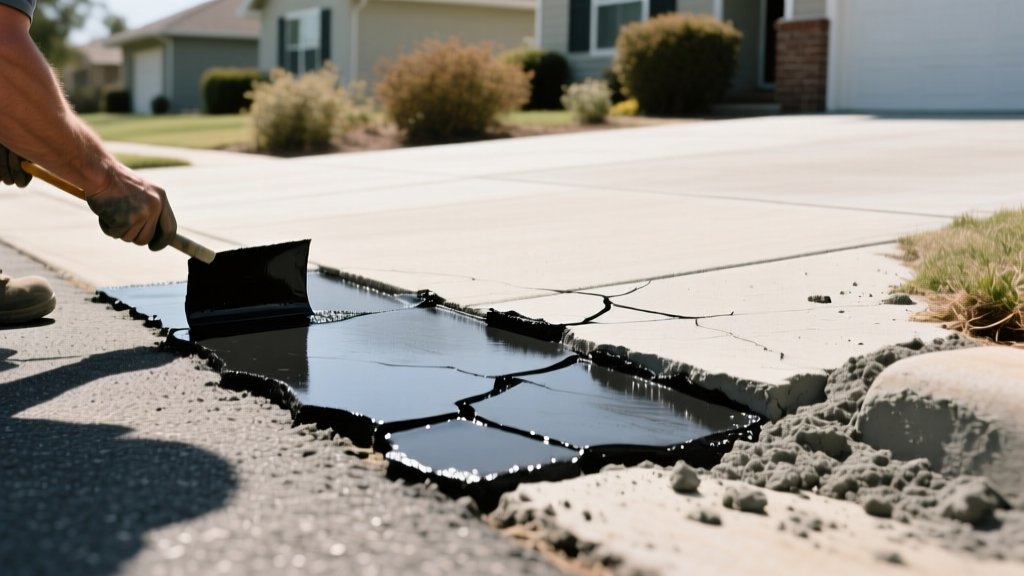
- The Amateur Fix: Pouring liquid crack filler over alligator cracks. This fails within 6 months as the unstable base continues to shift, causing the crack to reflect through the new filler.
- The Professional Repair: Saw-cutting the affected area, excavating the compromised base, re-compacting with 3/4-inch minus crushed rock, and patching with hot-mix asphalt or a high-performance cold patch (e.g., Sakrete U.S. Cold Patch).
- 2026 Repair Cost: $6.00 to $11.00 per square foot for full-depth patching.
Binder Oxidation & Raveling
UV radiation causes photo-oxidation of the asphalt binder. The lighter maltenes evaporate, leaving behind brittle asphaltenes. The surface turns gray, and the aggregate begins to loosen (raveling). If caught early, this is reversed by applying a coal tar or asphalt emulsion sealer. If ignored, the surface loses its waterproofing capability, allowing water into the base.
- Maintenance Interval: Every 3 to 4 years.
- 2026 Repair Cost: $0.25 to $0.50 per square foot for professional sealcoating.
Concrete Driveway Troubleshooting: Rigid Pavement Defects
Concrete is a rigid pavement relying on the structural integrity of its Portland cement paste and aggregate matrix. The American Concrete Institute (ACI) Committee 546 outlines that concrete failures are rarely structural; they are almost always environmental or chemical reactions occurring at the surface level or within the control joints.
Freeze-Thaw Scaling & De-Icer Spalling
When water trapped in the concrete's capillary pores freezes, it expands by 9%. Properly mixed driveway concrete includes 'air-entrainment'—microscopic bubbles that give expanding ice room to move. If the concrete was over-troweled during installation (trapping water and sealing the surface) or if harsh de-icing salts like calcium chloride are used, the osmotic pressure causes the top 1/8-inch of the surface to flake off, known as scaling.
- The Repair Protocol: Pressure wash the spalled area, apply a concrete bonding adhesive, and trowel on an ASTM C928-compliant rapid-hardening polymer-modified patching compound (e.g., Quikrete Vinyl Concrete Patcher).
- 2026 Repair Cost: $3.00 to $6.00 per square foot for localized patching; $4.00 to $8.00 per square foot for full-slab resurfacing.
Differential Settlement & Slab Voiding
Unlike asphalt, which bends and potholes when the base washes out, concrete bridges voids until the tensile limit is reached, resulting in sudden, catastrophic snapping or severe tilting. This is usually caused by downspouts dumping water near the slab edge, washing away the supporting soil.
- Traditional Mudjacking: Pumping a cementitious slurry under the slab. It costs less but the slurry weighs 100+ lbs per cubic foot, which can cause further subsidence in weak soils.
- Polyurethane Slabjacking: Injecting high-density structural foam. The foam weighs only 2-3 lbs per cubic foot, cures in 15 minutes, and is impervious to water.
- 2026 Repair Cost: $5.00 to $8.00 per square foot for mudjacking; $9.00 to $15.00 per square foot for polyurethane lifting.
2026 Repair Cost Matrix: Head-to-Head
The following matrix breaks down the specific troubleshooting scenarios and their associated repair costs to help you forecast long-term expenses.
| Failure Mode | Material | Repair Method | 2026 Cost (per Sq Ft) | Repair Lifespan |
|---|---|---|---|---|
| Surface Oxidation | Asphalt | Sealcoating | $0.25 - $0.50 | 3-4 Years |
| Linear Shrinkage Cracks | Asphalt | Hot-Pour Crack Fill | $1.50 - $3.00 / linear ft | 2-3 Years |
| Subgrade Failure | Asphalt | Full-Depth Patching | $6.00 - $11.00 | 10+ Years |
| Joint Degradation | Concrete | Joint Resealing | $2.00 - $4.00 / linear ft | 5-7 Years |
| Surface Scaling | Concrete | Polymer Resurfacing | $4.00 - $8.00 | 10-15 Years |
| Slab Settlement | Concrete | Polyurethane Lifting | $9.00 - $15.00 | 15+ Years |
The Decision Framework: When to Patch vs. Replace
Understanding the true price of asphalt vs concrete driveway maintenance requires knowing when a repair is throwing good money after bad. Use this diagnostic framework before hiring a contractor.
Sourcing Materials for DIY Driveway Triage
For minor troubleshooting, DIYers can achieve professional results by selecting the correct material specifications rather than generic hardware store fillers:
- For Asphalt Edge Raveling: Avoid standard 'cold patch' bags that remain soft. Source a high-performance, solvent-free cold asphalt emulsion patch that cures via compaction and evaporation, allowing you to feather the edges down to 1/2-inch.
- For Concrete Hairline Cracks: Do not use standard caulk. Use a low-viscosity, gravity-fed epoxy or polyurethane concrete crack injector. These penetrate deep into the micro-fissures, bonding the internal aggregate and preventing water from reaching the rebar or dowel bars beneath.
- For Concrete Joint Maintenance: Rout out old, hardened joint filler with an angle grinder and a diamond crack-chasing blade. Clean with compressed air, insert a closed-cell polyethylene backer rod, and cap with a self-leveling polyurethane joint sealant (e.g., SikaFlex-1C SL). This restores the waterproof barrier and prevents incompressible debris from spalling the joint edges during thermal expansion.
Ultimately, the price of asphalt vs concrete driveway ownership is dictated by your willingness to perform proactive maintenance. Asphalt demands frequent, low-cost cosmetic interventions to protect its binder, while concrete demands infrequent, highly technical structural interventions to protect its geometry. Choose the material whose maintenance profile aligns with your long-term property strategy, not just your immediate construction budget.
Written by
Marcus ChenMarcus Chen is a licensed structural engineer (PE) and building materials analyst with over 12 years of experience across residential, commercial, and industrial construction. He holds a Master of Science in Civil Engineering from UC Berkeley and spent six years at Thornton Tomasetti before transitioning to independent consulting and technical writing. Marcus specializes in material selection for seismic-prone regions, concrete reinforcement strategies, and lifecycle cost analysis. His work has been cited by the American Concrete Institute (ACI) and the Structural Engineers Association of California (SEAOC). When he is not on a job site or at his desk, you will find him hiking the Sierra Nevada or restoring a 1920s craftsman bungalow in Oakland, CA.
More from Marcus Chen
View all
Construction Cost
How Much Did the Eiffel Tower Cost to Build?
How much did the Eiffel Tower cost to build in 1889? We adjust for inflation and compare its budget to modern skyscraper construction.
Aug 4, 2026

Fire Resistance
What Is a Fire Resistant Material? Testing & Certification Guide
Discover what is a fire resistant material through ASTM and UL testing. Learn how fire ratings, certifications, and assemblies work in construction.
Aug 4, 2026

Construction Cost
How Much Did the Burj Khalifa Cost to Build?
How much did the Burj Khalifa cost to build? We break down the $1.5B project and extract 5 money-saving strategies for your next build.
Jul 30, 2026