Concrete Stain vs Concrete Paint: Best Finish for Your Project
Compare concrete stain vs concrete paint for patios, garages, and indoor floors. Discover costs, failure modes, and the best products for your 2026 project.

The Physics of Penetration vs. Film: Understanding the Core Difference
When evaluating concrete stain vs concrete paint for residential and commercial applications, the decision ultimately comes down to physics. Stains and paints interact with the concrete substrate in fundamentally different ways, dictating their longevity, maintenance requirements, and ideal use cases.
Concrete stains are penetrating finishes. Acid-based stains react chemically with the hydrated lime (calcium hydroxide) in the concrete to create permanent, variegated color, while water-based stains utilize microscopic pigments that embed themselves into the capillary pores of the slab. Neither adds measurable thickness to the surface. Paints, conversely, are film-forming coatings. Whether acrylic, epoxy, or polyurethane, paints sit on top of the concrete, creating a physical barrier that hides the substrate's natural texture and imperfections.
This distinction means that while paint offers superior color consistency and hides flaws, it is susceptible to peeling, chipping, and hydrostatic blistering. Stain will never peel because it becomes part of the concrete, but it cannot hide cracks, spalling, or existing surface blemishes.
Application Decision Matrix: Matching Finish to Environment
Selecting the wrong finish for a specific environment is the leading cause of premature coating failure. Use this matrix to align your project's environmental demands with the correct chemical solution.
| Application Scenario | Recommended Finish | Why It Wins | Est. Cost (per sq. ft.) |
|---|---|---|---|
| Outdoor Patios & Pool Decks | Acid or Water-Based Stain + Acrylic Sealer | UV stability, breathability, and slip resistance when wet. | $2.50 - $4.00 |
| Residential Garage Floors | 100% Solids Epoxy + Polyaspartic Topcoat | Resists hot tire pickup, chemical spills, and impact damage. | $4.50 - $7.00 |
| Indoor Living Spaces (Polished) | Water-Based Stain + Densifier/Guard | Low VOCs, enhances natural aggregate, zero film to scratch. | $3.00 - $5.50 |
| Basement Workshops / Utility | Moisture-Blocking Epoxy Paint | Seals out minor dampness, brightens low-light areas. | $2.00 - $3.50 |
| Driveways (Vehicle Traffic) | Pigmented Concrete Sealer (Not Paint) | Standard paint fails under snowplows/tire friction; penetrating sealers survive. | $1.50 - $2.50 |
Concrete Stain Showcase: Best for Patios and Indoor Living
Stains are the premier choice for applications where the natural, organic beauty of concrete is desired, and where the slab must remain breathable to release moisture vapor.
Acid Stains: The Variegated, Marbled Look
Acid stains (such as Kemiko Stone Tone) contain metallic salts and mild hydrochloric acid. They are ideal for exterior stamped concrete patios, walkways, and interior floors where a high-end, mottled aesthetic is required. Because the color is a result of a chemical reaction, the final hue depends on the cement chemistry, age of the slab, and finishing techniques used during the original pour. You cannot achieve a solid, uniform color with an acid stain.
- Prep Requirement: The slab must be free of cure-and-seal compounds, glues, and sealers. A CSP (Concrete Surface Profile) 1 is usually sufficient.
- Application Nuance: Requires a mandatory neutralization step (using baking soda and water) after the stain reacts, followed by thorough rinsing. Failure to neutralize will cause the acrylic or polyurethane topcoat to fail.
Water-Based Stains: Consistency and Control
For interior living spaces, retail showrooms, or modern minimalist homes, water-based stains (like Behr Semi-Transparent or Prosoco LB-6) offer a broader color palette and more predictable results. They do not require neutralization and emit significantly fewer VOCs, making them safer for occupied indoor environments.
Concrete Paint Showcase: Best for Garages and Workshops
When the goal is to protect the concrete from severe abrasion, chemical exposure, or to completely hide an ugly, patched slab, film-forming paints and coatings are required. However, the term "paint" in the concrete industry spans from cheap acrylics to advanced industrial polymers.
100% Solids Epoxy vs. Water-Based Epoxy Paint
Big-box store "epoxy paints" (like standard Rust-Oleum Garage Floor Kits) are typically water-based or solvent-based epoxies containing only 30% to 50% actual epoxy solids. The rest is water or solvent that evaporates, leaving a thin film (2-4 mils) that is highly susceptible to "hot tire pickup"—where the plasticizers in warm car tires soften the coating and peel it from the slab.
For a permanent garage floor in 2026, professional-grade 100% solids epoxy (such as ArmorPoxy or Legacy Industrial) is the baseline. These products contain zero solvents, build to a thickness of 10-16 mils, and chemically cross-link into a rigid, impermeable shield.
The 2026 Standard: Polyaspartic Topcoats
Epoxy has one fatal flaw: it yellows and chalks when exposed to UV light. If your garage door is frequently open, or you are coating an exterior carport, the epoxy must be top-coated. While polyurethane was the standard topcoat for years, aliphatic polyaspartics have become the industry standard due to their rapid cure times (walkable in 4 hours), extreme UV stability, and superior abrasion resistance. Applying a polyaspartic topcoat over a 100% solids epoxy base yields a floor that will easily last 15 to 20 years under residential vehicular traffic.
Surface Prep and Moisture: The Dealbreakers
According to the Portland Cement Association, up to 80% of all concrete coating failures are directly attributable to inadequate surface preparation or unmitigated moisture vapor transmission. You cannot simply roll paint over a dusty, unetched slab.
Achieving the Right CSP (Concrete Surface Profile)
The International Concrete Repair Institute (ICRI) defines CSP on a scale of 1 to 9.
- Stains and Thin Sealers: Require a CSP 1 or 2. Light acid etching or fine diamond grinding is sufficient.
- 100% Solids Epoxy and Thick Paints: Require a CSP 2 or 3. This is best achieved via mechanical diamond grinding using 30-grit or 40-grit metal-bonded segments. Acid etching is no longer recommended for epoxies, as it leaves latent salts and fails to remove laitance effectively.
Testing for Moisture Vapor Emission Rate (MVER)
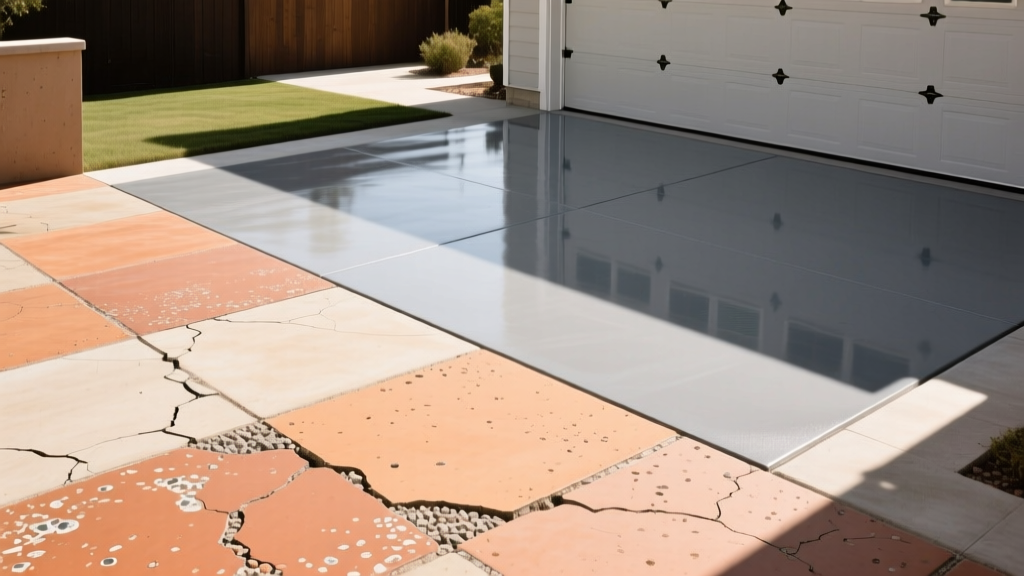
Concrete is essentially a hard sponge. If the slab was poured without a vapor barrier, or if the water table has risen, moisture vapor will push upward through the capillaries. When this vapor hits an impermeable film-forming paint, it creates hydrostatic pressure, resulting in blistering and delamination.
Before applying any concrete paint or epoxy, perform an ASTM F1869 Calcium Chloride test. If the MVER exceeds 3 lbs per 1,000 square feet per 24 hours, standard epoxies will fail. You must either use a breathable concrete stain, or apply a specialized moisture-mitigating epoxy primer (such as Mapei Primer SN or Vapor-Epoxy) designed to withstand up to 20 lbs of hydrostatic pressure before applying your topcoat.
Common Failure Modes and Edge Cases
Understanding how these finishes fail in the real world will save you thousands of dollars in remediation costs.
Efflorescence Ruining Stained Patios
Efflorescence is the white, powdery salt deposit that migrates to the surface of exterior concrete. If you apply a water-based stain and a low-quality acrylic sealer to a patio with high salt content, the salts will crystallize beneath the sealer, creating a cloudy, white haze that cannot be wiped away. Always test exterior slabs for efflorescence and treat with a mild acid wash and thorough flushing before staining.
VOC Regulations and Indoor Air Quality
When painting interior concrete, particularly in basements or enclosed workshops, solvent-based paints pose severe air quality risks. The Environmental Protection Agency (EPA) strictly warns against the accumulation of Volatile Organic Compounds (VOCs) in poorly ventilated spaces, which can cause acute respiratory distress. Always specify low-VOC, water-based epoxies or 100% solids epoxies (which emit virtually zero VOCs because they contain no solvents to evaporate) for indoor applications.
The "Peeling Paint" Driveway Disaster
Homeowners frequently attempt to paint exterior driveways with masonry paint to refresh the look. This is a guaranteed failure. Driveways are subject to snowplow blades, de-icing salts, and the sheer mechanical friction of turning tires. No standard masonry paint can withstand these shear forces. For driveways, abandon the idea of paint entirely. Opt for a penetrating silane/siloxane sealer with added tint, or a heavy-duty polyaspartic flake system if a solid color is mandatory.
Summary: Making the Final Call
Choose concrete stain when you want to highlight the natural character of the slab, require a breathable finish for exterior or high-moisture environments, and are willing to accept color variations. Choose concrete paint (specifically high-solids epoxies) when you need a thick, protective shield against chemicals, hot tires, and heavy impact, and when the substrate has been verified to be dry and properly profiled. By matching the chemical properties of the finish to the mechanical and environmental demands of the space, you ensure a durable, high-performing floor that lasts for decades.
Written by
Priya KapoorPriya Kapoor is a real estate market analyst and construction economics researcher with expertise in housing affordability, development feasibility, and infrastructure investment. She holds a Master of Regional Planning from Cornell University and previously worked as a senior analyst at CBRE's Investment Properties group, where she modeled returns for $4B in mixed-use development pipelines. Priya now runs an independent research practice advising developers, municipalities, and REITs on construction cost forecasting and market timing. She publishes the quarterly "BuildMat Market Pulse" report tracking material price indices across 12 commodity categories. Based in Austin, TX, Priya serves on the board of Habitat for Humanity Austin and is a marathon runner.
More from Priya Kapoor
View all
Construction Cost
Cost to Build a 1600 Sq Ft Home in 2026: Full Breakdown
Accurate 2026 cost to build a 1600 sq ft home—material, labor, and regional pricing breakdowns included. Plan your budget with real-time estimates.
Aug 11, 2026

Wood & Lumber
Name the Types of Wood for Pressure Treatment and Preservation
Learn how to name the types of wood best suited for pressure treatment. Compare species treatability, chemical retention levels, and 2026 preservation costs.
Aug 4, 2026

Stone & Masonry
Stone Veneer Suppliers Lindenhurst: 2026 Cost Analysis
Analyze 2026 stone veneer costs in Lindenhurst, NY. Compare local supplier pricing, delivery fees, and Suffolk County installation labor rates.
Aug 4, 2026