Concrete Slab Foundation Repair: A Material Selection Guide
Compare epoxies, polyurethanes, and hydraulic cements for concrete slab foundation repair. Learn material taxonomy, costs, and selection criteria.
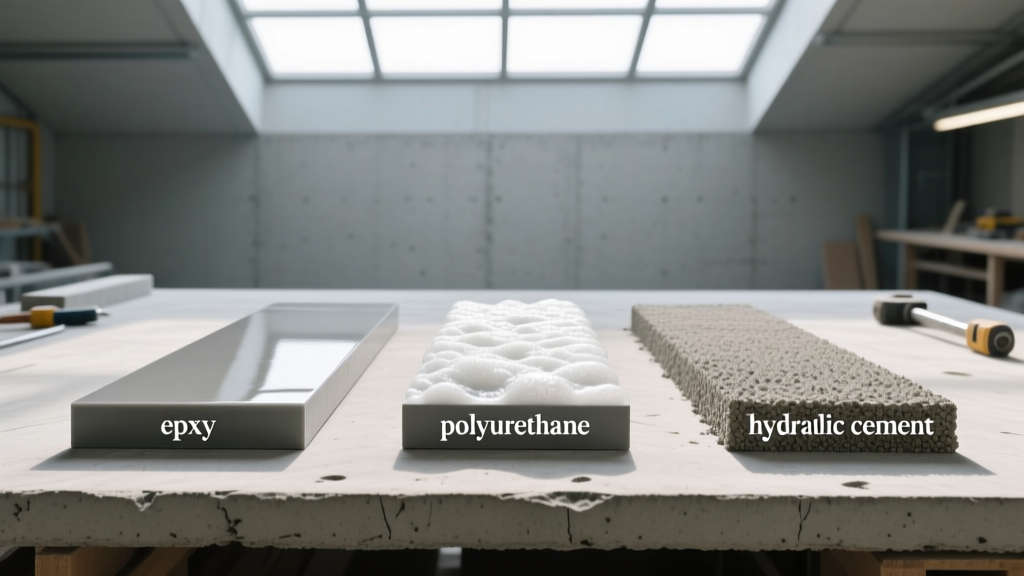
Executing a successful concrete slab foundation repair requires matching the exact chemical and mechanical properties of the repair material to the specific failure mechanism. Applying a rigid, high-modulus epoxy to an active settlement crack driven by expansive soils will inevitably result in a secondary failure adjacent to the repair zone. Conversely, using a flexible polyurethane foam to weld a dormant structural shear crack will fail to restore the slab's load-bearing continuity. This guide provides a comprehensive material taxonomy for foundation repair, detailing the specific polymers, cements, and composites required for distinct structural defects.
Diagnostic Taxonomy: Identifying the Failure Mechanism
Before selecting a repair material, the defect must be classified by its kinematic behavior and stress state. The American Concrete Institute (ACI) categorizes slab foundation distress into three primary material-selection drivers:
- Active Settlement Cracks: Driven by soil consolidation, expansive clays, or moisture variation. These cracks exhibit ongoing vertical displacement. Materials used here must accommodate movement or be paired with deep foundation underpinning.
- Dormant Shrinkage Cracks: Resulting from initial concrete curing and thermal contraction. These cracks are stable, typically map-pattern or linear, and require rigid structural bonding to prevent water ingress and rebar corrosion.
- Spalling and Surface Delamination: Caused by freeze-thaw cycles, alkali-silica reaction (ASR), or corrosion of embedded steel. Repair materials must match the thermal expansion coefficient of the host concrete.
Injection Resins: Polyurethane vs. Epoxy
Sub-slab injection is the most common intervention for both void filling and structural crack welding. However, the polymer chemistry dictates the application. High-density structural polyurethane foams and low-viscosity epoxy resins serve fundamentally different engineering purposes.
| Property | Structural Polyurethane Foam | 100% Solids Epoxy Resin |
|---|---|---|
| Primary Function | Void filling, slab jacking, soil stabilization | Structural crack welding, restoring tensile strength |
| Density (Cured) | 2.5 to 4.0 lbs/ft³ (High-density structural grades) | 1.1 to 1.2 g/cm³ (Solid liquid) |
| Compressive Strength | 40 to 80 psi (Foam matrix) | 8,000 to 12,000 psi |
| Viscosity | Expands 20x to 30x upon injection | 200 to 500 cP (Water-thin for deep penetration) |
| Cure Time | 15 to 45 seconds (Immediate load-bearing) | 4 to 12 hours (Temperature dependent) |
| Cost (2026 Avg) | $3.50 to $6.00 per pound of material | $45 to $65 per gallon of mixed resin |
When to Specify Polyurethane
Specify closed-cell, high-density polyurethane (such as Alchemy-Spetec AP Lift 44 or NCFI TerraThane) when the slab has lost subgrade support. The material is injected through 5/8-inch ports drilled in a grid pattern. As the two-part resin reacts, it expands, compacting loose soils and generating enough upward hydrostatic force to lift sunken slab sections back to grade. It is entirely impervious to water, making it ideal for high-water-table environments.
When to Specify Epoxy
For dormant structural cracks wider than 1/16 inch, specify a low-viscosity 100% solids epoxy like Sika Sikadur-52. The material is injected via surface-mounted ports after sealing the crack face. The epoxy penetrates deep into the concrete matrix, achieving a tensile strength that exceeds the concrete itself, effectively welding the slab back into a monolithic block.
Never inject rigid epoxy into a below-grade slab crack that is actively weeping water under hydrostatic pressure. The water will displace the resin, creating voids in the cure. For active leaks, a hydrophobic polyurethane grout (which reacts with water to form a flexible gel) must be used first to stop the flow, followed by structural epoxy once the substrate is dry.
Surface Patching and Spall Repair Compounds
When the concrete slab foundation exhibits surface degradation, exposed aggregate, or pop-outs, the repair material must provide high bond strength and low shrinkage to prevent curling at the repair margins.
Hydraulic Cements vs. Polymer-Modified Mortars
Hydraulic water-stop cements (e.g., Quikrete Hydraulic Water-Stop) set in 3 to 5 minutes and expand slightly as they cure. They are strictly for plugging active, localized water infiltration at slab-to-wall joints. They possess low flexural strength and should never be used for structural load-bearing patches.
For structural spall repairs exceeding 1/2 inch in depth, single-component polymer-modified mortars (PMMs) are the industry standard. Products like MAPEI Planitop XS contain acrylic polymers and silica fume, which reduce the water-cement ratio while maintaining workability. This results in a repair patch with a compressive strength exceeding 6,000 psi and a significantly reduced modulus of elasticity, allowing it to absorb micro-movements without debonding from the host slab.
According to guidelines published by the International Concrete Repair Institute (ICRI), the success of any patching compound relies heavily on the surface preparation profile. A minimum Concrete Surface Profile (CSP) of 3 to 5, achieved via shot blasting or scarification, is mandatory for polymer-modified mortars to achieve adequate mechanical interlock.
Structural Reinforcement: Carbon Fiber Composites
In cases where a concrete slab foundation has experienced severe bending or shear stress due to differential settlement, but the slab must remain in place, external reinforcement is required. Carbon fiber reinforced polymer (CFRP) systems, such as SikaWrap Hex-230C, provide immense tensile strength with negligible added thickness.
Carbon fiber straps are applied to the tension face of the slab (often the underside in suspended slabs, or the top surface in grade beams) using a high-modulus saturating epoxy. A standard 12-inch wide carbon fiber strip can provide the equivalent tensile resistance of a #5 steel rebar, but weighs a fraction of an ounce. This material taxonomy is critical when traditional steel underpinning or sistering is physically impossible due to clearance constraints.
Decision Framework: Matching Material to Defect
Use this sequential logic to specify the correct materials for your concrete slab foundation repair project:
- Assess Movement: Is the crack active (widening/settling) or dormant? If active, address the soil mechanics with helical piers or polyurethane deep-injection before applying surface materials.
- Measure Width: Cracks < 1/16 inch require high-solids polyurethane sealants or cementitious crystalline capillary treatments. Cracks > 1/16 inch require low-viscosity epoxy injection.
- Evaluate Moisture: If the substrate is damp or actively leaking, use hydrophobic polyurethane grouts or hydraulic cements. Epoxies and PMMs require a dry substrate (typically < 4% moisture content by weight).
- Determine Load: If the repair zone is subject to heavy dynamic rolling loads (e.g., industrial forklifts), specify a high-modulus epoxy or a magnesium phosphate cement (MPC) which offers rapid return-to-service (under 1 hour) and extreme abrasion resistance.
Selecting the precise chemical and mechanical profile for your repair materials eliminates the cycle of temporary fixes. By aligning the material taxonomy with the specific geotechnical and structural failure mode, contractors and engineers can ensure the long-term monolithic integrity of the repaired slab foundation.