Acid vs Water Based Concrete Stain: Application Showcase
Compare acid vs water based concrete stain through real-world application showcases, cost breakdowns, chemical reactions, and failure mode troubleshooting.

Raw concrete slabs offer a blank canvas, but achieving architectural-grade finishes requires understanding the chemical interaction between the stain and the cementitious matrix. When evaluating concrete stain acid vs water based options for a new build or renovation, the decision dictates not just the color palette, but the surface preparation, application labor, and long-term maintenance. This showcase breaks down how both chemistries perform in real-world applications, providing the technical data needed to specify the right product for your slab.
The Chemical Divide: Reactive vs. Non-Reactive Pigmentation
To specify the correct stain, contractors must first understand the underlying chemistry. Acid stains are reactive. They consist of metallic salts (copper, iron, chromium) suspended in a mild hydrochloric acid solution. When applied, the acid etches the surface and opens the pores, allowing the metallic salts to react with the hydrated lime (calcium hydroxide) present in the cured cement paste. This reaction produces permanent, variegated color that becomes an integral part of the concrete.
Water-based stains, conversely, are non-reactive. They utilize acrylic polymers and non-reactive metallic or organic pigments suspended in a water carrier. Instead of chemically altering the concrete, these stains penetrate the capillary pores and deposit the pigment mechanically as the water evaporates. This fundamental difference in mechanism drives the divergent application protocols and visual outcomes detailed in the showcases below.
Showcase 1: Acid Stain in High-Traffic Commercial Retail
Project Profile: 4,500 Sq. Ft. Boutique Apparel Store
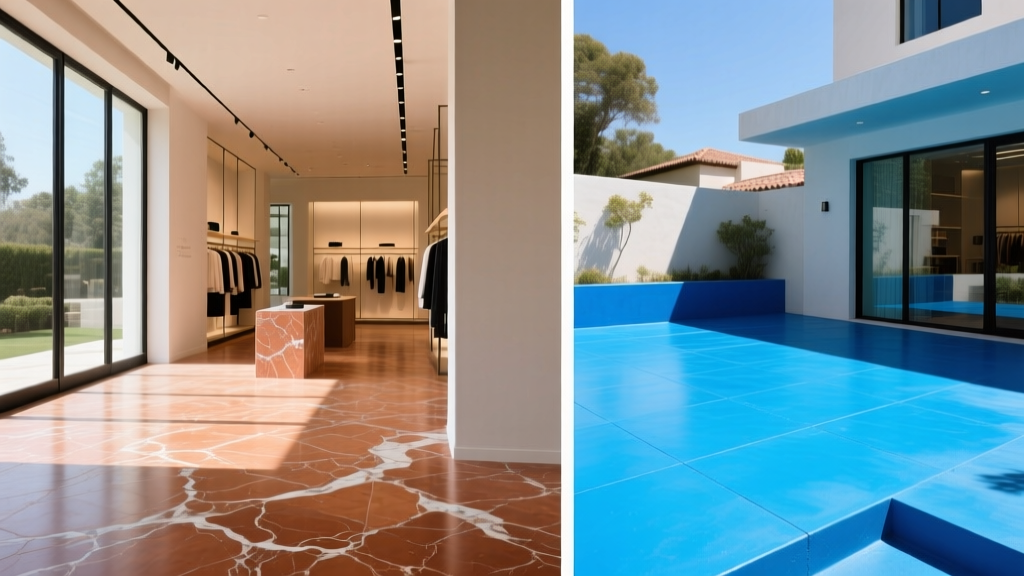
For a high-end retail environment requiring an organic, marbled aesthetic that hides foot traffic scuffs, the design team specified an acid stain system. The goal was a rich, variegated terra-cotta and espresso tone that mimicked natural leather.
Material & Execution Specifications
- Product: Kemiko Stone Tone (English Red and Cola)
- Surface Prep: The slab was new but heavily power-troweled, resulting in a closed surface. The crew used a planetary diamond grinder with 80-grit metal-bonded diamonds to achieve a Concrete Surface Profile (CSP) of 1 to 2, exposing the calcium hydroxide necessary for the chemical reaction.
- Application: Stain was applied using an HVLP (High Volume Low Pressure) sprayer at a rate of 250 square feet per gallon. Two passes were made in perpendicular directions to ensure even saturation.
- Neutralization: This is the most critical step for acid stains. After a 6-hour dwell time, the slab was mopped with a neutralizing solution of water and baking soda (sodium bicarbonate). Crews used pH test strips to verify the surface had returned to a neutral pH of 7.0 before rinsing.
- Sealing: A 100% solids epoxy primer was rolled on to lock in the color and provide structural adhesion, followed by two coats of an aliphatic polyurethane topcoat for UV stability and scuff resistance.
Showcase 2: Water-Based Stain on Exterior Stamped Patios
Project Profile: 1,200 Sq. Ft. Residential Pool Deck and Patio
Exterior stamped concrete requires UV-stable, vibrant colors that do not rely on the chemical makeup of the underlying slab. Because stamped overlays often contain polymers and low water-cement ratios, they lack the abundant calcium hydroxide required for acid staining. Water-based stain is the mandatory choice here.
Material & Execution Specifications
- Product: Direct Colors Water-Based Concrete Stain (English Chestnut and Pool Blue)
- Surface Prep: Because the stamped overlay was fully cured but free of sealers, mechanical grinding was unnecessary. The surface was cleaned using a 3,000 PSI pressure washer with a 25-degree tip to remove efflorescence and dirt without damaging the stamp texture.
- Application: Applied via a pump-up garden sprayer. The crew utilized a 'wet-on-wet' technique, spraying the base coat (Chestnut) and immediately misting the highlight color (Blue) into the low grout lines of the stamp pattern to create artificial depth and shadowing.
- Drying Time: Water-based stains require complete evaporation of the carrier. The slab was left to dry for 24 hours at 75°F before sealing.
- Sealing: A solvent-based acrylic sealer (SuperSeal 25) was applied via roller. The solvent carrier slightly re-emulsifies the acrylic polymers in the stain, creating a chemical bond and yielding a high-gloss 'wet look' that enhances the stamped texture.
Head-to-Head Comparison Matrix
| Feature | Acid (Reactive) Stain | Water-Based (Non-Reactive) Stain |
|---|---|---|
| Color Palette | Earth tones only (browns, tans, terra cottas, soft blue-greens) | Full spectrum (vibrant reds, blues, whites, blacks, metallics) |
| Visual Finish | Variegated, marbled, translucent, organic | Opaque, consistent, uniform, highly pigmented |
| Substrate Dependency | High (requires abundant calcium hydroxide; fails on overlays) | Low (works on overlays, old concrete, and low-cement mixes) |
| Prep & Cleanup | Requires mechanical profiling and chemical neutralization | Standard cleaning; no neutralization required |
| VOC Content | Higher (acidic carriers often contain VOCs) | Extremely Low (compliant with strict indoor air quality standards) |
| UV Stability | Excellent (inorganic metallic salts do not fade) | Good to Excellent (depends on the quality of organic pigments used) |
Failure Modes & Troubleshooting: What Goes Wrong on Site
Understanding how these systems fail is just as critical as knowing how to apply them. Below are the most common edge cases and failure modes encountered in the field.
Acid Stain Failure: 'Ghosting' and Blotching
Symptom: Light, uncolored outlines of tape, nails, or debris appear on the finished floor. Alternatively, large patches of the slab refuse to take color, remaining gray.
Cause: Ghosting occurs when carpet tape, curing compounds, or drywall mud seal the concrete pores, preventing the acid from reaching the calcium hydroxide. Blotching is usually caused by 'burning' the slab during power troweling, which pushes aggregate to the surface and buries the reactive cement paste.
Fix: Ghosting requires aggressive diamond grinding to remove the sealed layer. For burned slabs, contractors must apply a concrete dye (which penetrates deeper than stain) to force color into the dense surface.
Water-Based Stain Failure: Moisture Vapor Peeling
Symptom: The stain and sealer system blisters, turns milky white (blushing), and eventually peels off the slab in sheets, particularly in exterior or below-grade applications.
Cause: Water-based stains and acrylic sealers are highly susceptible to Moisture Vapor Transmission (MVT). If the concrete slab lacks a proper vapor barrier, hydrostatic pressure pushes water vapor up through the capillaries, breaking the mechanical bond of the stain and sealer.
Fix: Always conduct a Calcium Chloride MVT test (ASTM F1869) before application. If emissions exceed 3 lbs per 1,000 square feet per 24 hours, you must apply a moisture-mitigating epoxy primer before staining, or switch to a breathable, penetrating silane/siloxane sealer rather than a film-forming acrylic.
Cost Breakdown & Environmental Compliance
Budgeting for decorative concrete requires separating material costs from the labor-intensive preparation and sealing phases. As of current market rates, material costs for acid stain range from $0.25 to $0.50 per square foot, while water-based stains cost slightly more, between $0.30 and $0.60 per square foot. However, water-based systems often yield a lower total installed cost ($2.50 to $6.00 per square foot) compared to acid stains ($3.00 to $7.00+ per square foot) because they eliminate the labor-intensive neutralization, washing, and wet-vacuuming steps required for acid systems.
Environmental compliance is another major factor, particularly for interior commercial projects. According to the U.S. Environmental Protection Agency (EPA), volatile organic compounds (VOCs) can severely impact indoor air quality and are heavily regulated in architectural coatings. Water-based stains typically contain less than 50 g/L of VOCs, making them ideal for LEED-certified buildings and occupied spaces. Acid stains, due to their acidic carriers and required solvent-based sealers, often require extensive HVAC ventilation and respirator protocols during application. For comprehensive surface preparation standards prior to applying either system, contractors should consult the guidelines published by the American Concrete Institute (ACI) to ensure the substrate is properly profiled and free of contaminants.
Final Specification Verdict
Specify acid stain when the project demands a permanent, translucent, earth-toned marbled effect on a standard gray concrete slab, and when the budget allows for the rigorous prep and neutralization labor. Specify water-based stain when working with stamped overlays, when vibrant or non-earth-tone colors are required, or when strict indoor VOC limits and faster turnaround times are the primary project constraints.
Written by
Sarah WhitfieldSarah Whitfield is a chartered quantity surveyor (MRICS) and construction cost analyst with 15 years of experience in material pricing, procurement strategy, and project budgeting. She earned her degree in Construction Management from the University of Reading (UK) and has worked on projects ranging from $2M custom homes to $180M mixed-use developments across North America and Europe. Sarah currently leads cost estimating for BuildMat Insight, maintaining a proprietary database of 4,000+ material price points updated quarterly. She is a frequent contributor to RSMeans cost data panels and has presented at the International Cost Engineering Council (ICEC) congress. Based in Denver, CO, Sarah is an avid trail runner and volunteer mentor for Women in Construction.
More from Sarah Whitfield
View all
Wood & Lumber
What Are the Different Types of Wood? A Builder's Guide
Compare structural softwoods, finish hardwoods, and engineered lumber. Analyze Janka ratings, MOE values, and 2026 pricing for construction.
Aug 4, 2026

Walls & Panels
Steel Framing vs Wood Framing: Corrosion and Moisture Defense
Compare steel framing vs wood framing for moisture resistance. Learn about galvanized coatings, condensation risks, and corrosion protection strategies.
Jul 21, 2026

Stone & Masonry
How to Cut Stone Veneer: Wet Saw vs Grinder Comparison
Compare the best tools for cutting stone veneer. We review wet saws, angle grinders, and chop saws to help you achieve clean, chip-free cuts.
Jul 21, 2026