Paver vs Concrete Patio: Complete 2026 Cost Breakdown
Compare paver vs concrete patio costs in 2026. Get exact pricing, installation labor rates, maintenance expenses, and ROI data to choose the right material.

The True Cost of Outdoor Living: Pavers vs. Poured Concrete
Choosing between a paver vs concrete patio requires looking past the initial contractor quote to understand the total lifecycle cost of the hardscape. While poured concrete generally offers a lower barrier to entry in terms of upfront material and labor costs, interlocking concrete pavers provide superior structural flexibility, easier localized repairs, and often a higher return on investment. In 2026, supply chain stabilization has normalized aggregate and cement prices, but regional labor shortages continue to drive installation costs upward for both materials.
This cost breakdown analysis dissects the exact material specifications, hidden site-preparation variables, and long-term maintenance economics of both systems, referencing standards from the Concrete Network and the Interlocking Concrete Pavement Institute (ICPI).
Quick Cost Summary (Per Square Foot, Installed)
- Basic Broom-Finish Concrete: $8.00 – $12.00
- Stamped/Decorative Concrete: $15.00 – $25.00+
- Standard Concrete Pavers: $14.00 – $20.00
- Premium/Tumbled Pavers: $22.00 – $35.00+
Note: Prices reflect 2026 national averages for a standard 400 sq. ft. patio. Complex geometries, severe slopes, and poor soil conditions will increase these baselines by 15% to 30%.
Upfront Material & Labor Costs: The Initial Investment
The initial price gap between poured concrete and pavers is primarily driven by manufacturing processes and installation labor intensity. Poured concrete is a monolithic system delivered via ready-mix trucks, whereas pavers are individual precast units requiring meticulous hand-placement.
| Cost Component | Poured Concrete Patio | Interlocking Paver Patio |
|---|---|---|
| Material Cost | $2.50 – $4.50 / sq ft (3000-4000 PSI mix) | $4.00 – $9.00 / sq ft (ASTM C936 compliant) |
| Base & Prep Materials | $1.00 – $1.50 / sq ft (Gravel, vapor barrier) | $2.50 – $4.00 / sq ft (Class II base, bedding sand, edge restraint) |
| Labor & Equipment | $4.50 – $8.00 / sq ft (Forming, pouring, finishing) | $8.00 – $15.00 / sq ft (Excavation, compaction, hand-laying) |
| Sealing/Finishing | $0.75 – $1.50 / sq ft (Curing compounds, sealers) | $0.50 – $1.00 / sq ft (Polymeric sand activation, joint sealers) |
Concrete Specifications Driving Cost
A durable poured concrete patio requires a minimum 4-inch thick slab with a compressive strength of 3,000 to 4,000 PSI. In freeze-thaw climates, the mix must be air-entrained (typically 5% to 8% air content) to prevent surface spalling. Reinforcement with #3 or #4 rebar on a 2-foot grid, or 6x6 W1.4/W2.0 welded wire mesh, adds $0.50 to $0.85 per square foot but is non-negotiable for preventing structural cracking. Furthermore, control joints must be saw-cut or tooled every 10 feet to control inevitable shrinkage cracks.
Paver Specifications Driving Cost
Concrete pavers must meet ASTM C936 standards, requiring a minimum compressive strength of 8,000 PSI and a maximum water absorption rate of 5%. For pedestrian patios, 2 3/8-inch thick pavers are standard, while 3 1/8-inch units are required if the patio will occasionally support vehicular loads. The higher cost of pavers reflects the energy-intensive precast manufacturing process, which involves high-pressure vibration and kiln curing.
The Hidden Economics of Site Preparation
Contractor estimates often gloss over site preparation, yet this phase accounts for up to 30% of the total project cost. The foundational requirements for concrete and pavers differ significantly, impacting the final invoice.
Expert Insight: Never allow a contractor to install pavers directly over an existing concrete slab without a proper drainage plane and edge restraint system. Trapped moisture will cause the pavers to heave and the polymeric sand joints to fail within two seasons.
Excavation and Base Aggregates
Poured concrete requires a 4-inch compacted gravel base (typically 3/4-inch minus crushed stone) beneath the 4-inch slab. Pavers, however, demand a much more robust foundation. According to ICPI guidelines, a standard pedestrian paver patio requires 4 to 6 inches of compacted Class II road base (ASTM D2940) topped with a 1-inch layer of coarse, washed concrete sand for bedding. If the native soil is expansive clay, a non-woven geotextile fabric must be laid before the aggregate base, adding $0.40 to $0.60 per square foot to prevent base contamination and subsidence.
Access and Equipment Surcharges
If your backyard lacks a 10-foot wide clear path for a ready-mix concrete truck, you will incur a concrete pump truck fee, which typically ranges from $800 to $1,200 per day in 2026. Pavers circumvent this issue entirely, as materials are delivered on pallets and transported via skid steer or wheelbarrow, though manual labor costs will rise if the site is inaccessible to small machinery.
Long-Term Maintenance, Repair, and Lifespan
The true financial divergence between a paver vs concrete patio emerges 5 to 10 years post-installation. Concrete is a rigid, monolithic structure; when it fails, it fails catastrophically. Pavers form a flexible, interlocking matrix that accommodates ground movement without structural failure.
Concrete Slab Maintenance & Repair
- Sealing: Acrylic or polyurethane sealers must be reapplied every 2 to 3 years to protect stamped concrete from UV fading and water ingress ($0.75 – $1.25 per sq ft).
- Crack Repair: Despite control joints, concrete will crack. Epoxy or polyurethane crack injection costs $300 to $500 per linear foot of repair.
- Heaving/Settling: If tree roots or soil erosion cause a slab to heave or sink, the only viable repair is mudjacking (slabjacking) or polyurethane foam jacking, costing $500 to $1,500 per affected section. If the slab fractures during lifting, full demolition and replacement ($15+ per sq ft) is required.
Paver Patio Maintenance & Repair
- Joint Sand: Polymeric sand in the joints degrades over time due to pressure washing and weathering. Re-sanding and re-sealing joints costs $0.25 to $0.40 per sq ft every 3 to 5 years.
- Heaving/Settling: This is where pavers offer massive economic advantages. If a section settles, the pavers are simply unzipped, the base is re-graded and re-compacted, and the exact same pavers are reinstalled. The repair cost is purely labor (typically $150 to $300 minimum call-out fee), with zero material waste.
- Stain Removal: Oil or grease stains on concrete are permanent unless chemically poulticed. On pavers, a severely stained unit can be pried out and replaced with a spare for under $5.
'While the initial capital expenditure for interlocking concrete pavers is 30% to 50% higher than broom-finished concrete, the lifecycle cost over a 25-year period often equalizes due to the elimination of slab replacement and major structural repairs.' — Hardscape Engineering Analysis, 2025.
ROI and Resale Value Analysis
Outdoor living spaces consistently yield high returns on investment, but the material choice influences the appraisal value. According to real estate and landscaping industry data, well-executed hardscaping can return 50% to 80% of its cost at resale.
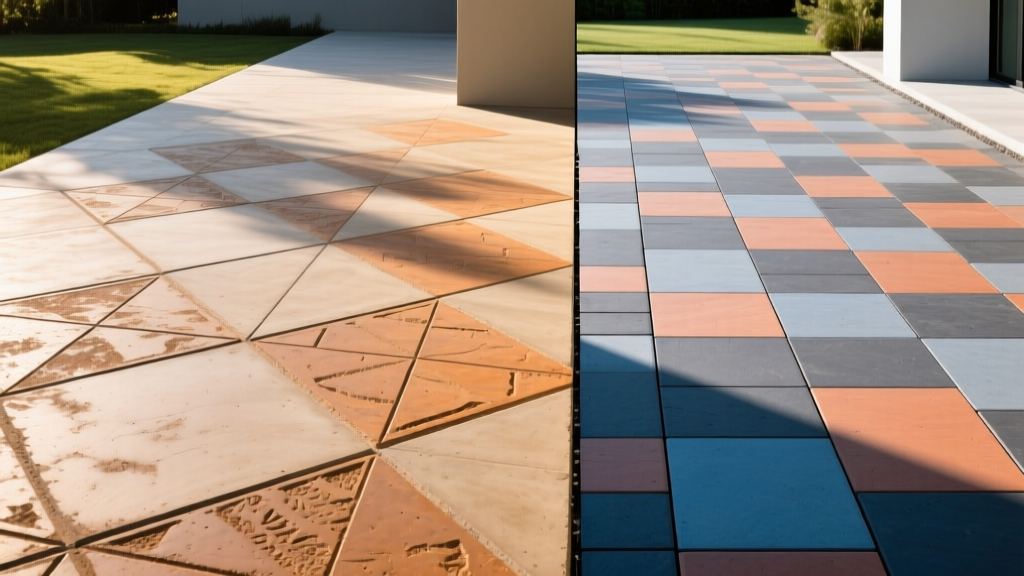
Stamped concrete offers a high aesthetic appeal that mimics natural stone at a fraction of the cost, making it highly attractive to buyers looking for immediate visual impact without the premium price tag of natural stone. However, savvy homebuyers and professional inspectors are increasingly wary of large concrete slabs in regions with expansive soils or aggressive tree root systems, knowing the liability of future cracking.
Paver patios, particularly those utilizing premium brands like Belgard or Techo-Bloc with integrated permeable drainage systems, are perceived as premium, permanent landscaping features. Permeable paver systems, which allow water to infiltrate the base rather than running off into storm drains, can also qualify homeowners for local municipal stormwater utility rebates, effectively reducing the net cost of the project by 5% to 10% in certain jurisdictions.
Decision Framework: When to Choose Which
Use this practical framework to finalize your material selection based on your specific site conditions and financial priorities.
Choose Poured Concrete If:
- Budget is the primary constraint: You need to maximize square footage under a strict $10,000 to $12,000 cap for a standard 400 sq ft area.
- The design requires monolithic curves: Poured concrete is easier to form into sweeping, continuous radii without the jagged cut edges required by rectangular pavers.
- Heavy, concentrated static loads are expected: If you plan to place a massive brick pizza oven, a heavy hot tub, or a permanent outdoor kitchen with masonry countertops, a 6-inch thick, heavily reinforced concrete slab provides superior point-load bearing capacity without the risk of paver depression.
Choose Interlocking Pavers If:
- Soil conditions are poor or expansive: If your property features heavy clay soils, high water tables, or mature trees with aggressive surface roots, the flexible matrix of pavers will shift and settle without fracturing.
- Utility access is required: If the patio will cover main sewer cleanouts, gas lines, or irrigation manifolds, pavers can be removed and replaced to access underground utilities. Cutting a trench through a new concrete slab destroys its structural integrity and aesthetics.
- Long-term maintenance anxiety is high: You prefer a system where localized damage (stains, settling, cracking) can be repaired invisibly by swapping individual units rather than living with patched concrete or paying for mudjacking.
Ultimately, the paver vs concrete patio decision hinges on how you weigh immediate capital outlay against long-term structural resilience. By factoring in the hidden costs of base preparation, equipment access, and inevitable maintenance, you can select the hardscape system that aligns with both your 2026 budget and your decade-long property goals.
Written by
Marcus ChenMarcus Chen is a licensed structural engineer (PE) and building materials analyst with over 12 years of experience across residential, commercial, and industrial construction. He holds a Master of Science in Civil Engineering from UC Berkeley and spent six years at Thornton Tomasetti before transitioning to independent consulting and technical writing. Marcus specializes in material selection for seismic-prone regions, concrete reinforcement strategies, and lifecycle cost analysis. His work has been cited by the American Concrete Institute (ACI) and the Structural Engineers Association of California (SEAOC). When he is not on a job site or at his desk, you will find him hiking the Sierra Nevada or restoring a 1920s craftsman bungalow in Oakland, CA.
More from Marcus Chen
View all
Construction Cost
How Much Did the Eiffel Tower Cost to Build?
How much did the Eiffel Tower cost to build in 1889? We adjust for inflation and compare its budget to modern skyscraper construction.
Aug 4, 2026

Fire Resistance
What Is a Fire Resistant Material? Testing & Certification Guide
Discover what is a fire resistant material through ASTM and UL testing. Learn how fire ratings, certifications, and assemblies work in construction.
Aug 4, 2026

Construction Cost
How Much Did the Burj Khalifa Cost to Build?
How much did the Burj Khalifa cost to build? We break down the $1.5B project and extract 5 money-saving strategies for your next build.
Jul 30, 2026