Concrete Countertops vs Quartz: Technical Specs and Performance Data
Compare concrete countertops vs quartz with exact technical specs. Analyze PSI strength, ASTM porosity rates, thermal limits, and 2026 costs.

The Engineering Divide: Cast-in-Place vs. Engineered Polymer Matrix
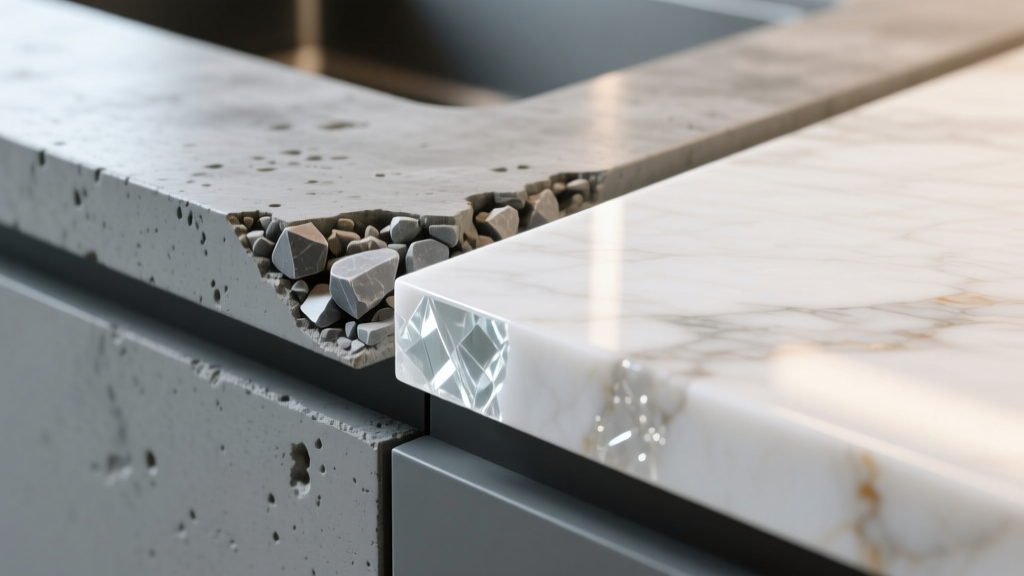
When evaluating concrete countertops vs quartz from a strict materials science perspective, the comparison shifts from aesthetic preference to structural mechanics, thermodynamics, and fluid dynamics. Concrete is a heterogeneous, cementitious composite reliant on hydration kinetics, while engineered quartz is a homogeneous, vibro-compacted polymer matrix. This technical analysis dissects the exact ASTM performance metrics, failure vectors, and fabrication tolerances defining both materials in 2026.
Quick Spec Snapshot
- Concrete (GFRC): 6,000+ PSI compressive, high thermal mass, requires chemical densification.
- Engineered Quartz: 10,000+ PSI compressive, near-zero porosity, polymer thermal limits.
Compressive and Flexural Strength Analysis
Countertops act as horizontal beams spanning cabinetry. Flexural strength (Modulus of Rupture) dictates overhang capabilities and load-bearing limits.
Concrete: Wet-Cast vs. GFRC
Traditional wet-cast concrete relies on a low water-to-cement (w/c) ratio (0.35 to 0.40) and Type I/II Portland cement, achieving compressive strengths of 4,000 to 5,000 PSI. However, its flexural strength remains relatively low (600–800 PSI), making it brittle and prone to micro-cracking under point loads.
Glass Fiber Reinforced Concrete (GFRC) alters this matrix by integrating 4% to 6% alkali-resistant (AR) glass fibers by weight. According to the Portland Cement Association, GFRC achieves compressive strengths exceeding 6,000 PSI and flexural strengths up to 2,500 PSI. This tensile upgrade allows GFRC countertops to be cast at 3/4-inch thicknesses and support unsupported overhangs up to 24 inches without steel corbels.
Quartz: The Vibro-Compacted Matrix
Engineered quartz comprises 90-93% crushed quartzite aggregate bound by 7-10% polyester or acrylic resins. The manufacturing process utilizes vacuum vibro-compression, eliminating void spaces. Testing per ASTM C170 reveals compressive strengths routinely exceeding 10,000 PSI, with flexural strengths averaging 7,000 PSI. Despite this immense compressive capacity, quartz slabs (typically 2cm or 3cm thick) still require structural corbeling for overhangs exceeding 10 to 15 inches due to the elastomeric nature of the polymer binder under sustained cantilever stress.
Porosity, Absorption, and Chemical Vectors
Fluid ingress is the primary failure mode for countertop surfaces. The absorption rate, measured via ASTM C97 standards referenced by the Natural Stone Institute, dictates sealing requirements and stain resistance.
| Material Metric | Wet-Cast Concrete | GFRC Concrete | Engineered Quartz |
|---|---|---|---|
| Unsealed Absorption Rate | 5.0% - 8.0% | 3.0% - 5.0% | < 0.5% |
| Sealed Absorption Rate | < 1.0% (Topical) | < 0.5% (Densified) | < 0.1% |
| Mohs Hardness Scale | 5 - 6 | 6 | 7 |
| Acid Etching Resistance | Poor (Calcium Carbonate) | Poor (Requires Urethane) | Excellent (Resin Bound) |
Concrete is inherently alkaline and contains calcium hydroxide, making it highly susceptible to acid etching from citric acid, vinegar, or wine. To achieve near-zero porosity, modern fabricators use lithium silicate densifiers that react with free lime to form calcium silicate hydrate (C-S-H) gels, followed by a topical aliphatic polyurethane sealer. Quartz, conversely, requires no sealing; its polymer matrix is entirely impervious to both water and acidic compounds.
Thermal Dynamics and Heat Tolerance
Thermal Shock Warning
Never place a 400°F+ cast-iron pan directly on engineered quartz. While the quartz aggregate can withstand 1,500°F, the polyester resin binder undergoes a glass transition phase at approximately 300°F to 350°F, resulting in permanent thermal scorching, yellowing, or micro-fissuring.
Concrete possesses exceptional thermal mass and is entirely non-combustible. The cementitious matrix easily tolerates temperatures exceeding 1,000°F. The vulnerability lies entirely in the sealer. Topical polyurethanes and epoxies will soften, blister, or leave white thermal rings when exposed to temperatures above 300°F. Penetrating sealers offer better heat resistance but sacrifice surface stain protection.
Edge Profiles and CNC Machining Limits
The physical composition of each material dictates the complexity of achievable edge profiles.
Quartz Machining: Because engineered quartz is a homogeneous, resin-bonded matrix, it can be routed with diamond-tipped CNC bits to create intricate ogee, bullnose, and mitered waterfall edges. The polymer binder prevents micro-chipping, allowing for crisp, polished inside radii down to 1/8 inch. Fabricators can seamlessly bond mitered edges using color-matched epoxy adhesives, creating the illusion of a 4-inch thick monolithic slab from standard 2cm material.
Concrete Casting Limits: Concrete edge profiles are dictated by the mold (negative space). While elastomeric polyurethane molds can capture intricate textures and chamfers, sharp inside radii are structural weak points where stress concentrates and micro-cracks propagate. GFRC fabricators typically rely on eased edges, standard bullnoses, or form-liner textures (like wood grain or fluted patterns) rather than deep, routed profiles. Attempting to CNC-route cured concrete results in severe aggregate tear-out and requires extensive hand-grinding to restore the surface paste.
Dimensional Stability and Fabrication Tolerances
Shrinkage and warping dictate fabrication precision.
- Concrete Drying Shrinkage: Wet-cast concrete experiences volumetric shrinkage of 0.05% to 0.08% as excess water evaporates. Fabricators must compensate for this by casting slightly oversized and grinding to final dimensions post-cure (typically 28 days for full hydration).
- Quartz Stability: Engineered quartz exhibits virtually zero post-cure dimensional change. CNC routers can cut quartz to a tolerance of ±1/32 inch, allowing for near-perfect seam alignment in large kitchen layouts.
2026 Cost and Fabrication Economics
Pricing structures differ fundamentally due to the production pipeline. Quartz is manufactured in standardized 120x60 inch slabs, optimizing yield and reducing labor costs. Concrete is a bespoke, custom-cast product requiring mold fabrication, casting, curing, and multi-stage wet polishing.
| Cost Factor (2026) | Custom GFRC Concrete | Premium Engineered Quartz |
|---|---|---|
| Material & Fabrication | $90 - $130 / sq. ft. | $60 - $90 / sq. ft. |
| Template & Installation | $20 - $40 / sq. ft. | $30 - $50 / sq. ft. |
| Total Installed Average | $110 - $170 / sq. ft. | $90 - $140 / sq. ft. |
Technical Decision Matrix
Select between concrete and quartz based on the specific engineering demands of your project:
- Specify GFRC Concrete when: The design requires integrated drainboards, custom integral sinks, unsupported 24-inch overhangs, or specific aggregate exposures (e.g., recycled glass or local river stone) that engineered slabs cannot replicate.
- Specify Engineered Quartz when: The application demands absolute chemical resistance, zero-maintenance hygiene (NSF-51 certified for food prep), tight CNC-machined seam tolerances, and high-traffic durability without the need for annual urethane resealing.
Understanding the exact material science behind concrete countertops vs quartz ensures the selected surface aligns with both the structural realities of the cabinetry and the operational demands of the end user.
Written by
Sarah WhitfieldSarah Whitfield is a chartered quantity surveyor (MRICS) and construction cost analyst with 15 years of experience in material pricing, procurement strategy, and project budgeting. She earned her degree in Construction Management from the University of Reading (UK) and has worked on projects ranging from $2M custom homes to $180M mixed-use developments across North America and Europe. Sarah currently leads cost estimating for BuildMat Insight, maintaining a proprietary database of 4,000+ material price points updated quarterly. She is a frequent contributor to RSMeans cost data panels and has presented at the International Cost Engineering Council (ICEC) congress. Based in Denver, CO, Sarah is an avid trail runner and volunteer mentor for Women in Construction.
More from Sarah Whitfield
View all
Wood & Lumber
What Are the Different Types of Wood? A Builder's Guide
Compare structural softwoods, finish hardwoods, and engineered lumber. Analyze Janka ratings, MOE values, and 2026 pricing for construction.
Aug 4, 2026

Walls & Panels
Steel Framing vs Wood Framing: Corrosion and Moisture Defense
Compare steel framing vs wood framing for moisture resistance. Learn about galvanized coatings, condensation risks, and corrosion protection strategies.
Jul 21, 2026

Stone & Masonry
How to Cut Stone Veneer: Wet Saw vs Grinder Comparison
Compare the best tools for cutting stone veneer. We review wet saws, angle grinders, and chop saws to help you achieve clean, chip-free cuts.
Jul 21, 2026