Fiberglass Pools vs Concrete: 2026 Cost Breakdown & ROI
Compare fiberglass pools vs concrete with our 2026 cost breakdown. Analyze upfront installation, long-term maintenance, and hidden expenses.

The Upfront Installation Cost Matrix
Choosing between a pre-manufactured shell and a custom-poured basin is the most consequential financial decision in residential aquatic construction. While marketing materials often highlight the 'low maintenance' of fiberglass or the 'custom luxury' of gunite, the true financial picture requires a granular look at line-item costs. According to the Angi 2026 pool cost database, the national average for an inground pool spans from $55,000 to $95,000, but the distribution of those costs varies wildly between materials.
| Cost Category | Fiberglass Pool (14x28) | Concrete / Gunite Pool (14x28) |
|---|---|---|
| Excavation & Soil Removal | $4,500 - $6,500 | $5,500 - $8,500 |
| Shell Material & Fabrication | $22,000 - $35,000 (Factory molded) | $18,000 - $28,000 (Rebar & Gunite mix) |
| Delivery & Crane Rigging | $2,500 - $5,000 | $0 (Materials delivered via mixer trucks) |
| Plumbing & Electrical | $6,000 - $9,000 | $7,500 - $11,000 |
| Labor & Installation Time | $8,000 - $12,000 (3-6 weeks) | $18,000 - $28,000 (3-6 months) |
| Interior Finish (Plaster/Gel) | Included (Gelcoat) | $8,000 - $15,000 (Pebble/Quartz) |
| Total Estimated Base Cost | $51,000 - $76,500 | $67,000 - $101,500 |
Concrete (Gunite/Shotcrete) Deep Dive: The Customization Premium
Concrete pools are constructed using either gunite (dry mix hydrated at the nozzle) or shotcrete (wet mix). The structural integrity relies on a grid of #4 or #5 steel rebar spaced at 10 inches on center, pneumatically encased in a 4,000 to 6,000 PSI concrete mixture. The American Concrete Institute (ACI) mandates specific curing protocols to prevent structural micro-cracking, which is why concrete pools require a 28-day curing period before the interior finish can be applied.
Where the Money Goes
- Labor Intensity: Building a concrete pool is essentially constructing a custom concrete structure from scratch in your backyard. You are paying for specialized trades: steel tie-offs, plumbing rough-ins, gunite nozzlemen, and plasterers.
- Interior Finishes: Raw concrete is porous and abrasive. It requires an interior finish. Standard white marcite plaster costs around $5,000 but degrades in 7-10 years. Upgrading to exposed quartz or PebbleTec aggregates pushes this line item to $10,000-$15,000 but extends the lifespan to 15-20 years.
- Design Freedom: The premium you pay for concrete buys you infinite geometric possibilities. If you want a zero-edge vanishing boundary, a custom sun shelf with integrated bubblers, or a beach entry, concrete is the only viable medium.
Fiberglass Deep Dive: The Logistics & Access Tax
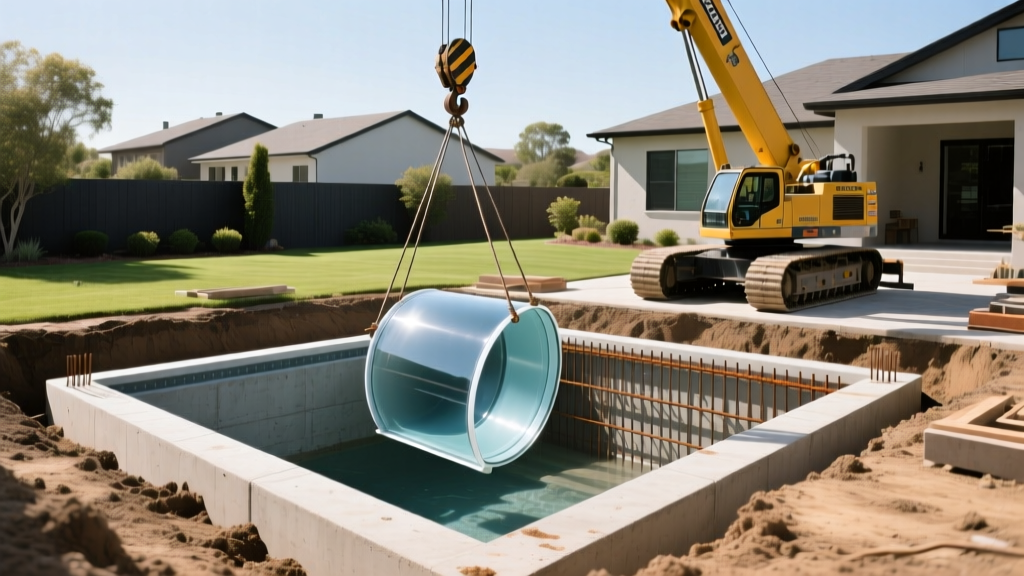
Fiberglass pools are manufactured in climate-controlled factories using layered fiberglass matting and vinyl ester resin, finished with a UV-resistant gelcoat. The shell is cured, popped from the mold, and shipped as a single monolithic unit. While the material cost is lower and installation is drastically faster, fiberglass introduces unique logistical expenses that concrete avoids.
The Hidden Logistical Costs
- Crane Rigging: A 14x28 fiberglass shell weighs between 3,500 and 5,000 pounds. If a standard boom truck cannot access the site due to overhead powerlines or narrow property setbacks, you must hire a massive hydraulic crane. A 100-ton crane with an operator can cost $1,500 to $2,500 per day.
- Transportation Permits: Pool shells exceed standard highway width limits. Transporting them requires wide-load permits and escort vehicles, adding $1,000 to $3,000 to the delivery fee depending on your distance from the manufacturer.
- Size Limitations: Because they are shipped on public roads, fiberglass pools are strictly limited to a maximum width of 16 feet and a length of 40 feet. If your design requires a 20-foot width, fiberglass is automatically disqualified.
Fiberglass shells are essentially giant, lightweight boats. In areas with high water tables or heavy seasonal rainfall, an empty or poorly anchored fiberglass pool can literally float out of the ground, destroying the surrounding deck and plumbing. Proper installation requires a specialized gravel backfill and a hydrostatic relief valve in the sump pit to equalize groundwater pressure.
Lifetime Maintenance & Resurfacing Costs (Years 1-20)
The upfront installation is only half the financial equation. The chemical reactivity and surface porosity of the materials dictate your ongoing operational expenditures.
Concrete Maintenance Profile
Concrete is highly alkaline and inherently porous. Even with a pebble finish, the microscopic surface texture provides a foothold for algae.
- Chemical Consumption: Expect to spend $800 to $1,200 annually on chemicals. You will frequently need to add muriatic acid to lower the pH, which naturally drifts upward due to the concrete's alkalinity.
- Acid Washing: Every 3 to 5 years, the pool will likely require an acid wash to remove mineral scaling and stubborn stains, costing $300 to $500 per service.
- Resurfacing: At year 15, the interior finish will degrade. Draining, chipping out the old plaster, and applying a new pebble finish will cost between $8,000 and $12,000 in 2026.
Fiberglass Maintenance Profile
The gelcoat finish on a fiberglass pool is entirely non-porous and chemically inert.
- Chemical Consumption: Algae cannot penetrate the smooth surface, and the shell does not alter water chemistry. Annual chemical costs typically range from $400 to $600.
- Resurfacing: A high-quality vinyl ester resin gelcoat will last 20 to 30 years without needing replacement. If it eventually fades or blisters (osmosis), a professional gelcoat recoating costs $4,000 to $6,000—roughly half the cost of concrete resurfacing.
20-Year Total Cost of Ownership (TCO) Projection
To understand the true ROI, we must project the costs over a 20-year horizon, assuming standard usage and proper winterization.
| 20-Year Expense Category | Fiberglass TCO | Concrete TCO |
|---|---|---|
| Initial Installation (Mid-Range) | $63,000 | $84,000 |
| 20-Year Chemical Costs | $10,000 | $20,000 |
| Acid Washing / Stain Treatment | $0 | $2,000 |
| Resurfacing (Year 15) | $0 (Gelcoat intact) | $10,000 |
| Estimated 20-Year Total | $73,000 | $116,000 |
Decision Framework: Which Material Fits Your Project?
Do not base your decision solely on the initial quote. Use this framework to align the material with your specific property constraints and financial goals.
Choose Fiberglass If:
- You prioritize speed and low maintenance: You want the pool operational in 4 weeks and refuse to spend weekends balancing pH levels and brushing walls.
- Your design fits standard molds: You are satisfied with a standard rectangular, kidney, or freeform shape under 16 feet wide.
- Site access is open: A crane can easily swing over your house or driveway without requiring road closures or massive rigging fees.
- Soil conditions are stable: Your lot does not suffer from severe expansive clay or a perpetually high water table that threatens hydrostatic uplift.
Choose Concrete If:
- You demand bespoke architecture: Your landscape design requires custom vanishing edges, integrated architectural steps, or dimensions that exceed highway shipping limits.
- Site access is restricted: Overhead wires, tight property lines, or steep gradients make crane access impossible, but concrete mixer trucks and pump trucks can navigate the site.
- You are building a commercial or HOA facility: The heavy-duty structural mass of steel-reinforced concrete is better suited for the extreme bather loads and abuse of commercial environments.
Ultimately, the Pool & Hot Tub Alliance (PHTA) emphasizes that the longevity of any aquatic structure relies more on the expertise of the builder than the material itself. A poorly backfilled fiberglass pool will crack under soil pressure, just as a poorly cured concrete pool will suffer from structural delamination. Vet your contractor's structural warranties, demand soil-bearing reports before excavation, and ensure your contract explicitly details the PSI of the concrete mix or the resin grade of the fiberglass shell.
Written by
Elena RodriguezElena Rodriguez is a civil engineer and technical writer specializing in concrete technology, masonry systems, and ASTM/ACI compliance. She earned her B.S. in Civil Engineering from Texas A&M University and spent a decade at a materials testing laboratory, performing over 2,000 concrete compressive strength tests and masonry prism evaluations. Elena is an ACI-certified Field Testing Technician (Grade I) and a member of ASTM Committee C12 on Natural Building Stone. She currently consults on forensic engineering cases involving concrete failures and moisture intrusion. Based in San Antonio, TX, Elena is a proud member of the Society of Women Engineers (SWE) and coaches her daughter's FIRST Robotics team.
More from Elena Rodriguez
View all
Walls & Panels
Cost Analysis: Light Gauge Steel Framing Advantages and Disadvantages
Evaluate light gauge steel framing advantages and disadvantages through a strict cost analysis lens, comparing material, labor, and lifecycle expenses.
Aug 4, 2026

Walls & Panels
Gypsum Board Types: Exact Specifications, Thickness & Dimensions
Compare standard, Type X, and moisture-resistant gypsum board types. Get exact specifications, thicknesses, dimensions, and ASTM standards for your project.
Aug 4, 2026

Fire Resistance
Best Fire-Resistant Outdoor Decking Materials: 2026 Buyer Guide
Discover the best fire-resistant outdoor decking materials for 2026. Compare Class A PVC, aluminum, and hardwood options for WUI compliance and safety.
Aug 4, 2026