Cement vs Concrete Cost Breakdown: 2026 Material Pricing
Analyze the true cement vs concrete cost breakdown for 2026. Compare raw Portland cement, ready-mix, and site-mixed pricing per cubic yard.
The Fundamental Distinction: Binder vs. Composite
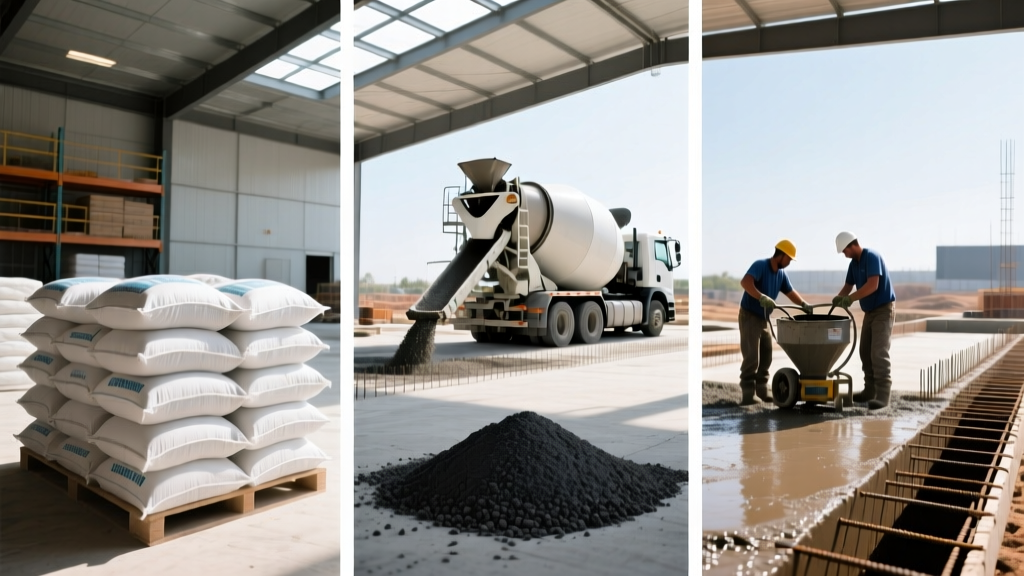
Before analyzing procurement budgets, it is critical to resolve the most common semantic error in construction: confusing the binder with the final composite. When evaluating cement vs concrete for project costing, you are not comparing two interchangeable materials. You are comparing a single raw ingredient against a fully engineered structural composite.
Material Definition Matrix
Portland Cement: The fine gray powder (primarily limestone and clay) that acts as the chemical binder. It is never used alone in structural applications.
Concrete: The composite material created by mixing Portland cement (typically 10-15% by volume), water, and aggregates (sand and gravel, making up 60-75% of the volume).
Because cement is merely one component of concrete, comparing their costs requires standardizing the metric. Procurement professionals and contractors must evaluate the cost of purchasing raw cement to mix on-site versus purchasing batched ready-mix concrete delivered to the job site. According to the National Ready Mixed Concrete Association (NRMCA), over 80% of all structural concrete placed in commercial and large-scale residential projects is ready-mixed, primarily due to the economies of scale in aggregate batching and quality control.
2026 Raw Material Costs: Portland Cement
If you opt to site-mix your own concrete or mortar, your primary expense is the cementitious binder. In 2026, Portland cement pricing has stabilized following the supply chain disruptions of the early 2020s, though regional variations persist due to the high cost of transporting heavy bulk powders.
Bagged Cement Pricing (Retail/Small Volume)
- Standard Type I/II Portland Cement (80 lb bag): $18.00 – $24.00 per bag. Brands like Quikrete and Sakrete dominate the retail space. Type I/II is the general-purpose standard for most slabs and footings.
- Type III High-Early-Strength Cement (80 lb bag): $22.00 – $28.00 per bag. Used when rapid form removal or cold-weather curing is required.
- Masonry Cement (Type S, 70 lb bag): $14.00 – $18.00 per bag. Formulated specifically for mortar in brick and block work, not for structural concrete slabs.
Bulk Cement Pricing (Commercial/High Volume)
For operations with on-site silos, bulk pneumatic delivery is measured by the ton. According to data tracked by the Bureau of Labor Statistics Producer Price Index (PPI) for cement manufacturing, bulk Type I/II Portland cement averages between $135 and $165 per metric ton in 2026. This translates to roughly $0.11 to $0.14 per pound, making bulk procurement roughly 40% cheaper per unit than bagged retail cement.
Ready-Mix Concrete Pricing and Surcharges
Ready-mix concrete is batched at a central plant and delivered via transit mixer. Pricing is quoted per cubic yard (CY) and is heavily dependent on the specified compressive strength (PSI), slump, and aggregate size.
Base Rates by Compressive Strength (Per Cubic Yard)
- 3000 PSI (Standard residential slabs, sidewalks): $135 – $150 / CY
- 4000 PSI (Driveways, garage floors, structural footings): $145 – $165 / CY
- 5000+ PSI (Commercial columns, heavy-duty industrial floors): $160 – $190 / CY
These base rates assume a standard 3/4-inch aggregate and a 4-inch slump. Requesting fiber-mesh reinforcement, air-entrainment for freeze-thaw resistance (typically adding $8 to $12 per CY), or chemical accelerators will increase the base price.
The Break-Even Analysis: Site-Mixed vs. Ready-Mix
The core of the cement vs concrete cost debate hinges on project volume. Site-mixing requires purchasing cement, sand, and gravel separately, renting a mixer, and absorbing massive labor costs. Ready-mix shifts the batching labor to the plant but introduces delivery logistics.
Let us calculate the true material cost to produce one cubic yard (27 cubic feet) of standard 3000 PSI concrete using a 1:2:3 volumetric mix ratio (1 part cement, 2 parts sand, 3 parts gravel).
Site-Mixed Material Cost (1 Cubic Yard)
- Cement: Requires roughly 6.5 bags (80 lb) of Type I/II Portland cement @ $20/bag = $130.00
- Sand: Requires ~0.45 tons of masonry sand @ $45/ton = $20.25
- Gravel: Requires ~0.65 tons of 3/4-inch crushed stone @ $55/ton = $35.75
- Total Raw Materials: $186.00 per CY
Ready-Mix Cost (1 Cubic Yard)
- Base 3000 PSI Concrete: $145.00
- Short-Load Fee: Most plants charge a penalty for loads under 10 CY. A typical short-load fee is $50 per missing yard. For a 1 CY load, the surcharge is roughly $450.
- Total Delivered: $595.00 per CY
Comprehensive Cost Matrix: Project Volume Scenarios
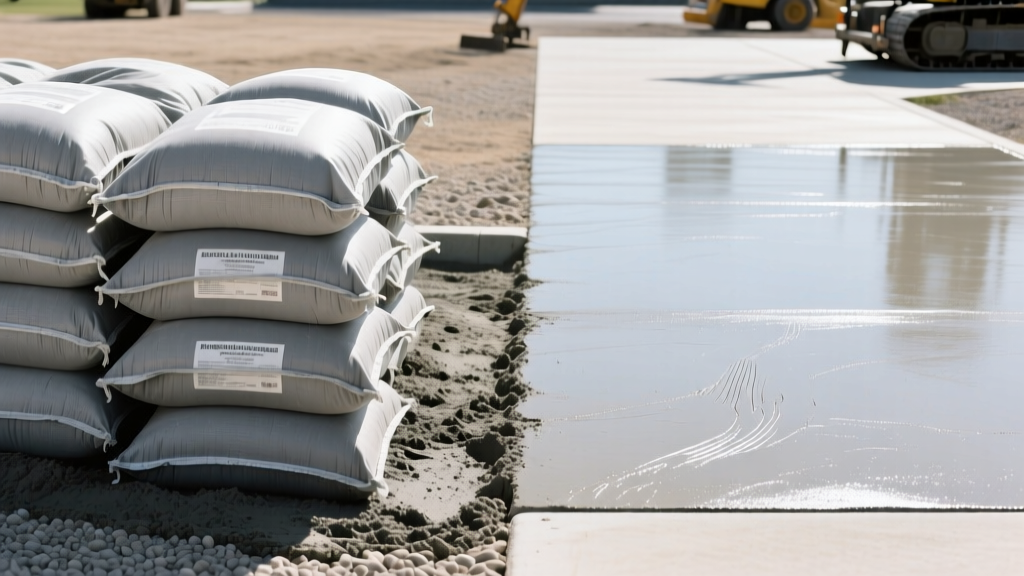
The following table illustrates how the cost advantage shifts dramatically based on the total volume required for the pour. This matrix includes estimated labor and equipment rental costs (e.g., $150/day for a 9-cubic-foot gas mixer) to provide a holistic view of project expenses.
| Project Scope | Volume (CY) | Site-Mixed Total Cost | Ready-Mix Total Cost | Most Economical Choice |
|---|---|---|---|---|
| Fence Post Footings | 0.5 CY | $110 (Materials + Bagged Aggregate) | $620 (Base + Max Short-Load) | Site-Mix / Bagged |
| Small Patio Slab (10x10) | 2.0 CY | $520 (Materials + Mixer Rental + 8 hrs Labor) | $740 (Base + Short-Load Fee) | Site-Mix |
| Standard Driveway (20x40) | 10.0 CY | $2,800 (Materials + 3 Days Labor + Mixer) | $1,500 (Base Rate, No Short-Load) | Ready-Mix |
| Foundation Footings | 25.0 CY | Not Feasible (Quality/Time Risk) | $3,750 (Bulk Volume Discount) | Ready-Mix (Mandatory) |
Hidden Costs and Surcharges in Concrete Procurement
When budgeting for ready-mix concrete, the per-yard base rate is only the starting point. Failing to account for logistical surcharges is the primary reason residential and commercial pours exceed their material budgets. Always verify these specific fees with your local batch plant, as outlined by guidelines from the American Concrete Institute (ACI) regarding placement logistics.
- Short-Load Fees: As demonstrated above, trucks carry up to 10-12 CY. If you order less than a full truck, expect a surcharge of $40 to $75 for every unused cubic yard of capacity.
- Pump Truck Rentals: If the transit mixer cannot back directly up to the forms (e.g., backyard pools, second-story decks), you must hire a concrete pump. Line pumps cost $600 – $900 per day, while boom pumps range from $1,200 – $2,500 per day.
- Overtime / Waiting Fees: Transit mixers allot roughly 7 to 10 minutes per cubic yard for unloading. If your crew is slow and the truck sits on-site beyond the allotted time, plants charge $50 to $100 per hour of waiting time.
- Winter Heating Surcharges: In cold climates, batch plants must heat the mixing water and aggregates to ensure proper hydration. Expect a $10 to $20 per CY surcharge for heated concrete between November and March.
Procurement Decision Framework
Use this deterministic framework to finalize your material procurement strategy based on project parameters:
Scenario A: Volume is under 1.5 Cubic Yards
Action: Purchase pre-blended bagged concrete mix (e.g., Quikrete 5000) or site-mix raw cement and aggregates.
Rationale: Ready-mix short-load fees make truck delivery financially illogical. Pre-blended bags (approx. $6.50 per 80lb bag) eliminate the need to source and measure separate sand and gravel piles for micro-projects.
Scenario B: Volume is between 2 and 8 Cubic Yards, Access is Restricted
Action: Site-mix using bulk aggregates and bagged cement, or rent a volumetric mobile mixer.
Rationale: You will still incur short-load fees for ready-mix, and if access is restricted, you will also have to pay for a pump truck. Site-mixing allows you to wheelbarrow the material to the restricted zone at the cost of intense manual labor.
Scenario C: Volume exceeds 8 Cubic Yards, Standard Access
Action: Order ready-mix concrete.
Rationale: The short-load penalties disappear. The guaranteed compressive strength, consistent slump, and rapid placement time of ready-mix vastly outweigh the material cost of site-mixing, while eliminating the severe labor bottleneck of manual batching.
Scenario D: High-Early Strength or Specialized Admixtures Required
Action: Order ready-mix exclusively.
Rationale: Achieving precise water-to-cement ratios and evenly distributing chemical admixtures (like superplasticizers or accelerators) is nearly impossible with manual site-mixing. Improper manual batching of high-strength mixes routinely leads to catastrophic curing failures and structural weakness.
Written by
Priya KapoorPriya Kapoor is a real estate market analyst and construction economics researcher with expertise in housing affordability, development feasibility, and infrastructure investment. She holds a Master of Regional Planning from Cornell University and previously worked as a senior analyst at CBRE's Investment Properties group, where she modeled returns for $4B in mixed-use development pipelines. Priya now runs an independent research practice advising developers, municipalities, and REITs on construction cost forecasting and market timing. She publishes the quarterly "BuildMat Market Pulse" report tracking material price indices across 12 commodity categories. Based in Austin, TX, Priya serves on the board of Habitat for Humanity Austin and is a marathon runner.
More from Priya Kapoor
View all
Construction Cost
Cost to Build a 1600 Sq Ft Home in 2026: Full Breakdown
Accurate 2026 cost to build a 1600 sq ft home—material, labor, and regional pricing breakdowns included. Plan your budget with real-time estimates.
Aug 11, 2026

Wood & Lumber
Name the Types of Wood for Pressure Treatment and Preservation
Learn how to name the types of wood best suited for pressure treatment. Compare species treatability, chemical retention levels, and 2026 preservation costs.
Aug 4, 2026

Stone & Masonry
Stone Veneer Suppliers Lindenhurst: 2026 Cost Analysis
Analyze 2026 stone veneer costs in Lindenhurst, NY. Compare local supplier pricing, delivery fees, and Suffolk County installation labor rates.
Aug 4, 2026