Concrete vs Mortar vs Cement: Which to Use and When
Discover the structural differences in concrete vs mortar vs cement. Learn exact mix ratios, PSI ratings, and which material to use for your project.

The Core Distinction: Binder, Mixture, and Mortar
The terms cement, concrete, and mortar are frequently used interchangeably in casual conversation, but in structural engineering and masonry, substituting one for another will result in catastrophic failure. Understanding the exact chemical and physical differences between these materials is the first step in any successful build. According to the Portland Cement Association, the most common misconception is treating cement as a final product rather than an ingredient.
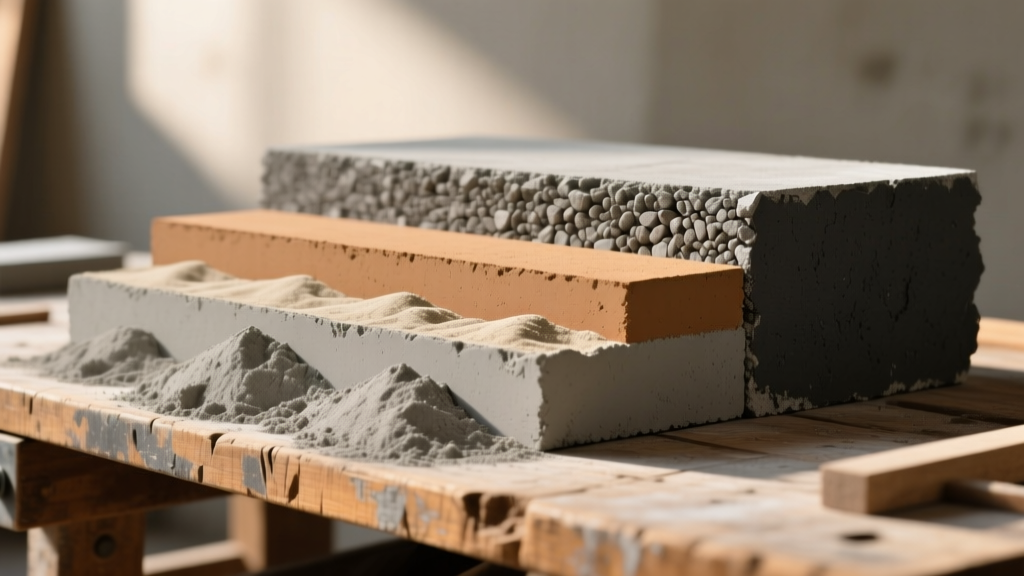
Cement is the reactive binder (the 'flour').
Mortar is cement + sand + lime + water (the 'dough' used as glue).
Concrete is cement + sand + coarse aggregate + water (the 'structural block').
Cement: The Activated Binder
Cement is never used on its own as a structural building material. It is a finely ground powder, primarily composed of calcium silicates, produced by heating limestone and clay in a kiln to 2,700°F (1,480°C) to form clinker, which is then ground with a small amount of gypsum. When mixed with water, it undergoes an exothermic chemical reaction called hydration, forming calcium silicate hydrate (C-S-H) gel, which is the actual glue that binds aggregates together.
Portland Cement Classifications (ASTM C150)
For most residential and light commercial projects, you will encounter specific Types of Portland cement:
- Type I/II: The standard all-purpose cement. Accounts for roughly 90% of all cement produced. Suitable for general masonry and concrete mixes where no special soil conditions exist.
- Type III: High early-strength cement. Ground finer to accelerate hydration. Used when forms need to be stripped quickly or in cold-weather pouring conditions.
- Type V: Sulfate-resistant cement. Formulated with low tricalcium aluminate (C3A) to prevent expansion and cracking when exposed to high-sulfate soils or groundwater.
Pure cement paste has virtually no structural tensile strength and shrinks massively as it cures. It must be combined with aggregates to function in construction.
Mortar: The Masonry Glue
Mortar is specifically engineered to bind masonry units (brick, block, stone) together. Unlike concrete, mortar contains no coarse aggregate (gravel). Instead, it relies on a mixture of fine sand, cement, and crucially, hydrated lime. The lime provides essential workability, water retention, and flexibility, allowing the mortar to accommodate slight structural shifts without cracking the masonry units.
Mortar Types and PSI Ratings (ASTM C270)
Selecting the correct mortar type is dictated by the compressive strength of the masonry units and the structural load. A fundamental rule of masonry is that the mortar should always be slightly weaker (lower PSI) than the brick or block it binds; otherwise, thermal expansion will crack the bricks rather than the mortar joints.
| Mortar Type | Compressive Strength | Ratio (Cement : Lime : Sand) | Primary Application |
|---|---|---|---|
| Type M | 2,500 PSI | 1 : 0.25 : 3.5 | Below-grade foundations, retaining walls, heavy loads. |
| Type S | 1,800 PSI | 1 : 0.5 : 4.5 | At-grade masonry, structural brick walls, patios. |
| Type N | 750 PSI | 1 : 1 : 6 | General above-grade exterior walls, soft stone veneers. |
| Type O | 350 PSI | 1 : 2 : 9 | Interior non-load-bearing walls, historic tuckpointing. |
Concrete: The Structural Powerhouse
Concrete is the heavy-duty structural workhorse of the construction industry. As detailed by the National Ready Mixed Concrete Association, concrete's defining characteristic is the inclusion of coarse aggregate (crushed stone or gravel ranging from 3/8-inch to 1.5-inches in diameter). This aggregate skeleton carries the compressive loads, while the cement paste binds it all together and fills the voids.
The Water-Cement Ratio (w/c) Imperative
The single most critical factor in concrete strength is the water-cement ratio. Adding extra water to a mix makes it easier to pour, but it drastically reduces the final compressive strength and increases shrinkage cracking. A standard 4,000 PSI concrete mix requires a strict w/c ratio of approximately 0.45 by weight. For every 100 lbs of cement, you should use no more than 45 lbs of water (about 5.4 gallons).
Mortar lacks the coarse aggregate required to distribute heavy point loads. If you use Type S mortar to pour a deck footing or foundation wall, the high cement-to-sand ratio will cause massive thermal cracking during hydration, and the compressive strength will max out around 1,800 PSI—well below the 2,500 to 3,000 PSI minimum required by the International Residential Code (IRC) for structural footings.
Direct Comparison Matrix: Concrete vs Mortar vs Cement
When evaluating concrete vs mortar vs cement for procurement and application, use this matrix to align material properties with project requirements.
| Property | Portland Cement | Masonry Mortar | Structural Concrete |
|---|---|---|---|
| Primary Role | Chemical Binder | Adhesive / Joint Filler | Load-Bearing Structure |
| Coarse Aggregate | None | None (Fine sand only) | Yes (Gravel / Crushed Stone) |
| Avg. Compressive PSI | N/A (Used in mixes) | 350 - 2,500 PSI | 2,500 - 5,000+ PSI |
| Working Time | Varies by mix | 90 - 120 minutes | 60 - 90 minutes |
| Avg. Retail Cost (Bag) | $16 - $20 (94 lb bag) | $6 - $9 (80 lb bag) | $6 - $8 (80 lb bag) |
Real-World Failure Modes: What Happens When You Choose Wrong?
Misunderstanding the boundaries between these materials leads to specific, predictable structural failures on the job site.
Failure Mode 1: Using Concrete to Lay Brick
If a mason attempts to use a standard concrete mix to lay brick, the 3/4-inch gravel aggregate will physically prevent the creation of a uniform, 3/8-inch mortar joint. This results in 'point loading,' where the heavy gravel rests directly against the brick edges. As the wall settles or experiences thermal expansion, the bricks will spall and crack because the rigid concrete joint cannot flex.
Failure Mode 2: Using Mortar for a Driveway Slab
Mortar lacks the interlocking gravel skeleton required to handle the dynamic shear forces and heavy point loads of vehicle tires. A driveway poured with a sand/cement mortar mix will exhibit severe plastic shrinkage cracking within 48 hours and will inevitably shatter under the weight of a standard passenger vehicle due to its low tensile and flexural strength.
Failure Mode 3: Applying Pure Cement as a Surface Topping
Sprinkling dry cement powder over a wet concrete slab to 'harden' the surface is a common DIY myth. The dry cement will absorb the bleed water unevenly, creating a brittle, non-bonded crust that will scale, flake, and delaminate during the first freeze-thaw cycle. Surface hardening requires specialized metallic or mineral aggregate shake-on hardeners, not raw cement.
Curing and Hydration Differences
While all three materials rely on the hydration of Portland cement, their curing protocols differ based on their mass and application.
- Concrete Curing: Requires continuous moisture retention for a minimum of 7 days to achieve 65% of its design strength, and 28 days to reach its specified PSI. Curing compounds or wet burlap are mandatory to prevent plastic shrinkage.
- Mortar Curing: Because mortar is applied in thin 3/8-inch joints, it loses moisture rapidly to the porous masonry units and the ambient air. Bricks often need to be pre-wetted before laying to prevent them from sucking the hydration water out of the mortar too quickly, which causes joint crumbling.
- Cement Paste: Pure cement paste cures extremely hot and fast due to the high density of reactive compounds, requiring aggressive thermal management in large-scale industrial applications to prevent internal cracking.
Sourcing and Procurement Benchmarks
For small-scale projects, pre-blended bags from manufacturers like Quikrete or Sakrete are standard. An 80 lb bag of pre-mixed concrete yields approximately 0.6 cubic feet of material. For larger structural pours (exceeding 2 cubic yards), ordering ready-mix concrete from a local batch plant is vastly more economical and ensures strict quality control over the water-cement ratio. Expect to pay between $135 and $175 per cubic yard for standard 3,000 PSI ready-mix delivered to a residential site, factoring in short-load fees for orders under 5 yards.
By respecting the distinct chemical compositions and structural limitations of cement, mortar, and concrete, builders can ensure long-lasting, code-compliant masonry and structural foundations.
Written by
Priya KapoorPriya Kapoor is a real estate market analyst and construction economics researcher with expertise in housing affordability, development feasibility, and infrastructure investment. She holds a Master of Regional Planning from Cornell University and previously worked as a senior analyst at CBRE's Investment Properties group, where she modeled returns for $4B in mixed-use development pipelines. Priya now runs an independent research practice advising developers, municipalities, and REITs on construction cost forecasting and market timing. She publishes the quarterly "BuildMat Market Pulse" report tracking material price indices across 12 commodity categories. Based in Austin, TX, Priya serves on the board of Habitat for Humanity Austin and is a marathon runner.
More from Priya Kapoor
View all
Construction Cost
Cost to Build a 1600 Sq Ft Home in 2026: Full Breakdown
Accurate 2026 cost to build a 1600 sq ft home—material, labor, and regional pricing breakdowns included. Plan your budget with real-time estimates.
Aug 11, 2026

Wood & Lumber
Name the Types of Wood for Pressure Treatment and Preservation
Learn how to name the types of wood best suited for pressure treatment. Compare species treatability, chemical retention levels, and 2026 preservation costs.
Aug 4, 2026

Stone & Masonry
Stone Veneer Suppliers Lindenhurst: 2026 Cost Analysis
Analyze 2026 stone veneer costs in Lindenhurst, NY. Compare local supplier pricing, delivery fees, and Suffolk County installation labor rates.
Aug 4, 2026